

Cyber in Australia
View more cyber insights
The Security of Critical Infrastructure Act 2018 (SOCI Act) has seen a lot of reform in recent years, as the Australian Government strives to better protect the country’s critical infrastructure sectors and assets from threats to its social or economic stability, its defence and its national security.
The SOCI Act and accompanying rules seek to achieve this by:
The legislation covers a broad range of assets and obligations, which extend to various participants in the supply chain, including “responsible entities”, “reporting entities”, “direct interest holders”, “managed service providers” and “operators”.
The SOCI Act has been revised several times in recent years. These amendments have primarily focused on making the regime more comprehensive, in recognition of an evolving threat landscape – not necessarily making the regime simpler to understand or comply with. The upshot is that the SOCI Act and its accompanying rules are dense and difficult to navigate.
This summary seeks to demystify the regime’s complexities. In doing so, we acknowledge that complexity exists below the surface and will invariably require a case-by-case assessment.
If you need help understanding how the SOCI Act applies to your organisation or sector, we would be delighted to assist.
The SOCI Act was most recently reformed in November 2024, when the Security of Critical Infrastructure and Other Legislation Amendment (Enhanced Response and Prevention) Act 2024 (ERP Act) was introduced.
The ERP Act seeks to address gaps in the existing regulatory framework and enhance the government’s ability to respond to a wide range of incidents (beyond cyber).
Specifically:
For more information about the ERP Act, the rationale for the reforms and what they mean for you, please see here.
Most amendments described in the ERP Act took effect on 20 December 2024.
The telecommunications sector reforms in Schedule 5 of the ERP Act took effect on 4 April 2025.
The Security of Critical Infrastructure (Telecommunications Security and Risk Management Program) Rules 2025 and the Security of Critical Infrastructure Amendment (2025 Measures No. 1) Rules 2025 operationalise various aspects of the ERP Act. These rules took effect on 4 April 2025.
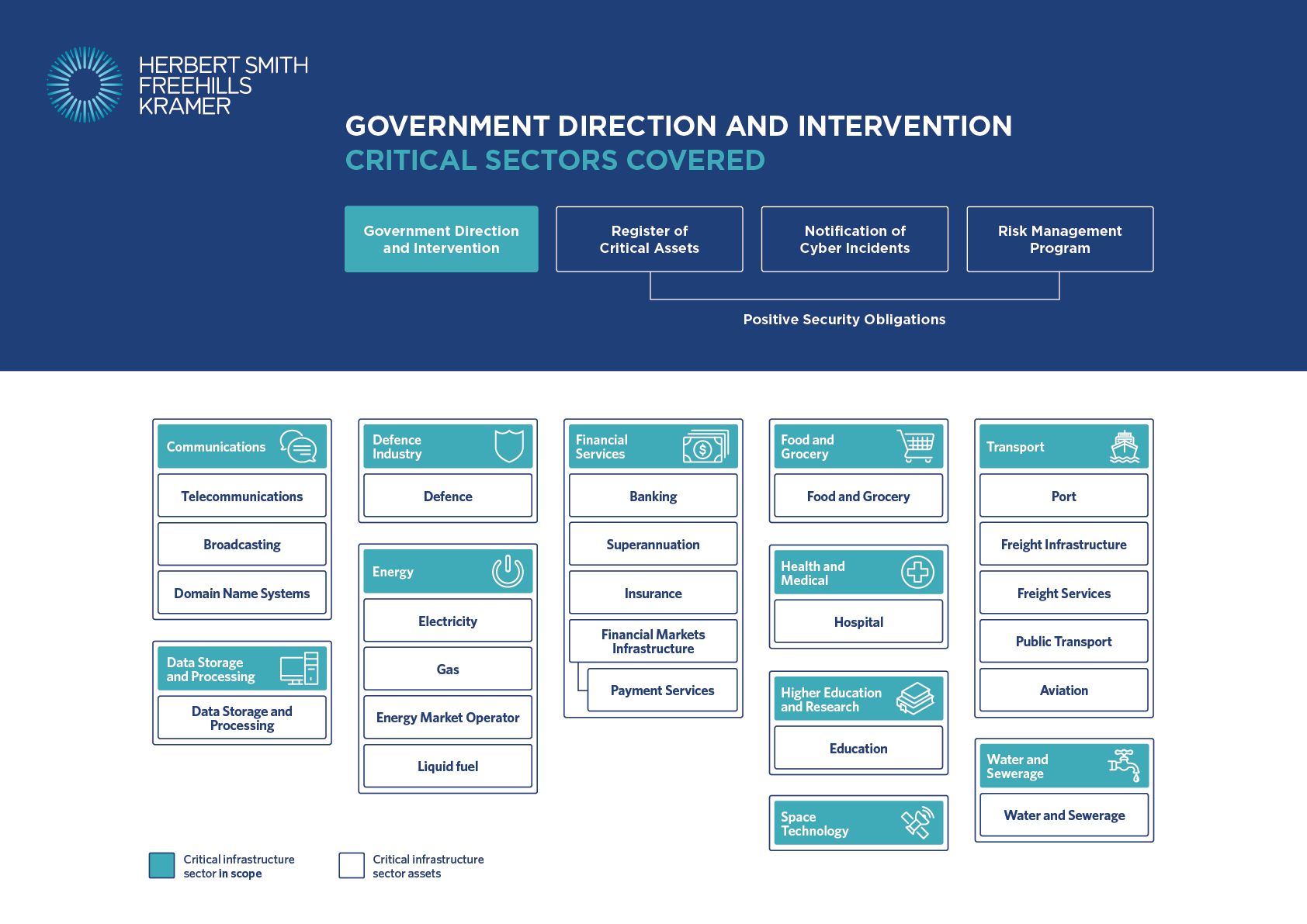
The above provides a simplified visual presentation of the different critical infrastructure assets or critical infrastructure sectors assets which are or will be captured by obligations or powers under the SOCI Act (as described below).
Hover over the different obligations or powers to reveal the assets or sectors covered.
|
Entity |
Definition |
Key obligations |
|---|---|---|
|
Responsible Entity |
The definition is asset specific, but generally the responsible entity will be the entity that owns, or is licensed or responsible for operating, the asset. |
Reporting of operational information. Notification of cyber incidents. Risk management program. |
|
Direct Interest Holder |
Entity that (a) together with any associates of the entity, holds a legal or equitable interest of at least 10% in a critical infrastructure asset (including if any of the interests are held jointly with one or more other entities); or (b) holds an interest in the asset that puts the entity in a position to directly or indirectly influence or control the asset. |
Reporting of interest information. |
|
Reporting Entity |
Responsible Entity. Direct Interest Holder. |
Reporting of interest and operational information. |
|
Relevant Entity |
Responsible Entity. Direct Interest Holder. Operator (entity that operates the critical infrastructure asset or part of the asset). Managed service provider (entity that manages (part of) a critical infrastructure asset, aspect of the asset, or the operation of the asset). |
Response to Government information gathering, direction and intervention powers. |
|
Trigger |
Powers and Safeguards |
|---|---|
|
When:
|
The Minister may authorise the Secretary to do any or all of the following things relating to an incident impacting one or more critical infrastructure assets or specified critical infrastructure sector assets (as applicable):2
|
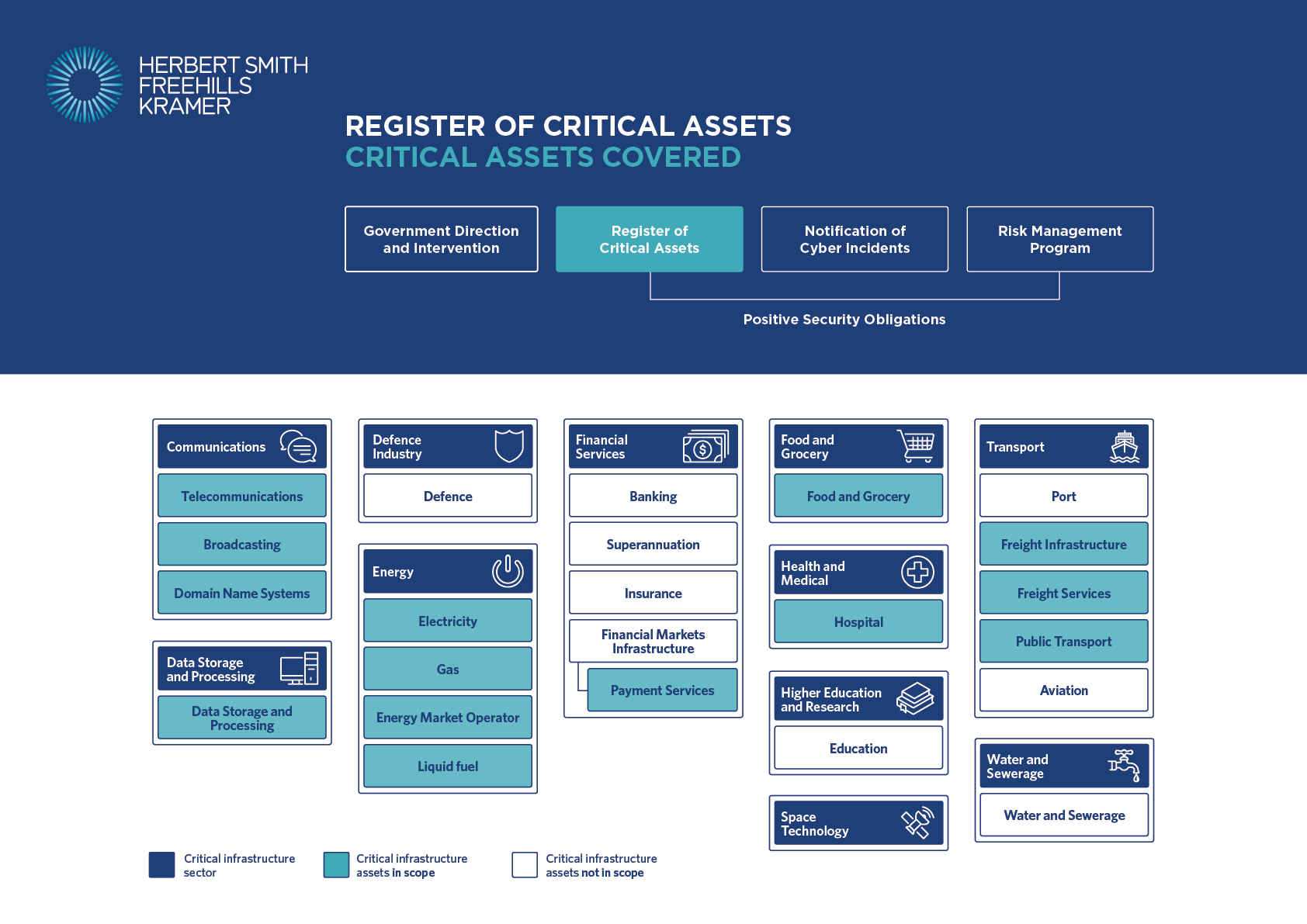
The Cyber and Infrastructure Security Centre (CISC) maintains the confidential Register of Critical Infrastructure Assets.
A responsible entity for, or a direct interest holder in, an applicable critical infrastructure asset (each a “reporting entity”) must provide the CISC with certain operational and interest and control information relating to the assets in the register.
The types of information the responsible entity must provide include information about the location of the critical infrastructure asset, a description of the area the critical infrastructure asset services, a description of the arrangements under which another entity operates the critical infrastructure asset or a part of the critical infrastructure asset, a description of the arrangements under which relevant data types are managed by a third-party, the type and level of the interest the direct interest holder holds in the asset, and more.
Reporting entities must comply with these obligations from the date that is 6 months after the asset becomes a critical infrastructure asset.
Responsible entities are also required to update the CISC where operational information becomes incorrect or incomplete, or the reporting entity for an asset changes, no later than 30 days after the relevant event has occurred.
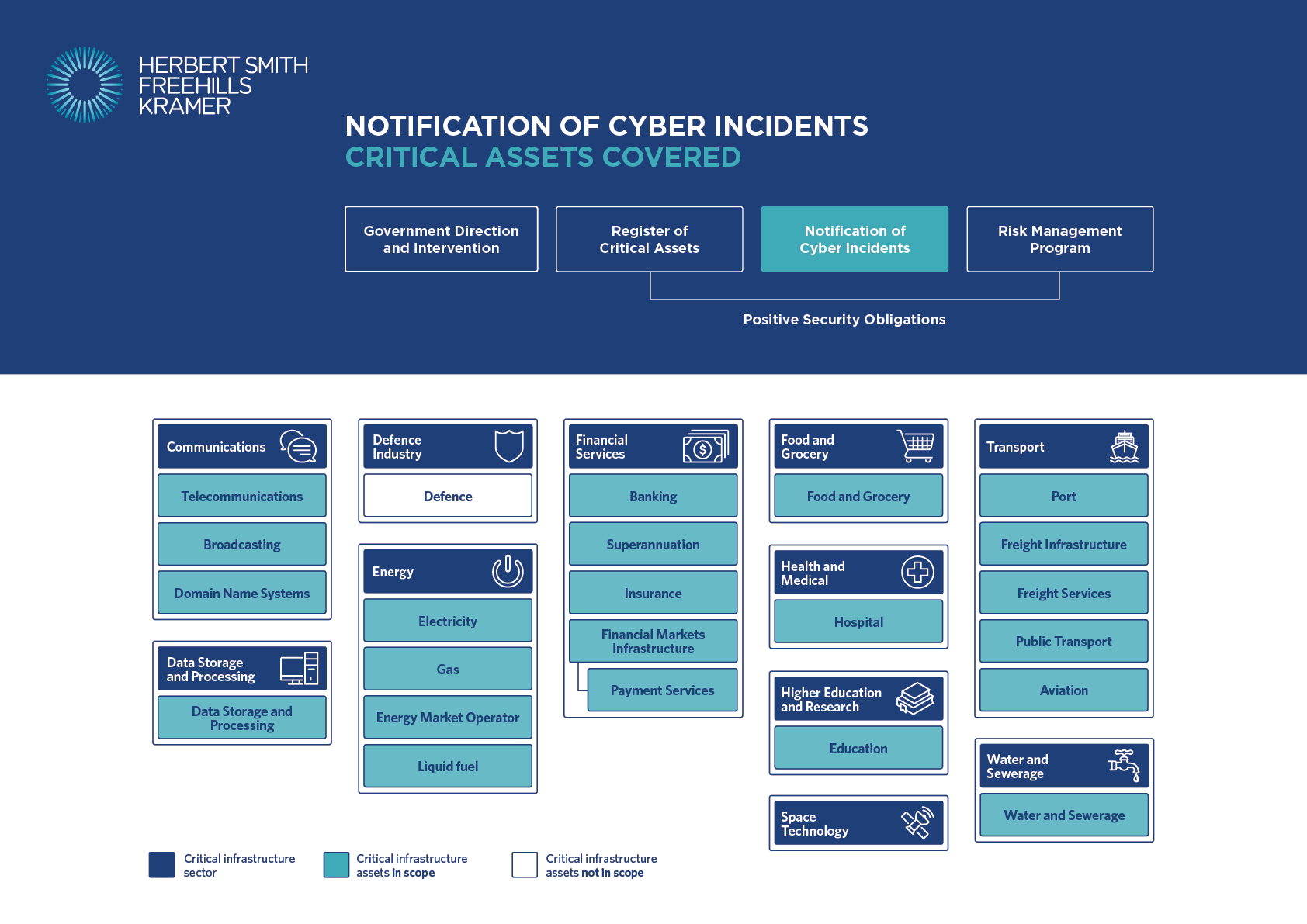
A responsible entity for an applicable critical infrastructure asset must report actual or imminent cyber security incidents to the ASD.
If the incident has a “relevant impact” (i.e. if the incident directly or indirectly impacts the asset’s availability, integrity or reliability, or the confidentiality of information about or stored on the asset) reporting must occur within 72 hours of the entity becoming aware.
This timeframe is reduced to 12 hours if the incident has had, or is having, a “significant impact” on the availability of the asset (i.e. if the incident is materially disrupts the provision or availability of essential goods or services).
Cyber security incidents can be reported over the phone if a written report is also provided.
Responsible entities must comply with these obligations from the date that is 3 months after the relevant asset becomes a critical infrastructure asset.
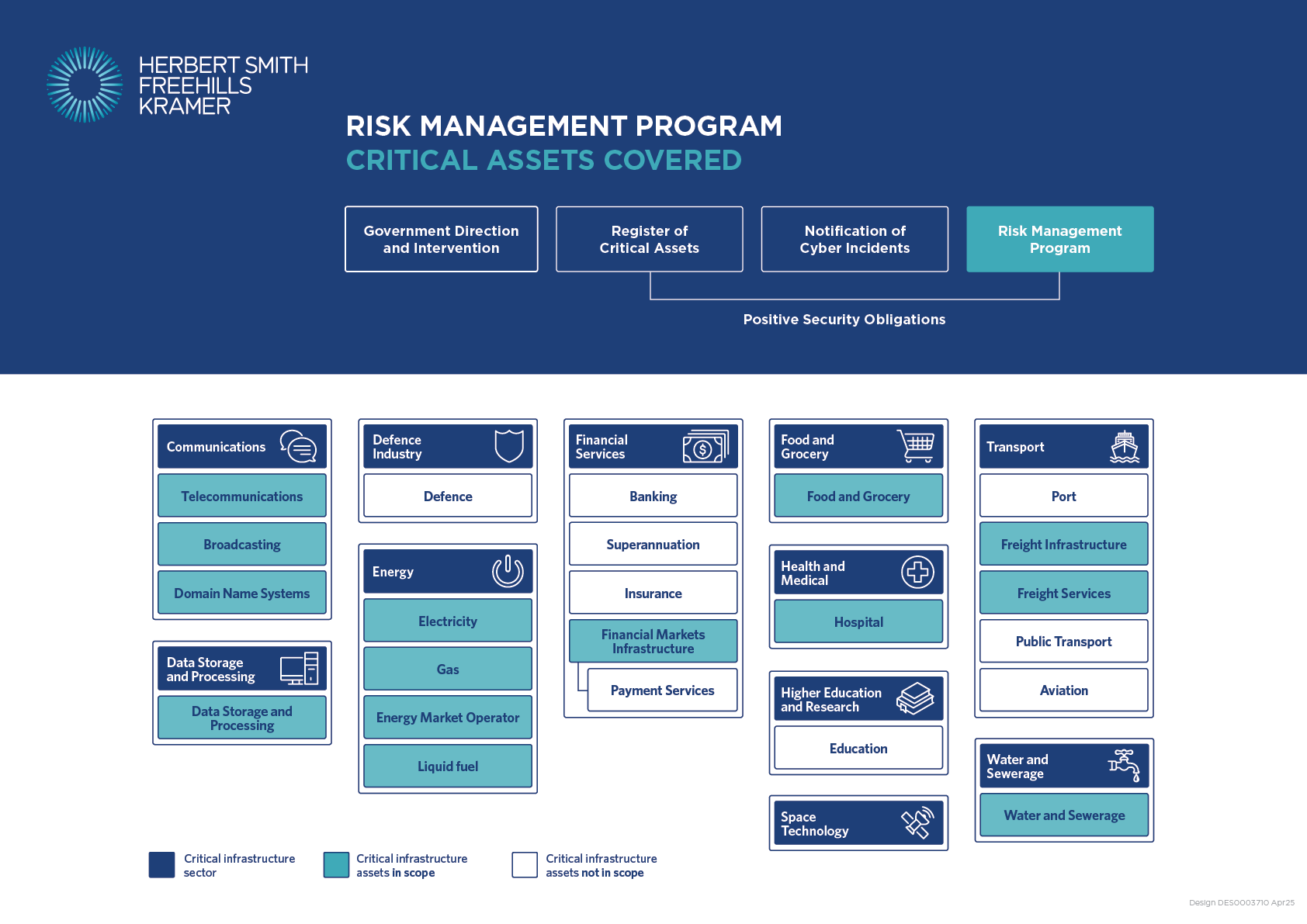
A responsible entity for an applicable critical infrastructure asset must adopt, maintain and comply with a CIRMP.
A CIRMP is a written program, adopting an “all-hazards” approach to the asset, that:
The “all-hazards” approach requires consideration of both natural and man-made hazards, including cyber and information security, personnel, supply chain, physical security and natural hazards.
The Security of Critical Infrastructure (Critical Infrastructure Risk Management Program) Rules 2023 specify requirements applicable in respect of CIRMPs, based on the above principles-based outcomes. These include obligations to comply with an information security framework and establish and maintain a process to identify and manage risk in respect of “critical workers”.
Responsible entities must, before 28 September of each year, submit an annual report on their CIRMP that has been signed by their board, council or other governing body, to the CISC (or the Reserve Bank of Australia in the case of entities responsible for critical payment systems). The report must address whether the program is up to date, any variations to the program, and details of how the program was effective in mitigating any relevant impacts that hazards may have had on the relevant asset during that year.
The CISC may give a responsible entity a written direction to vary its CIRMP to address a “serious deficiency” posing a material risk to Australia’s national security, defence or social or economic stability.
Data storage and processing providers that hold a certificate of hosting certification (at a strategic level) do not need to have a CIRMP, however they must, within 90 days after the end of each financial year, report on their assets and any hazards that had a significant relevant impact on one or more of those assets during the relevant period.
On 4 April 2025, the legislative reforms under the ERP Act streamlined national security obligations in relation to the telecommunications sector.
While the intention is to bring the existing security obligations arising under the TSSR regime into SOCI Act, the reality is that the reforms also brought about changes to these existing obligations. For example, the definition of ‘telecommunications assets’ subject to critical infrastructure regulatory oversight has been expanded to include any assets (in addition to telecommunication networks) that are owned or operated by a carrier or carriage service provider and used in connection with the supply of a carriage service.
For operators of telecommunications assets, this reform agenda is complex, with many moving parts. The new obligations will need to be carefully reviewed against existing obligations for individual assets, with close attention paid to details set out in the ERP Act and Security of Critical Infrastructure (Telecommunications Security and Risk Management Program) Rules 2025.
At a high level, following passage of the ERP Act, responsible entities for critical telecommunications assets may be required to comply with the following obligations:
Footnotes
This article was originally published on 29 March 2023 and updated on 6 January 2025 and 28 April 2025.

Partner, Melbourne

Partner, Melbourne

Partner, Head of TMT, Asia, Singapore
The contents of this publication are for reference purposes only and may not be current as at the date of accessing this publication. They do not constitute legal advice and should not be relied upon as such. Specific legal advice about your specific circumstances should always be sought separately before taking any action based on this publication.
© Herbert Smith Freehills Kramer 2026
Receive timely insights and briefings from HSF Kramer, tailored to keep you informed and ahead