

The International Chamber of Commerce (ICC) has published its 2024 arbitration and ADR statistics, reaffirming the global reach and popularity of its arbitration and alternative dispute resolution services. In this year's statistical report the ICC seeks to give users more insight into the ICC arbitration process including by publishing statistics and other procedural decisions or awards where appropriate.
2024 caseload: 841 new arbitrations across six global hubs
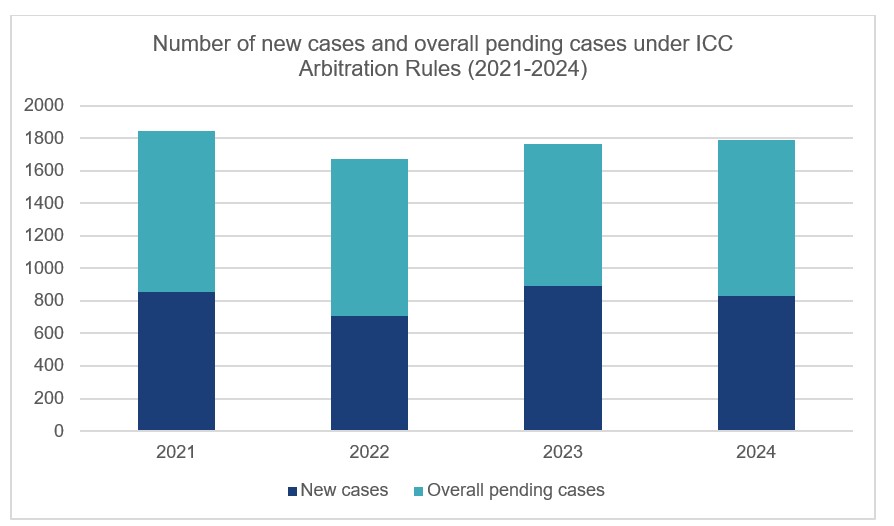
- In 2024, the ICC registered 841 new arbitration cases, with 831 filed under the ICC Arbitration Rules and 10 under the Appointing Authority Rules.
- By year-end, the ICC was administering a total of 1,789 cases through its Secretariat's offices in Paris, New York, São Paulo, Singapore, Hong Kong, and Abu Dhabi.
- While 69% of ICC arbitrations involved cross-border disputes, 50% of new cases featured parties from the same region, and 31% involved parties of the same nationality—highlighting the ICC’s relevance in both international and regional contexts.
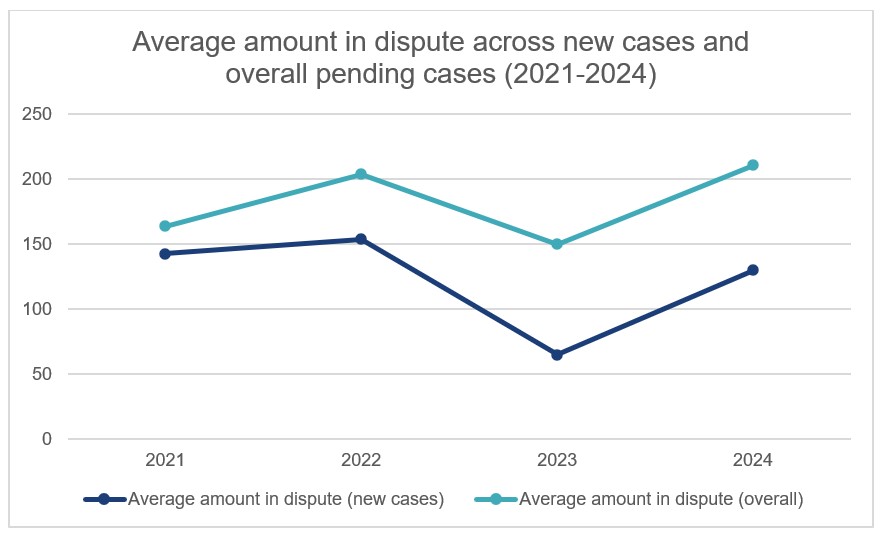
Amounts in dispute: Dispute values reach new highs in 2024
- In 2024, around 50% of both newly filed and pending cases involved amounts between $1 million and $30 million, while 37% of new cases fell below $3 million, qualifying them for the ICC’s Expedited Procedure.
- The average amount in dispute reached $130 million for new cases and $211 million for pending cases. The total value of disputes hit unprecedented levels—$102 billion for new cases and $354 billion for the overall caseload.
- The median amount in dispute held steady at $5 million for new cases and $14 million for pending ones, with individual case values ranging from under $10,000 to a staggering $53 billion.
Sectoral Breakdown of ICC Arbitration Cases in 2024
- Construction/engineering and energy disputes yet again dominated ICC filings in 2024, accounting for a combined 44% of all new cases—23.2% and 20.5% respectively.
- Other prominent sectors included transportation (6.3%), finance and insurance (5.8%), telecoms and tech (5.8%), healthcare (4.8%), business services (4.6%), trade and distribution (4.5%), leisure (4.3%), and industrial equipment (4.2%).
Expedited and Emergency Arbitration in 2024
- Expedited Procedure: In 2024, the ICC administered 152 cases under the Expedited Procedure Provisions (EPP), with 147 qualifying automatically and 5 initiated by party agreement. Since its 2017 launch, the EPP has handled 865 cases, resulting in 461 final awards, reinforcing its role in delivering swift, cost-effective arbitration.
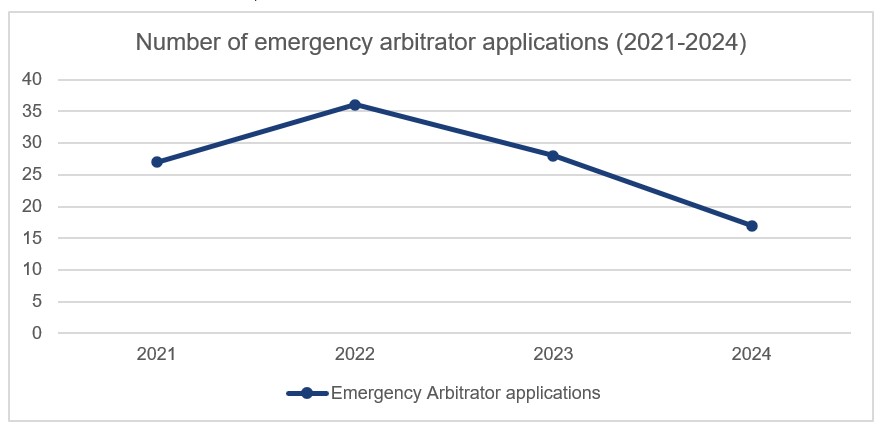
- Emergency Arbitration: The ICC received 17 Emergency Arbitrator applications in 2024, involving 46 parties from across all regions. Relief was fully granted in 3 cases, partially granted in 2, and dismissed in 12, demonstrating the ICC’s capacity to address urgent interim measures before tribunal constitution.

Global Representation: Parties from 136 Jurisdictions Engaging in ICC Arbitration
- Parties came from 136 countries or territories, with Europe contributing nearly 40% of all parties. North and West Europe led with 723 parties, followed by Asia and the Pacific (22%), the Americas (30%), and Africa (8%).
- The United States remained the most represented nationality (167 parties), followed by Brazil (156), Spain (137), Mexico (106), and Italy (101). In Africa, Ghana, Senegal, South Africa, Morocco, and Nigeria were among those with the most representation.
- Latin America and the Caribbean saw a significant rise in participation, with 511 parties—the second-highest on record for the region after the United States of America. The Middle East contributed 224 parties, led by the UAE (73) and Qatar (51).
- 19% of new cases involved 188 state or state-owned parties from all regions. Representation ranged from under 1% in North America to over 15% in East and South Asia and North Africa. One new case was filed under a bilateral investment treaty (BIT), bringing the total BIT cases administered by ICC to 48.

Places of Arbitration
- London was the most popular place of arbitration, as it was chosen in 96 cases. Paris was a close second, with 90 cases.
- In the top 10 cities, Dubai and Doha, with 23 and 19 cases, were the most prominent Middle Eastern places of arbitration. Saudi Arabia was chosen on 4 occasions, perhaps reflecting the more frequent selection of SCCA arbitration for KSA-related disputes, compared to (for example) the more popular selection of Oman as a place of arbitration (7 cases).
- Singapore was the most frequently chosen Asian place of arbitration (28 cases); China was selected in 9 cases.
- African places of arbitration continue to be selected very rarely: in only 8 cases across the continent as a whole (1 case in Nigeria, 1 in South Africa, and 1 in Algeria; with none at all in Egypt, Kenya, Rwanda or Senegal, amongst other important African centres of arbitration) – which is a troubling statistic when it is considered that 8% of the parties to ICC arbitration were African parties.
Award Scrutiny and Timeliness: Ensuring Quality and Accountability in ICC Arbitration
- In 2024, the ICC Court reviewed and approved 577 draft awards, including 413 final, 112 partial, and 52 consent awards. Notably, 71 drafts were returned for further revision, reflecting the ICC’s commitment to quality and enforceability.
- The average duration of proceedings ending in a final award was 26 months, with a median of 22 months, slightly improved from 2023. A total of 391 cases were withdrawn, mostly by joint party agreement.
- Only 51% of draft awards were submitted within the expected timeframe for the standard procedure. Delays led to arbitrator fee reductions in 57 cases, where delays were unjustified.
2024 Marks Significant Gains in Gender Representation Since 2020
- Women represented 28.6% (408) of all arbitrator confirmations and appointments in 2024, continuing the upward trend in gender diversity.
- 46% of appointments made by the ICC Court, either directly or via national committees, were women, up from 41% in 2023 and 42% in 2022.
- The number of individual women appointed or confirmed rose to 290, spanning 63 jurisdictions, compared to 269 in 2023.
- While significant gains have been made since 2020 in the appointment of women as sole arbitrators and tribunal presidents, with representation reaching 43% and 36% respectively, only 20% of co-arbitrator roles were held by women in 2024, highlight the continued need for greater gender balance in appointments made by co-arbitrators.
- In terms of roles, 37% of women served as co-arbitrators, 30% as sole arbitrators, and 33% as tribunal presidents. Notably, nine women served as emergency arbitrators, making up over half of such appointments.
Comment
The report confirms, once again, the ICC's global reach across 136 jurisdictions and underscores the prominence of arbitration for resolving cross-border disputes across industries and regions. With total ICC disputes valued at over $350 billion, arbitration remains the forum of choice for resolving matters that carry significant financial and reputational risk, including disputes involving states or state-owned entities.
The continued uptake of the Expedited Procedure and Emergency Arbitrator mechanisms reflects a shift in user expectations. Parties want speed, flexibility, and enforceability and institutions like the ICC are responding with scalable, time-bound solutions. The imposition of fee reductions for arbitrators who are delayed in submitting draft awards also emphasises the importance that the ICC places on efficiency, being prepared to take proactive steps to reduce the duration of the arbitrations it administers. These measures are also having a real impact in terms of reducing mean and median arbitration durations. It is worth noting that the ICC's duration statistics are broadly comparable with those of the LCIA.
The statistics on the selection of places of arbitration continue to provide interesting insights into party choice. Unsurprisingly, the most well-known and popular seats of arbitration continue to thrive, with London and Paris clearly still more favoured than other arbitral centres. On the other hand, the disproportionate relationship between the nationality of parties as against the very often limited selection of their home jurisdictions as ICC places of arbitration – particularly in Africa – gives pause for reflection about questions of representation and legitimacy, in the context of party autonomy. It also underlines the continuing challenge in developing seats of arbitration beyond the existing main centres.
Key contacts

Craig Tevendale
Partner, Head of Energy Sector, London

Charlie Morgan
Partner, London

Kyle Melville
Associate, Johannesburg

Elizabeth Kantor
Knowledge Counsel, London
Disclaimer
The articles published on this website, current at the dates of publication set out above, are for reference purposes only. They do not constitute legal advice and should not be relied upon as such. Specific legal advice about your specific circumstances should always be sought separately before taking any action.