


Stay in the know
Receive timely insights and briefings from HSF Kramer, tailored to keep you informed and ahead
Subscribe now
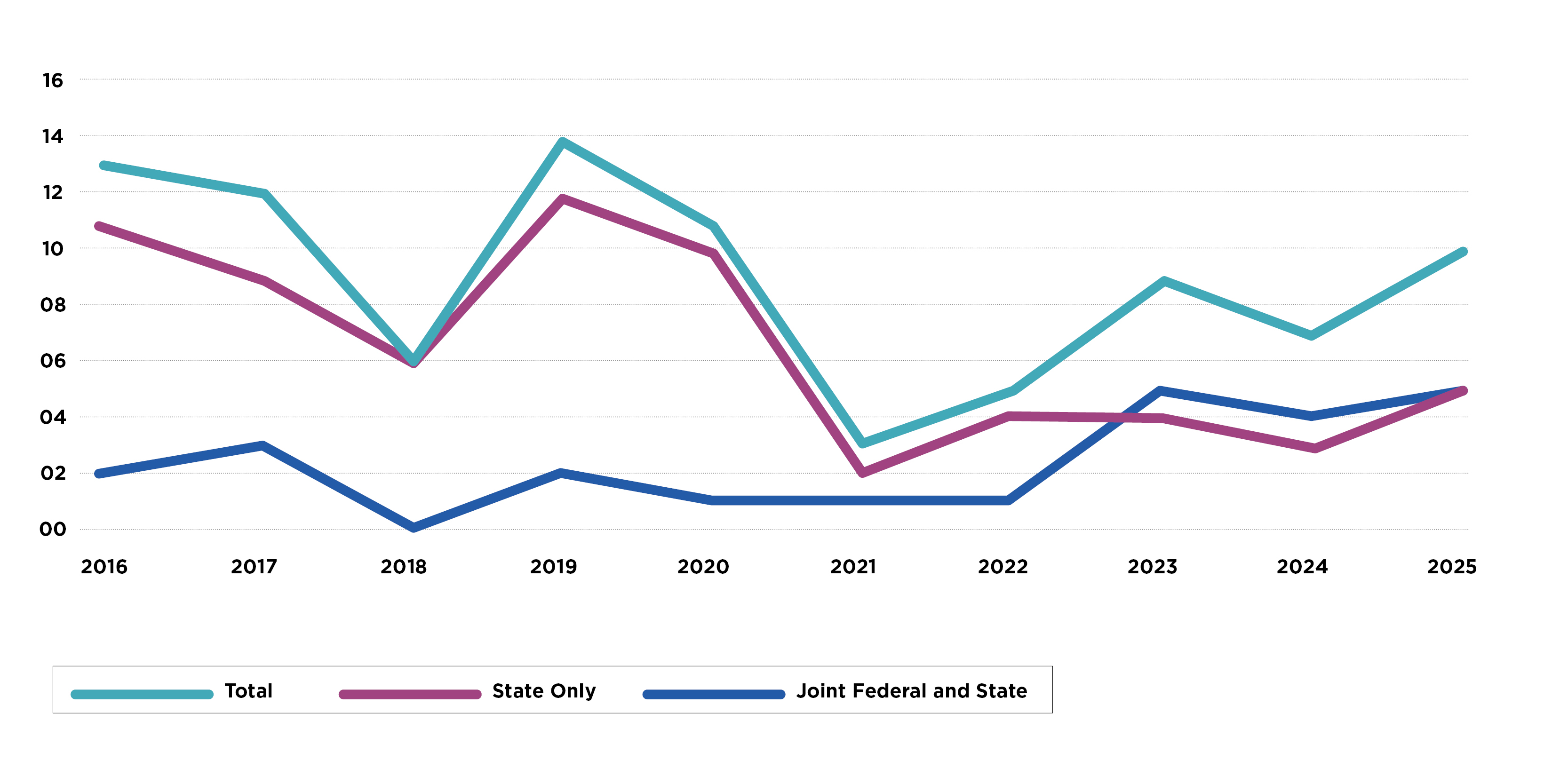
In recent years, the initiation of state enforcement actions and settlements for alleged antitrust violations has rebounded from a lull in 2021 and 2022.1 In 2025, the states collectively filed actions or announced settlements in five single-state matters, participated or joined with the Federal Trade Commission (FTC) in four other matters and joined with the Antitrust Division of the Department of Justice (DOJ) in another matter. In contrast, in 2021, the states filed just one action alongside the DOJ, plus three actions on their own, and in 2022 they filed one action together with the FTC and five on their own.2 The number of actions remains below a recent high-water mark set in 2019, when the states collectively initiated 12 actions or settlements, joined with the FTC in one other action, and joined with DOJ in another action.
It would be a mistake to underestimate state involvement in policing the antitrust laws, on both a local and national level. The state attorneys general remain strongly committed to antitrust enforcement.3,4 Moreover, two recent developments have thrust state antitrust enforcement into the spotlight. The first is the adoption by Colorado and Washington of the Uniform Antitrust Pre-Merger Notification Act. The second is California’s adoption of a law, effective January 1, 2026, that generally prohibits shared pricing algorithms that may be used to restrain trade.
The National Association of Attorney General (NAAG) has hosted a website devoted to listing and detailing state antitrust enforcement and settlement activity.5 On its website, the NAAG declares—
State attorneys general have enforced the antitrust laws since the nineteenth century, but their efforts increased dramatically after 1990, when the states formed the NAAG Multistate Antitrust Task Force. Through the Antitrust Task Force, state and territory attorneys general work closely together to protect their consumers by bringing antitrust cases in a wide variety of industries, including pharmaceuticals, health care and agriculture. Individual attorneys general also prosecute bid-rigging on public contracts of all kinds.6
State antitrust enforcement and settlement activity has fluctuated over the years, and recently appears to have recently rebounded, while still falling short off its peak activity in 2019. The following graph charts state enforcement actions and settlements initiated during the years 2016 through 2025 based on the matters collected in Appendix I:
.jpg)
The types of alleged antitrust violations addressed by state enforcers run the gamut of traditional antitrust enforcement.7 They include monopolization, merger and acquisition review, big-rigging, price manipulation, pay-for-delay and product hopping, and anti-poaching and non-solicitation. Recently, there have been state antitrust actions with an anti-ESG flavor. One case brought antitrust to bear on coal industry investment, another on truck manufacturing and clean air compliance and, most recently, a third on the recommendations of the large proxy advisory services.
As one may expect, state actions, particularly single state enforcement, are often directed towards local issues, such as the combinations of regional health care providers or bid-rigging on government construction projects. The states tend to join forces with the federal agencies where the antitrust concerns are national in scope, for example challenges to airline mergers and joint ventures, monopolization cases in the tech sector, and combinations of large healthcare insurers. But this is not always the case. One large case where the states are charting their own course is a suit against 36 pharmaceutical companies by 45 states and four territories for price manipulation of generic dermatological drugs, a case that has been winding its way through federal courts since 2020 and recently survived summary judgment.8
Notwithstanding fluctuations in the initiation of state antitrust matters, state antitrust enforcement, in the words of one director of a state antitrust division, “has never been stronger.”9 It has also been remarked that in the last couple of years, the state attorneys general offices have been increasing their staff numbers in antitrust divisions.10 Practitioners are therefore advised to be alert to possible state antitrust involvement, and in appropriate circumstances to approach the offices of the state attorneys general on antitrust sensitive transactions.11
The adoption in final form in 2024 of the Uniform Antitrust Pre-Merger Notification Act (UAPNA) by the National Conference of Commissioners of Uniform State Laws is one indicator of the continuing focus of the states on antitrust concerns. Thus far, laws modeled on the UAPANA have been adopted by Washington state, effective July 27, 2025, and Colorado, effective August 6, 2025.12 Perhaps not coincidentally, it was these two states that sued separately from the FTC in 2024 to block the Kroger-Albertsons supermarket chain merger.
The Prefatory Note to the UAPNA observes that:
State Attorneys General (AGs) also have a legal right to challenge anticompetitive mergers, both under the federal Clayton Act and their own state antitrust laws. See California v. American Stores Co., 495 U.S. 271 (1990). States often play an important role in merger investigations and challenges, either in parallel with the federal agencies, or on their own.
In explaining the rationale for the UAPNA, the drafters note that the state AGs do not have automatic access to the Hart-Scott-Rodino (HSR) premerger notification reports filed with the federal antitrust agencies. The AGs in most cases do have the right to subpoena HSR filings, but it is time consuming and cumbersome to do so, and by the time AGs obtain access to HSR filings, the process of investigating and negotiating remedies to a proposed transaction is often far along. The UAPNA is intended to balance the interests of the states in timely obtaining premerger information, with the concern of the business community about being subject to conflicting state and federal premerger notification regimes.
The principal features of the UAPNA are:
Separately, 16 states, including Colorado and Washington, thus far have enacted statutes providing for premerger notification of mergers in the healthcare space.13 In contrast to the UAPNA, these statutes are not uniform. For example, the timing for filing a notification can range from 30 days to 180 days prior to the closing date of the transaction. The filing criteria and notification requirements also vary significantly from state to state. What these statutes have in common with the UAPNA is the interest of the states in receiving timely notification of pending transactions that may have antitrust ramifications in their jurisdictions.
California has recently become the first state to pass non-sector specific legislation addressing potential antitrust violations arising out of AI-driven pricing.14 The legislation, which was signed into law on October 6, 2024 and went into effect on January 1, 2026, amends the Cartwright Act, California’s antitrust statute. It has two operative provisions, reading as follows:
The term “common pricing algorithm” is broadly defined as:
any methodology, including a computer, software, or other technology, used by two or more persons, that uses competitor data to recommend, align, stabilize, set, or otherwise influence a price or commercial term.
The statute is vague as what constitutes use of a pricing algorithm in restraint of trade. For example, the statute does not address the type of data that an algorithm may use in violation of the statute—and hence does not distinguish between public and non-public data. However, it is possible that an algorithm that feeds only on public data would not violate the statute. Recent federal enforcement action has taken issue with the use of non-public data provided by competitors in pricing programs, but not public data. In the Department of Justice’s settlement with RealPage, Inc., a provider of revenue management software in the multifamily rental housing industry, RealPage agreed that it would “[c]ease having its software use competitors’ nonpublic, competitively sensitive information to determine rental prices in runtime operation.” ,
Also open to question is whether the parallel use by competitors of a common algorithmic pricing tool that relies only on public data would violate the California statute. In the recently decided Gibson v. Cendyn Group, LLC, the U.S. Court of Appeals for the Ninth Circuit held that it was not a violation of Section 1 of the Sherman Act for competing Las Vegas hotels to each purchase a license to use the same price recommendation software program, in the absence of an allegation of agreement among the hotels. Whether multiple contracts with a common vendor of AI pricing software utilizing only public data would constitute a “contract, combination in the form of a trust, or conspiracy to restrain trade or commerce” under California law is left for the California courts to decide.
The states continue to be active in antitrust enforcement both on the litigation and legislative fronts. The initiation of state action to enforce the antitrust laws has rebounded from its low in 2021 and 2022. The states show no sign of tamping down the resources of their attorney general offices devoted to antitrust. Adoption of the UAPNA, which would give the states timely access to HSR filings, has begun, though it remains to be seen whether other states will follow the lead of Colorado and Washington and avail themselves of this tool. California has jumped out in front by incorporating in its antitrust statute a general prohibition on the use of algorithmic pricing in restraint of trade, albeit with contours that are unclear at least for the moment. Parties considering transactions and other activity with antitrust sensitivities are therefore advised not to limit their sights to the federal antitrust agencies alone. Particularly in situations with regional impact, but also in matters of more general reach, the enforcement agendas of the states may also need to be taken into account.

Partner, Head of Supreme Court and Appellate Litigation, US, Washington, DC

Counsel, New York

Counsel, New York
The contents of this publication are for reference purposes only and may not be current as at the date of accessing this publication. They do not constitute legal advice and should not be relied upon as such. Specific legal advice about your specific circumstances should always be sought separately before taking any action based on this publication.
© Herbert Smith Freehills Kramer 2026
Receive timely insights and briefings from HSF Kramer, tailored to keep you informed and ahead