

Published on 25 March 2026 by the Judiciary of England and Wales, the Commercial Court Report for 2024-2025 (the Report) provides a data-driven update of the Commercial Court's work in the past year. The Report finds that the number of arbitration applications made to the Commercial Court is still increasing, following the trend that we noted in 2023-2024.
Arbitration activity in the Commercial Court
In 2024-2025, arbitration matters accounted for around 30% of claims issued in the Commercial Court. The Report presents arbitration-related claims across several distinct sub-categories (see page 25 of the report which breaks down arbitration claims into s67, s68 and s69 applications, enforcement applications under s66 and s101, s18 applications and injunctions under s44.). Taken together, such claims would represent the largest single category of new claims in the Commercial Court, ahead of general commercial contracts and arrangements.
The majority of arbitration claims in the year 2024-2025 consisted of appeals on points of law (s69) and challenges alleging procedural irregularities (s68), both of which increased in number compared with previous years.
Number of applications made
Compared to previous years, 2024-2025 saw a continued rise in challenges to awards. The number of appeals on points of law (s69) has nearly doubled since 2022-2023. While injunction applications (s44) and jurisdiction applications (s67) saw a slight decrease, the number of applications made is nevertheless higher than in 2022-2023.
| Court Year | s44 | s67 | s68 | s69 |
|---|---|---|---|---|
| 2022-2023 | 20 | 7 | 27 | 37 |
| 2023-2024 | 50 | 24 | 37 | 52 |
| 2024-2025 | 34 | 21 | 48 | 73 |
Outcome of arbitration challenges
Across all three types of challenge in 2024-2025, only 1 application was successful (a s67 jurisdiction challenge), with zero successful outcomes recorded for s68 and s69. However, a significant number of applications remain pending.
The Report gives a detailed breakdown on the outcome or status of each type of award challenge:
- s67 applications: out of 21 applications, 1 was successful, 5 were dismissed following a hearing, 2 were dismissed on the papers, 1 was discontinued and 12 are still pending decision.
- s68 applications: out of 48 applications, 8 were dismissed at a hearing, 5 were dismissed on the papers, 4 were discontinued, 3 were transferred out, 2 were stayed and 26 are still pending decision.
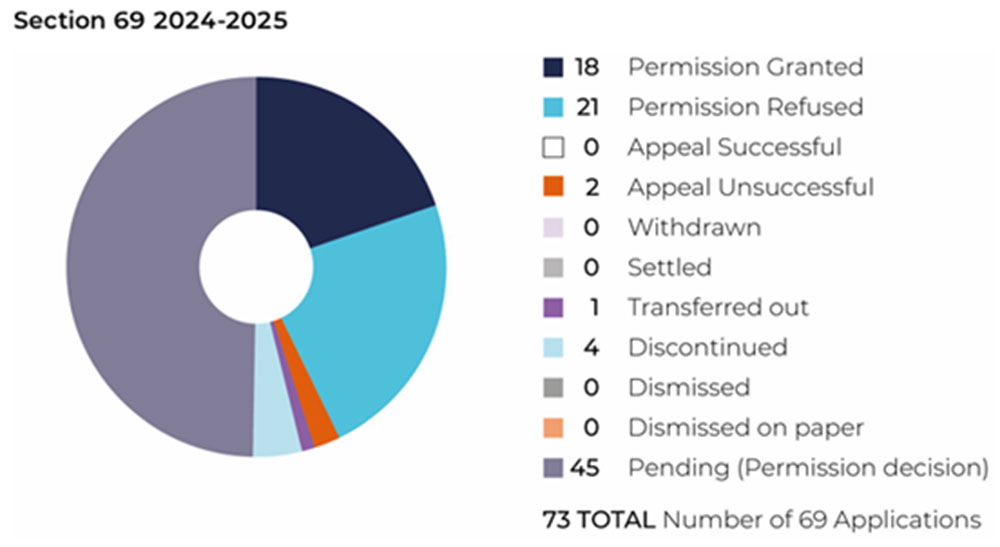
- s69 applications: out of 73 applications, 18 had permission granted, 21 were refused permission and 45 are still pending a decision (as set out in the chart below). On average, decisions to grant or refuse permission to appeal were issued within 118 days. This is a minor increase compared to the previous year, when the average time was 115 days. For applications where permission was granted, the average time for receipt of claim to a final decision was 308 days, which is a slight reduction from 2023-2024.
Comment
The Report confirms London's global importance as an arbitral seat. While the number of challenges continues to rise, the rate of successful applications remains very low. Of the challenges resolved in 2024-2025, only 1 has succeeded, albeit with a substantial number of applications still pending. S68 challenges had a nil success rate, which is particularly notable given that this provision is commonly invoked as an indirect means of challenging the merits of an award. This is consistent with the English courts' long-standing approach of upholding arbitral awards other than in exceptional cases.
As the Arbitration Act 2025 only came into force during the latter part of 2025, it is too soon to assess its impact on the volume or outcome of arbitration-related applications. The Act introduces procedural constraints on section 67 challenges, reducing the ability of parties to revisit issues and evidence already considered by the tribunal, while also expanding the powers of emergency arbitrators and clarifying the availability of section 44 relief, including against third parties. These reforms may, over time, influence both the willingness of parties to pursue challenges and the nature of applications brought before the Court.
For more information, please contact Craig Tevendale, Liz Kantor or your usual Herbert Smith Freehills Kramer contact.
The authors would like to thank Emily Gobet for her contribution to this post.
Key contacts

Craig Tevendale
Partner, Head of Energy Sector, London

Elizabeth Kantor
Knowledge Counsel, London
Disclaimer
The articles published on this website, current at the dates of publication set out above, are for reference purposes only. They do not constitute legal advice and should not be relied upon as such. Specific legal advice about your specific circumstances should always be sought separately before taking any action.