

The International Chamber of Commerce (ICC) has published its 2025 arbitration and ADR statistics, confirming that with 894 new cases registered, 2025 ranks among the top three years in ICC history for new cases and setting an all-time record for the number of cases pending at year-end.
Key Highlights:
- Parties from a record-equalling 147 countries, with arbitrations seated across 123 cities in 70 jurisdictions.
- Average amount in dispute fell sharply to $50 million, down from a record $130 million in 2024.
- 169 new cases administered under the Expedited Procedure Provisions, with voluntary opt-ins increasing.
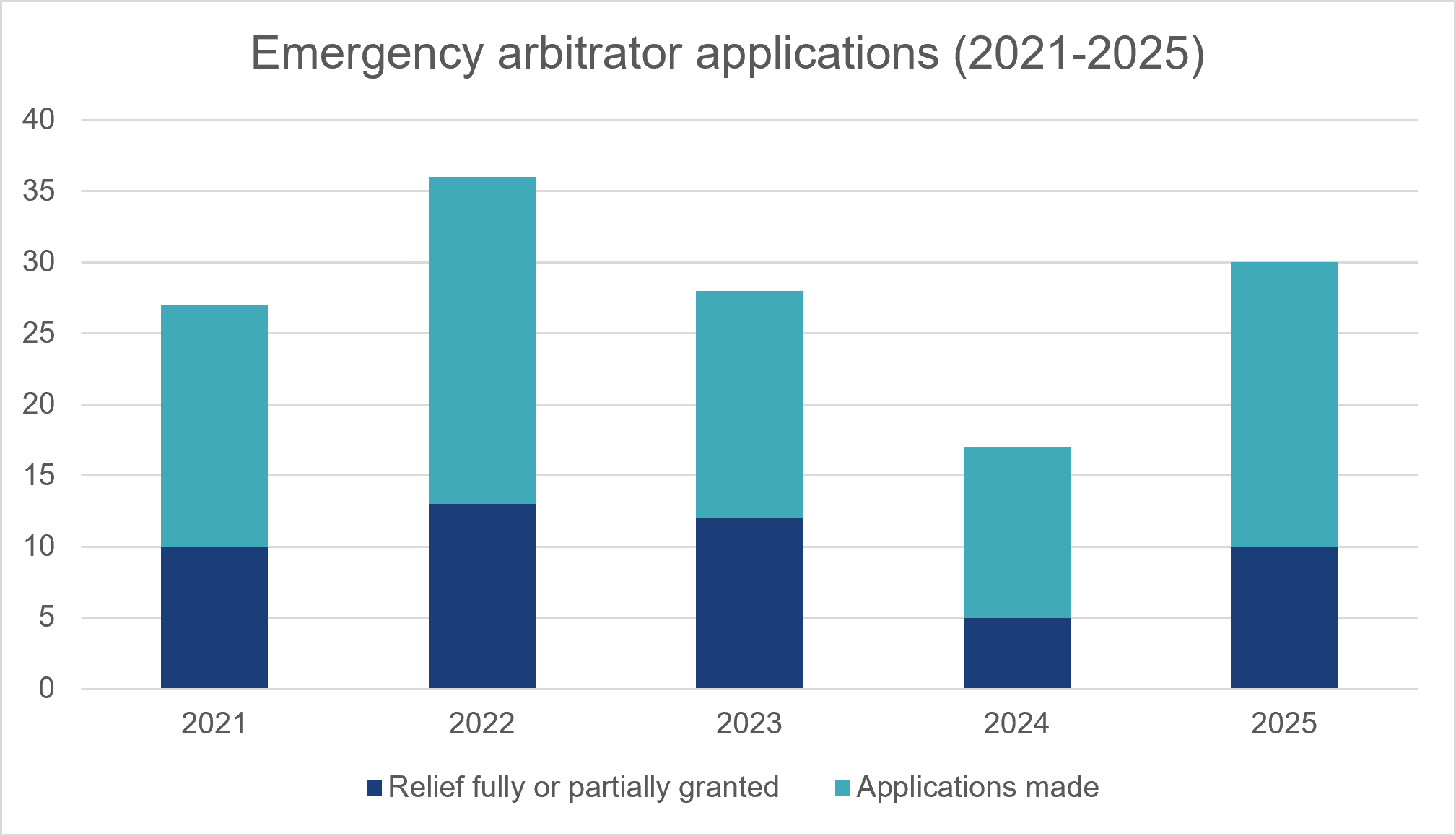
- Emergency Arbitrator applications nearly doubled to 30, though dismissal remained the most common outcome.
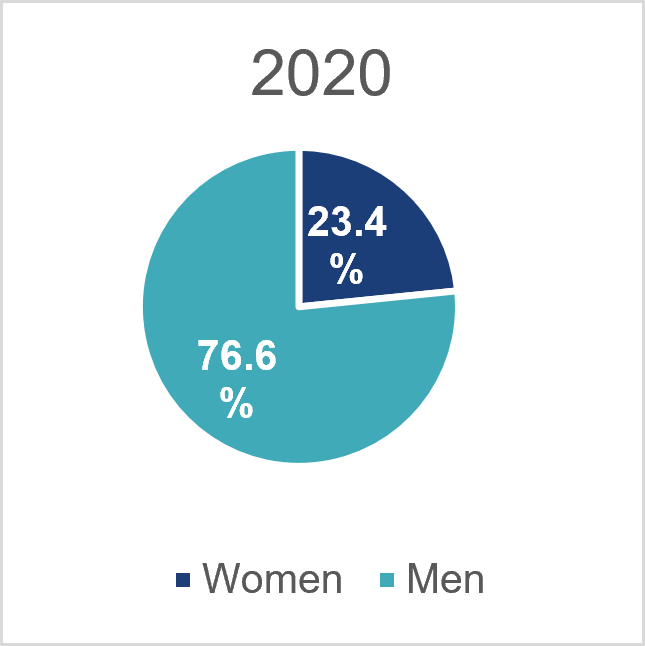
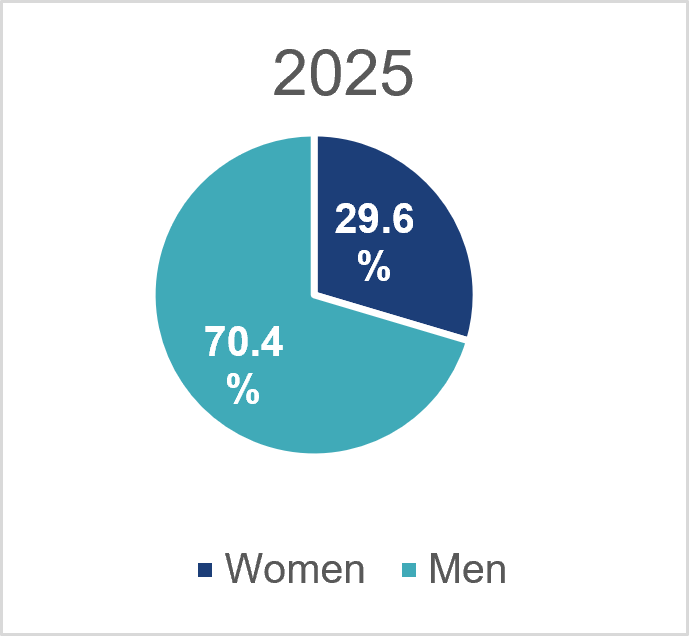
- Women represented 29.6% of all arbitrator confirmations and appointments, almost tripling the 10.4% recorded a decade ago.
2025 Caseload: Higher volumes, lower values
In 2025, the ICC registered 894 new cases, comprising 881 filed under the ICC Arbitration Rules and 13 under the Appointing Authority Rules. This places 2025 within the top three years in the ICC's history for case volume, alongside the previous highs of 2016 and 2020, and underscores a sustained demand for ICC arbitration.

However, the increase in case volume did not correspond with an increase in case value. The average amount in dispute in new cases was US$50 million, representing a significant decline from the record high of US$130 million in 2024. This was mirrored by a corresponding decline in the aggregate value of new cases at US$41 billion, down from US$102 billion in 2024.

Whether this decline reflects an anomaly or a structural shift, including whether lower-value disputes are gravitating to ICC arbitration for its expedited procedures, remains to be seen.
Sectoral Breakdown
Construction/engineering (28%) and energy (15%) continued to dominate, together accounting for 43% of all new cases which is broadly in line with the combined 44% recorded in 2024. The persistent concentration of ICC caseload in these two sectors reflects the inherent complexity and cross-border nature of disputes in these industries.
Expedited Procedures: Growing Uptake
The ICC administered 169 new cases under the Expedited Procedure Provisions (EPP) in 2025 (comprising 158 by automatic application and 11 by express agreement), a modest increase from 152 cases in 2024.
The number of parties voluntarily opting into the EPP increased, with 11 cases submitted by express agreement, compared with just 5 in 2024. This trend potentially signals sustained confidence in and familiarity with expedited procedures among users and practitioners.
The 2026 Rules raise the automatic application threshold for the EPP from $3 million to $4 million and introduce new Highly Expedited Arbitration Provisions (HEAP), opening the possibility that EPP numbers may fall if parties instead opt for even further expedition under the new HEAP process. It is therefore anticipated that next year’s statistics will reveal further evolution in the expedited arena as these changes take effect.
Emergency Proceedings
Thirty Emergency Arbitrator applications were filed in 2025, nearly doubling the 17 applications received in 2024 and bringing the cumulative total to 287 since the mechanism's introduction in 2012.
Of the 25 orders rendered, relief was dismissed in 15 cases, fully granted in 6, and partially granted in 4. Although emergency proceedings may serve as a valuable tactical tool in the early stages of proceedings, prospects of success remain relatively low.
Global Reach, Regional Popularity
The ICC’s global reach and popularity have long been established, and 2025 was no exception.
Parties came from 147 countries or independent territories, matching the record set in 2019 and maintaining a level that has consistently exceeded 130 for at least a decade.
As in 2024, 69% of ICC arbitrations involved cross-border disputes, 50% of new cases featured parties from the same region, and 31% involved parties of the same nationality. These figures reinforce the ICC's dual relevance as a forum for both international and intra-regional disputes. By contrast, other institutions exhibit a more exclusively international profile: the LCIA's 2024 caseload, for example, comprised 95% international cases.
Places of Arbitration and Governing Law
Arbitrations in 2025 were seated in 123 cities across 70 countries. Paris reclaimed the top spot from London with 82 cases, followed by London (78), New York (44) and Singapore (42). The continued dominance of these established seats reflects the importance that parties place on well-developed arbitration infrastructure and supportive legal frameworks. Despite the popularity of Paris as a seat, 76% of the 607 awards rendered in 2025 were in the English language.
English law and the laws of a US state were the most frequently chosen governing laws, each selected in 113 new cases. Brazilian law (54), Swiss law (50), German law (48), French law (44) and Spanish law (43) completed the top seven.
Tribunal Composition
The composition of arbitral tribunals remained broadly stable year-on-year. In 2025, 58% of cases were submitted to a three-member tribunal and 42% to a sole arbitrator, compared with 57% and 43% respectively in 2024. Where the ICC Court fixed the number of arbitrators (14% of cases), it appointed a sole arbitrator in 88% of those cases, consistent with the trend since the introduction of the EPP in 2017 and potentially indicative of the wider objective of improving efficiency and reducing costs.
Tribunal Diversity
The collation and transparent publication of statistics measuring the diversity of arbitrators remains an important benchmark and comparator of progress and diversity.
Women represented 29.6% (410) of all arbitrator confirmations and appointments in 2025, up marginally from 28.6% (408) in 2024. This marks a continued year-on-year shift and over the past decade (coinciding with the 10-year anniversary of the Equal Representation in Arbitration Pledge), the overall share of women among total confirmations and appointments has almost tripled from 10.4% in 2015 to 29.6% in 2025. However, this headline figure belies considerable regional variation: while women were appointed as arbitrators in 40% of matters in Central and South-East Europe, they accounted for just 11% of appointments in North Africa.
 |  |  |
Although nationality is not necessarily an indicator of cultural or ethnic diversity, it is notable that arbitrators were appointed from 93 different jurisdictions in 2025, including a growing number of arbitrators from traditionally underrepresented regions. For example, 73 arbitrators of African nationality were appointed from 15 different African countries, a marked increase from 58 in 2024, although African representation remains disproportionately low.
As regards generational diversity, the ICC Court continues to encourage the proposal of new or young arbitrators for less complex cases. In 2025, 34% of all confirmed or appointed arbitrators were under the age of 50. While the ICC Court's own appointments continue to skew younger, the overall trend among party-made appointees suggests that the promotion of younger or first-time arbitrators remains a work in progress.
Arbitrator challenges
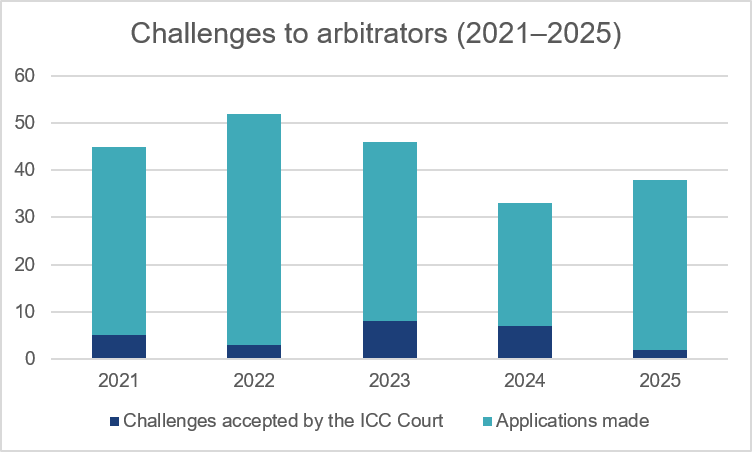
In 2025, 38 challenges were filed (in 29 cases), of which only two were accepted by the ICC Court, a notably lower acceptance rate compared with 2024, when seven of 33 challenges were accepted. These figures underscore the high threshold that parties must meet to succeed on a challenge and the importance of transparent disclosures by, and thorough due diligence of, prospective arbitrators at the outset of proceedings. This high threshold mirrors the robust approach taken by other arbitral institutions, for example the LCIA has only upheld one out of 35 challenges in the entire period from 2019 – 2024.
Outlook
The 2025 statistics confirm the ICC's sustained pre-eminence as the institution of choice for high-value, complex cross-border disputes. Future years’ statistics will shed light on the continued sustainability of growing caseloads, especially in light of increased competition from newer and specialised arbitral centres and emerging regional hubs, such as in the Middle East or Africa.
The entry into force of the 2026 ICC Arbitration Rules, incorporating a raised EPP threshold, new Highly Expedited Arbitration Provisions, the removal of mandatory Terms of Reference, and revised confidentiality provisions, makes the 2025 statistics the last full year dataset under the prior rules framework, providing a useful baseline against which the procedural effects of the new rules can be assessed in the years ahead. For more information about the new 2026 rules, please see our blog post here.
The authors would like to thank Nadia Odendaal and Juin Hsiung Ong for their contribution to this post.
Key contacts

Charlie Morgan
Partner, London

Hanna Azkiya
Senior Associate (Indonesia), Singapore

Veronica Connolly
Senior Associate, Johannesburg
Disclaimer
The articles published on this website, current at the dates of publication set out above, are for reference purposes only. They do not constitute legal advice and should not be relied upon as such. Specific legal advice about your specific circumstances should always be sought separately before taking any action.