

For decades, ICSID arbitration has been associated with investment treaty claims. Yet contract-based clauses were originally the primary gateway into ICSID: until 1987, nearly every registered ICSID case was contract-based. While treaty-based dispute resolution continues to dominate the ICSID caseload, contract-based proceedings remain a significant part of ICSID's practice (16% of ICSID's total caseload). As of 31 December 2025, 175 contract-based cases had been registered under the ICSID Convention and the Additional Facility Rules since records began. Disputes can be referred to ICSID through an investment contract between a State party and a national of another State party, provided that the jurisdictional requirements of the ICSID Convention are satisfied.
Drawing on this, ICSID has published its first in-depth study on contract-based ICSID dispute resolution (the ICSID Paper), accompanied by a special edition of its caseload statistics and revised Model Clauses for Contracts. Its findings reveal that contract-based arbitration remains a significant tool for managing investment risk, while shedding light on its distinctive characteristics and the trends that have emerged in relation to jurisdictional outcomes, settlement rates, case duration and compliance with awards. For investors, the paper highlights three key advantages of including an ICSID clause in an investment contract: a unique enforcement regime across 158 Contracting States, the depoliticisation of disputes once proceedings are commenced and protection from domestic court interference through ICSID's self-contained system.
This post examines the ICSID Paper's findings on caseload trends, outcomes, jurisdictional drafting, and merits and enforcement in contract-based disputes.
Caseload profile: who uses Contract-Based ICSID arbitration
- Of the 175 registered contract-based cases, 29 are pending and 146 have been concluded; arbitrations represent 93% and conciliations 7%, with the vast majority brought under the ICSID Convention rather than the Additional Facility Rules.
- In 83% of the 175 cases, the contract was the sole instrument of consent; in the remaining 17%, consent was combined with a treaty and/or domestic legislation.
- African States account for 49% of contract-based arbitrations, more than double their 21% share of the overall ICSID caseload, with South American States accounting for a further 21%. Together, these figures illustrate how contractual arbitration has become an especially significant feature of the investment landscape across the Global South, reflecting the central role it has played in managing disputes arising from major investment projects and long-term commercial relationships with States.
- Investors are mainly from Western Europe (32%), Africa (18%), and North America (17%).
- Oil, gas and mining represent 47% of all contract-based cases, much higher than their 26% share of the overall ICSID caseload; electric power and other energy sectors contribute a further 16%. These figures are unsurprising given the large-scale and long-term investments which energy and power investments typically involve, as well as heightened exposure to regulatory change for investors in the sector.
Outcomes: faster, more likely to settle, better for claimants
- Speed: contract-based arbitrations conclude in an average of 40 months from registration, versus 47 months for the overall ICSID caseload, a seven-month reduction that carries real cost implications for businesses.
- Settlement: of 140 contract-based arbitrations, 43% were settled or discontinued, compared to 34% for the general caseload, indicating that contract-based disputes are more likely to settle than treaty-based claims.
- Claimant success: when tribunals decide cases, claims are upheld in whole or in part in 66% of contract-based awards, versus 49% across the overall caseload. The Paper suggests that this may reflect the more defined nature of contractual obligations, making it more straightforward for tribunals to determine whether a breach has occurred compared with applying broader treaty standards.
- Jurisdictional objections: jurisdictional objections succeeded in only 14% of contract-based awards, compared with 20% across all ICSID arbitrations. A likely explanation is that contract-based arbitration is founded on a bespoke agreement between identified parties. Issues of consent and jurisdiction (governed by Article 25 of the ICSID Convention) may be addressed more carefully and intentionally at the time the contract is drafted between the State and the investor in question.

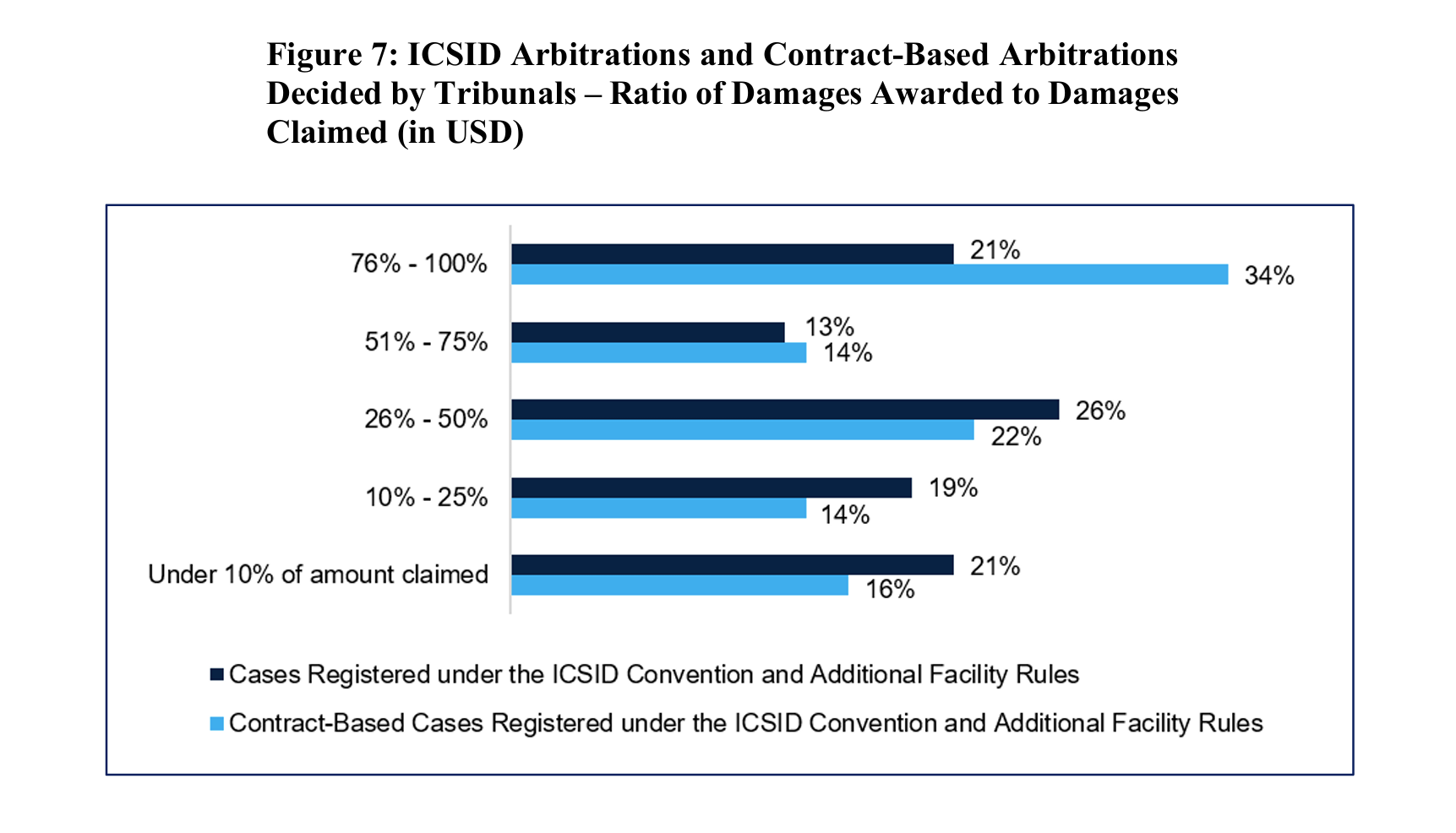
- Damages: claimants in contract-based arbitrations are more likely to succeed on liability and damages (62%) compared to 45% across the overall caseload. 48% of contract-based awards granted claimants more than 50% of the amounts claimed, versus 34% overall. Similarly, while 30% of the overall ICSID awards granted damages under USD 50 million, 45% of contract-based cases resulted in damages awards in this category. 17% of contract-based awards awarded damages above USD 50 million, compared to 15% for the overall caseload. Only 38% of contract-based awards concluded with no damages awarded, compared with 55% in the overall arbitration caseload.

- Counterclaims: counterclaims are raised in 26% of the cases and upheld in approximately 31%. This reflects the inherently bilateral nature of contractual relationships, where both parties owe obligations to one another and may have competing claims arising from the same dispute.
- Compliance: among 44 damages awards for which enforcement-related information was available, 80% were voluntarily complied with or resulted in post-award settlement. In fact, in the 38 cases for which the outcome was known (i.e., excluding where enforcement was pending or had not been pursued or the outcome was otherwise unavailable), 92% were voluntarily complied with or settled, and a further 3% were successfully enforced, resulting in satisfaction of 95% of contact-based damages awards with known outcomes (versus 66% across the overall ICSID caseload according to a 2024 Background Paper). The annulment rate for contract-based ICSID Convention awards also stands low at 8%.
Contractual drafting to bolster the jurisdictional position
While careful drafting cannot fully guarantee jurisdiction – as jurisdictional requirements under Article 25 of the ICSID Convention, such as nationality and legal standing, are mandatory – the ICSID Paper explains that such drafting can anticipate and limit risks and prevent needless jurisdictional fights. Contract-based awards thus decline jurisdiction less often than treaty-based ones - 14% versus 20% overall. Relevant contractual drafting includes the following:
- Investment presumption: including an ICSID clause in a contract creates a strong presumption that the transaction or venture qualifies as an investment for jurisdictional purposes.
- Unambiguous consent: consent may be direct (in the contract itself), indirect (by reference to another document), or conditional (effective upon the occurrence of a future event); it may be broad ("any dispute") or limited by subject-matter or thresholds, but it must be unambiguous. Tribunals will not presume consent to ICSID just because there is a reference to ICSID in the clause; consent must be clearly established, and arbitration clauses are interpreted in good faith and consistently with the parties' reasonable expectations.
- Non-signatories: tribunals may assert jurisdiction over non-signatory investors where they are explicitly identified in the contract, actively involved in its negotiation or performance, or where consent is transferred through succession or assignment. Conversely, tribunals consistently dismiss claims where the respondent's consent cannot be established clearly.
- Local company provision: article 25(2)(b) of the ICSID Convention allows a locally incorporated entity controlled by foreign parties to be treated as a foreign national by agreement. Investors incorporating local project companies (as often required by the State) should include specific Article 25(2)(b) language providing that the locally incorporated company will be treated as a national of another Contracting State for ICSID purposes. It is noteworthy that this provision was invoked in 45% of contract-based cases studied.
- Contracting with State agencies or companies: A Constituent Subdivision or Agency (CSA) of a State participated in 18% of contract-based arbitrations. Where a CSA is involved, jurisdiction requires: (i) designation to ICSID by the State, (ii) the consent of the CSA and (iii) State approval of such consent. Case law shows that tribunals can decline jurisdiction over the State itself where it was not a party to the contracts, even where State involvement is extensive. Investors should not assume that contracting with a ministry-owned entity automatically binds the State.
- Multiple contracts: where a project involves multiple contracts, aligning clauses across the full project contract stack (concession, EPC, financing, etc.) is a critical drafting priority in order to ensure that a single tribunal can assert jurisdiction under the “unity of investment” doctrine.
Merits and enforcement: what to anticipate In contract-based disputes
- Applicable law: under article 42 of the ICSID Convention, parties freely choose the applicable law. The host State law is most frequently selected, sometimes supplemented by or combined with international law and/or other principles. Absent a choice by the parties, tribunals apply host State law (including its conflict-of-laws rules) and applicable rules of international law.
- Key themes: the ICSID Paper groups contract-based merits disputes into three main categories: (i) non-performance or breach disputes, including termination and non-renewal; (ii) stabilisation clause disputes; and (iii) combined claims where the same facts give rise to both contractual claims and treaty or investment-law claims, requiring careful separation of standards and the avoidance of double recovery.
- Stabilisation clauses appear in a significant share of contract-based disputes. These clauses, aimed at ensuring foreseeability and insulating a long-term project from political and economic instability, take two principal forms: "freezing" clauses, which fix the legal framework applicable to the investment, and "economic equilibrium" or renegotiation clauses, which require the parties to adjust the contract to preserve its economic balance if the legal framework changes. Recent contract-based disputes have predominantly concerned freezing clauses.
- Defences: respondent States typically deploy two categories of defence: (i) domestic-law or contractual defences (including termination for cause, waiver, estoppel, force majeure, and legitimate public policy objectives) and (ii) international law or public policy defences, including corruption framed as a violation of international public policy. Counterclaims most frequently allege breach of contract, environmental harm, or failure to comply with local law obligations.
- Remedies: damages are the most commonly requested and awarded form of relief. Specific performance is rarely ordered but has been used in some cases to restore impaired contractual rights, such as the reinstatement of a concession or performance of a specific obligation. Declaratory relief is also sought, and tribunals may address interest, penalties for non-compliance, currency, and tax treatment depending on the governing law and the parties' agreement.
- Enforcement: although voluntary enforcement prevails, it is wise to include clauses in investment contracts in which the State explicitly waives any immunity from jurisdiction or execution in connection with contract-related proceedings. Given the different interpretations of the concept of waiver in various jurisdictions, drafters need to tailor any immunity waiver to the jurisdictions where enforcement is likely to be sought.
Comment
The ICSID Paper represents a helpful reminder of the value and effectiveness of investment contracts as a valuable risk mitigation tool for investors. Where no applicable investment treaty exists, a contractual ICSID clause may provide access to a neutral and highly enforceable dispute resolution framework.
The data also suggests that contract-based ICSID arbitration offers a number of practical advantages compared with treaty arbitration, including lower rates of successful jurisdictional objections, faster proceedings and strong compliance with awards.
More broadly, the Paper highlights that dispute resolution clauses in long-term investment contracts should not be treated as boilerplate. Careful drafting can have significant consequences for jurisdiction, applicable law, and the efficiency of any future dispute resolution process. This may be particularly true for investors entering into long-term, capital-intensive projects with the State or State entities as counterparties in the energy, extractives, and infrastructure sectors in Africa and South America. The message from the data is clear: where parties can negotiate access to ICSID, investing time in the drafting process at the outset can have a meaningful impact if a dispute arises later.
The authors would like to thank Mia Aroha Clifford for her contribution to this post.
Key contacts

Hannah Ambrose
Partner, London

Louise Barber
Of Counsel (Australia), London

Tiphaine Leverrier
Senior Associate, Paris

Elizabeth Kantor
Knowledge Counsel, London
Disclaimer
The articles published on this website, current at the dates of publication set out above, are for reference purposes only. They do not constitute legal advice and should not be relied upon as such. Specific legal advice about your specific circumstances should always be sought separately before taking any action.