

Stay in the know
Receive timely insights and briefings from HSF Kramer, tailored to keep you informed and ahead
Subscribe now
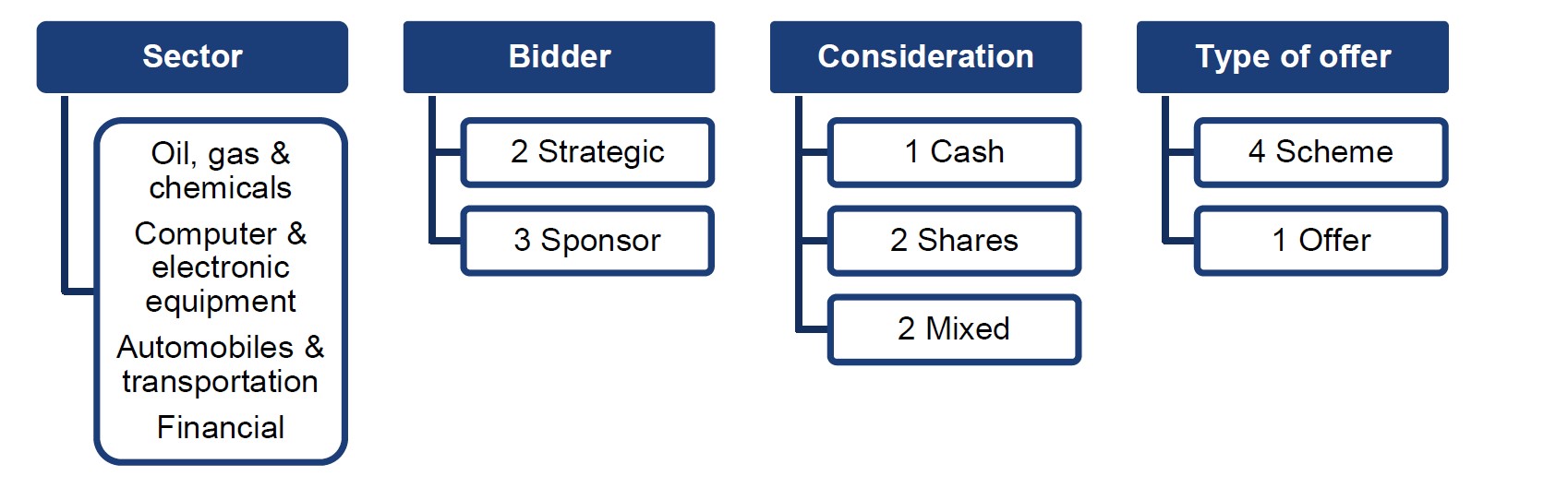
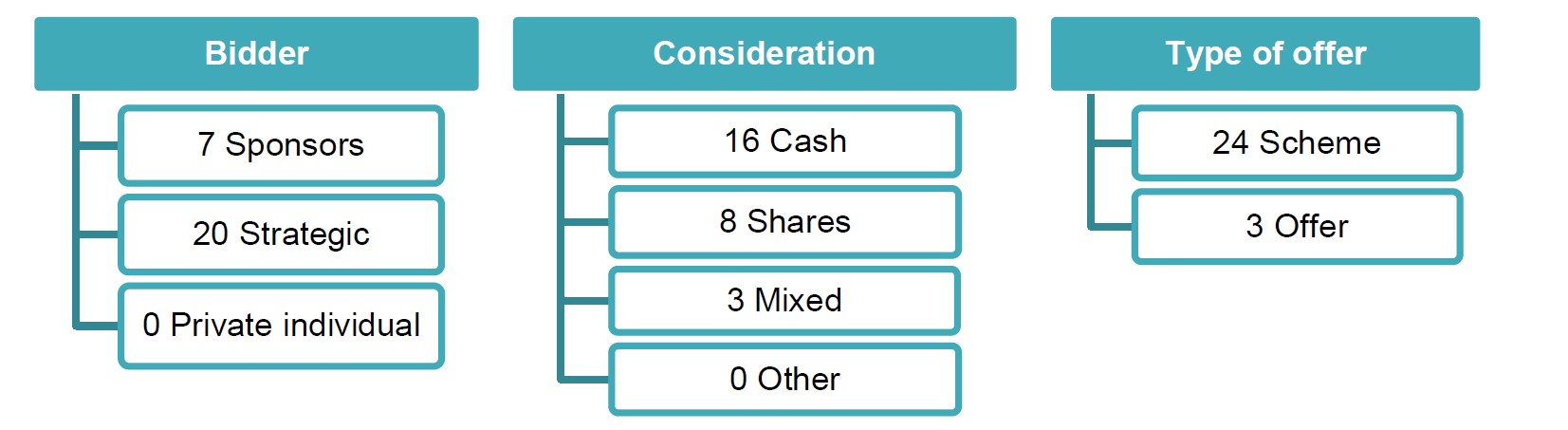
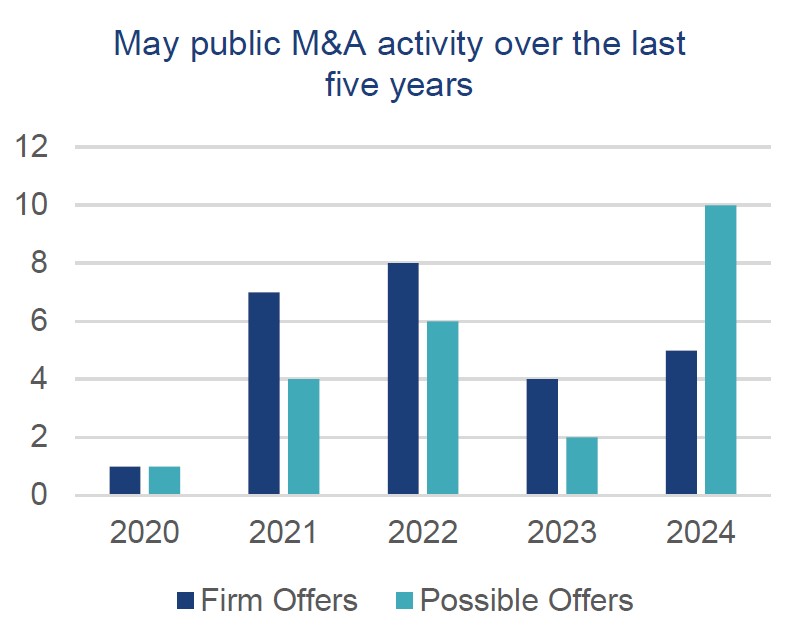
In May 2024, there were five Rule 2.7 announcements made across the UK public M&A market and ten further possible offers announced.
Consultation on the companies to which the Takeover Code should apply
The Takeover Panel has published a consultation paper (PCP 2024/1) proposing to narrow the types of companies to which the Takeover Code applies, to focus on companies which are registered and listed, or were in the last three years listed, in the UK. The Code currently applies, broadly speaking, to:
The Takeover Panel is proposing the following:
The consultation closes on 31 July 2024. The Panel says that it intends to publish a response statement in autumn 2024 and the implementation date will be approximately one month later.
We discuss the Takeover Panel’s proposals in our public M&A podcast series, which you can listen to here.
Updated Practice Statement on private sale processes
Practice Statement 31 sets out the Takeover Panel's approach to formal sale processes, strategic reviews, etc and when, for example, potential offerors have to be named in those situations. It has been updated, as described in Panel Statement 2024/12, to set out the Panel's approach to private sale processes (that is where a company initiates discussions on a private basis with more than one potential offeror and chooses not to announce those discussions).
If a company makes an announcement in respect of what was, until that point, a private sale process (whether voluntarily or in response to rumour or speculation or share price movement), that will commence an offer period in relation to the company, and trigger the requirement to identify any potential offeror with which the company is in talks, or from which an approach has been received (under Rule 2.4(a)). The Panel has updated the Practice Statement to say that where a company is genuinely initiating a private sale process, the requirement to identify any potential offeror may not be appropriate and it may be acceptable for the company to be required to identify a potential offeror only if it has been specifically identified in any relevant rumour or speculation.
Takeover Panel bulletin on statements of intention on an offer
The Takeover Panel has published Panel Bulletin 7 in which it discusses a bidder's statements of intention on a takeover offer, particularly around its intentions for the target business and employees.
Under the Takeover Code, a bidder making a takeover offer must set out its intentions as regards to the future of the target company's business and its employees.
The Panel says in Panel Bulletin 7 that it expects that a bidder will almost always have developed specific intentions in relation to these matters and they must be included in both the announcement of a firm intention to make an offer and in the offer document. If, exceptionally, a bidder has no intention to make any changes in relation to these matters, it must make a statement to that effect.
The Panel sets out a number of arguments that it says are not an acceptable basis for formulating intention statements, including:
The Panel recognises that a bidder may sometimes wish to state that it will conduct a review of the target's business after completion of the offer. However, it says that such a statement will not, of itself, fulfil the Code requirements, and bidders should disclose what the review is likely to cover and their expectations in relation to it.
We discuss the Panel Bulletin, and the background to it, in our article here.
Updated guidance on National Security and Investment Act
The government has published updated guidance on the National Security and Investment Act 2021 (NSI Act). The guidance comprises an updated “Section 3 statement“, which discusses how the power to call in transactions under the Act is exercised, and Market Guidance Notes which aim to improve understanding of how the regime works.
The NSI Act introduced a new framework for the review of transactions and investments on national security grounds in the UK with effect from 4 January 2022. The government published a Call for Evidence on the scope and implementation of the regime in November 2023 and this latest guidance follow the government’s response to that Call for Evidence (see our blog post here for more information).
Section 3 Statement
Under the NSI Act, where a party acquires “control” of a target, the Secretary of State may issue a call-in notice to investigate the transaction if it raises potential national security concerns (and for these purposes control can arise with a very low shareholding, potentially even lower than 15%). The Section 3 Statement sets out guidance on how the Secretary of State will exercise this call-in power. It has been updated to:
Updated Market Guidance
The updated Market Guidance Notes include tips for completing notification forms correctly and more detailed guidance on how long the NSI review process will take in practice, as well as some (limited) guidance on how the NSI regime can apply to outward direct investment.
For further information, see our Competition Notes blog here.
Reforms to UK merger control in the Digital Markets, Competition and Consumers Act
The Digital Markets, Competition and Consumers Act 2024 (DMCC Act), which received Royal Assent on 24 May 2024, will introduce significant changes to the UK’s competition law regime, including new merger control thresholds.
The changes to the UK merger control regime introduced by the DMCC Act include:
The scope and implications of the DMCC Act are wide-ranging. In addition to merger control, other key reforms introduced by the DMCC Act include implementing the UK’s new digital markets regime, which will see the most powerful technology firms with strategic market status having their conduct regulated by the CMA and being subject to a new mandatory merger reporting requirement, and strengthening the CMA’s role in the enforcement of consumer protection legislation.
Secondary legislation is required to implement the changes, so it is not yet clear when the various changes will take effect.
For more information on the DMCC Act, see our Competition, Regulation and Trade ebulletin here.
The number of firm offers made in May has increased slightly compared to the same period last year, with the announcement of five firm offers. Meanwhile the number of possible offers has increased five-fold, with ten possible offers having been announced. This is the highest number of possible offers made in any month in 2024 so far. Whilst this may not lead to firm offers being announced in relation to all of the targets – of the possible offers made in Q1 2024, 25% have resulted in the announcement of a firm offer – it does indicate that the market's appetite for public M&A is continuing to grow.
We continued to see competitive situations, with two possible competing offers announced in May, while the competitive situation in Hipgnosis continues to play out. We discuss why we are seeing more competitive situations and how the rules of the Code operate where there are competing offers in our public M&A podcast series here.
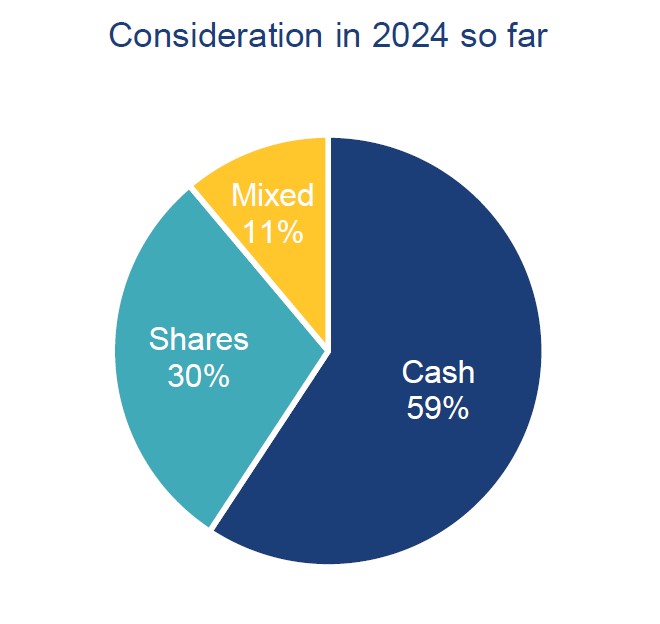
Although cash has been king so far in 2024 (accounting for the consideration on 59% of firm offers), May 2024 bucked this trend with two deals involving share consideration – Touchstone Exploration Inc.'s offer for Trinity Exploration & Production Plc and Mustang Energy PLC's offer for Cykel AI plc – and two deals offering an unlisted securities alternative – the offer for IQGeo Group plc by Kohlberg Kravis Roberts & Co. L.P. and Averon Park Limited's offer for Foresight Sustainable Forestry Company plc. Both of the offers which involved an unlisted securities alternative were public to private transactions involving sponsor bidders. It will be interesting to see if a trend emerges of sponsor bidders using mixed consideration structures as we move through 2024.

Partner, London

Partner, London

Knowledge Counsel, London

Consultant, London
The contents of this publication are for reference purposes only and may not be current as at the date of accessing this publication. They do not constitute legal advice and should not be relied upon as such. Specific legal advice about your specific circumstances should always be sought separately before taking any action based on this publication.
© Herbert Smith Freehills Kramer 2026
Receive timely insights and briefings from HSF Kramer, tailored to keep you informed and ahead