

Subscribe to
Asia private capital insights
Sign up to receive updates on this series
A quiet first half for Asia private capital, with both fundraising and buyout activity subdued, and no indication whether a second-half rebound will materialise as in recent years.
Still, bright spots amidst the data could point to a stronger finish if geopolitics and markets can stabilise.
Our analysis below examines what the data shows, where the regional divergences are sharpest, and why private credit disputes are increasingly the story to watch in the second half.
Q1 2026 was a particularly disappointing quarter for Asia fundraising, with the number of funds closed and the commitments raised at a multi-year low, and the number of funds closed in Q2 was lower still.
However, the value of commitments raised jumped to the highest figure since Q1 2024, due to three significant closings:
Quarterly Asia private capital fundraising (closed funds)

Source: Pitchbook, based on capital raised by closed funds
Q2's figures illustrate what is well known in the market: GPs with already large AuMs tend to be able to successfully raise large funds in all markets, while GPs with small to medium AuMs struggle most in a generally subdued fundraising environment.
Despite these seemingly negative figures, we believe that some parts of the market are underreported in the data. As in previous quarters, our experience is that deal activity in the market for smaller funds, especially targeted co-investments, remains healthy. There is significant activity in the market for commingled vehicles with less than US$500 million in commitments and defined investment targets. Focussing on blind pool funds alone may make the fund industry in Asia appear smaller than it is.
Domestic fundraising markets remain significant, in China, Japan and South Korea in particular, while India attracts proportionally more international capital.
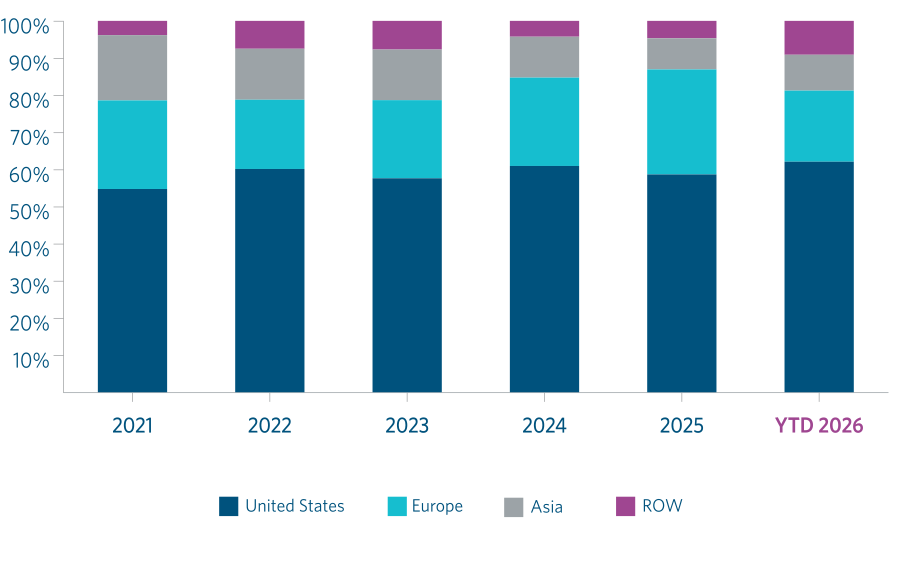
We predicted that European fundraising would grow and then contract when the European market was unable to absorb the amount of capital available. This happened faster than expected and was evident in the geographical allocation of Q1 fundraising.
For Q1 and Q2 2026, the figures show a very resilient US fundraising market. Asia's share of global fundraising remains below the years between 2021 and 2024 and is virtually stagnant compared to the very subdued 2025.
Geographic allocation based on capital raised by closed funds
Source: Pitchbook, based on capital raised by closed funds
The GP-led secondaries market is expected to grow significantly in Asia but, so far, this does not show in the numbers. It is not clear why this is so. Public markets are doing well which should offer exit opportunities, but the DPI figures for this quarter show no improvement.
Two continuation vehicle closings were recorded in Q2, one a US$3 billion vehicle.
Our expectation remains that the number of continuation vehicles will rise towards the end of the year.
Megadeals drove global M&A activity to record levels in 1H 2026 with deals worth US$2.8 trillion being agreed during the period according to data from LSEG – a 49% increase on the same period in 2025.
Despite this record level of M&A activity, there is once again a clear split between the winners and losers, with the US and Europe continuing to see strong deal flow, while Asia-Pacific deal value fell 2.4% on the same period last year.
The malaise in the general Asia M&A market has also been seen in the buyout market with the region once again recording muted levels of activity.
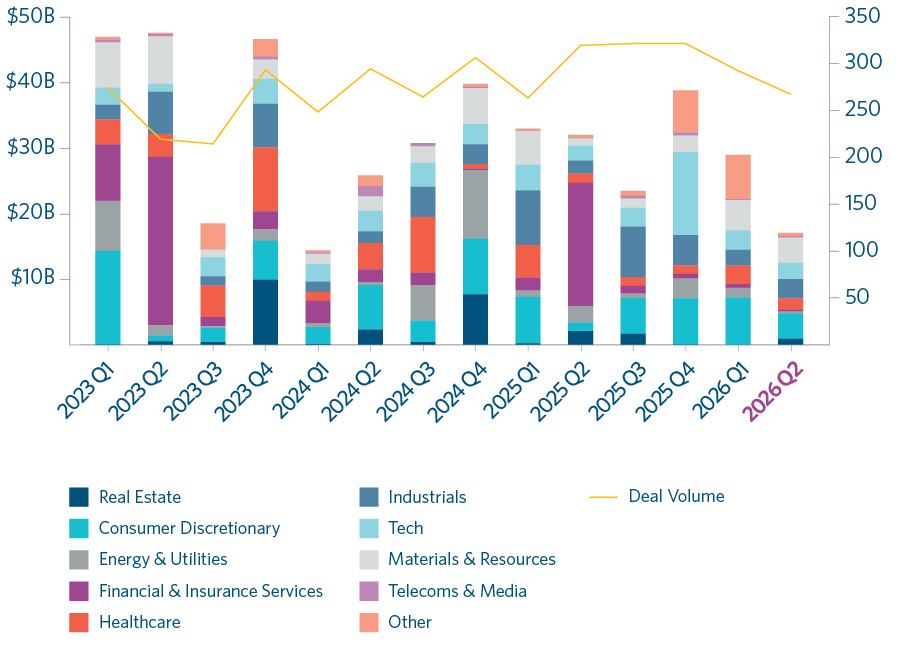
The momentum that built up in the latter part of 2023, 2024 and 2025 has once again failed to continue into the following year and there is a similar sense of ‘here we go again’ in 1H 2026.
Momentum lost again in 1H 2026 (US$ billions)
.2026-07-15-07-39-27.jpg)
Source: Preqin, data as of 3rd July 2026
Over the course of last year, the market largely seemed to get comfortable with uncertainty created by macroeconomic and geopolitical issues, such as the liberation day tariffs, and this spurred dealmaking.
1H 2026 brought a new set of concerns. The Iran war, shocks in private credit and the impact of AI on portfolio valuations are all driving uncertainty.
The AI question is of particular concern to private capital investors: Thoma Bravo reportedly walking away from Medallia is an early indicator of how AI disruption is reshaping valuations.
The momentum has certainly stalled in the Asia buyout market in 1H 2026, but there are signs that 2H could follow the examples of previous years and see a broader based recovery in 2H 2026.
Several factors point to a stronger second half for Asia: global markets are at near record highs; IPO activity is strong and providing alternative exits; an abundance of dry powder; GPs and LPs need to see an increase in DPIs; and a strong overall M&A market.
Whether that momentum can be maintained this time remains to be seen.
Japan continues to see a consistent level of activity, with 96 deals announced in Q2 compared with 102 in Q1, although deal value has fallen significantly from US$5.5 billion to US$2.7 billion.
It was the same story in India, with a small drop in deal volume from 37 to 29 between Q1 and Q2, but an oversized reduction in value from US$5 billion to US$1 billion.
China has, however, seen a slight increase in deal volume (98 to 110) whilst maintaining a consistent deal value of around $8.5 billion for each quarter, making it the strongest performing market.
Japan is likely to remain a key buyout market. Corporate governance reforms, carve-out opportunities, take-private activity, a weaker yen, and a supply of mature, control-oriented opportunities all support continued activity.
Japan's strength continues and China's recovery is sustaining

Source: Preqin, data as of 3rd July 2026
China’s increase in deal activity in Q2 was driven by tech investment exits, with four large Chinese technology deals and one telecoms deal driving the majority of the activity in the quarter. These deals were DeepSeek (US$7.1 billion), Silicon Flow (~US$2.9 billion), StepFun (US$2.5 billion), Moonshot AI (US$2 billion) and Guidao Chenguang (US$8.2 billion).
We have also seen a pick up in the VC market, which is unsurprising given the increased focused on AI investment and the strength of the VC market in Asia, particularly in China. This will likely lead to continued interest in the China market.
Technology and telecoms drive deal activity in Mainland China and Hong Kong (US$ billions)

Source: Preqin, data as of 3rd July 2026
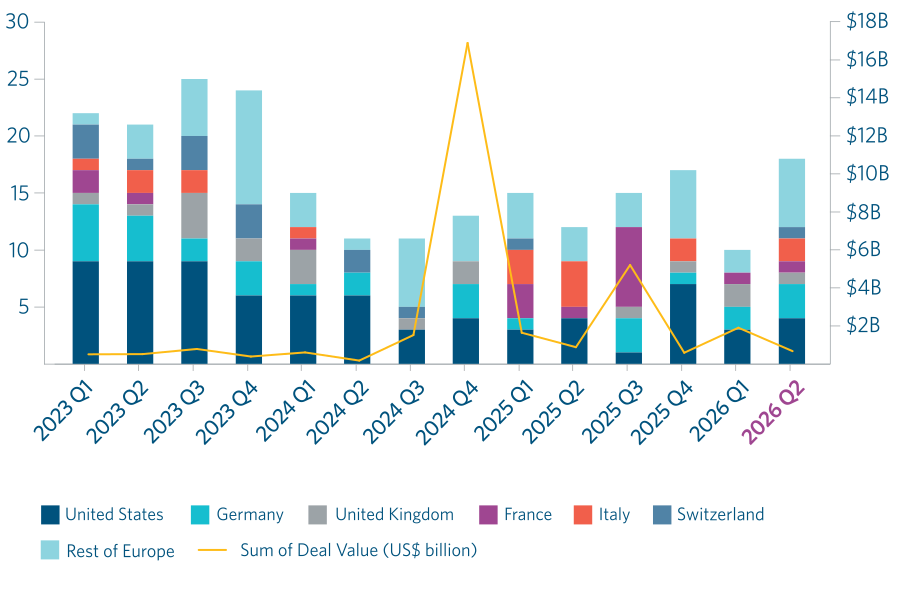
Finally, we have also seen continued interest in outbound investment from financial sponsors based in Mainland China and Hong Kong. This has become a steady theme over the last few quarters and anecdotally is something that more sponsors are targeting. Europe has seen much more of this outbound activity than the US, with Germany and the UK being the main target markets.
Outbound Mainland China & Hong Kong M&A, financial sponsored involvement: US and Europe targets
Source: LSEG, China & Hong Kong acquiror ultimate parents, target nations US and Europe, financial sponsor involvement flag, announced deals between Jan 2023 – 30/06/2026. Deal status: completed or pending.
Private credit has grown from a post-financial crisis financing solution into a major global asset class, but the market is now under pressure from rising defaults, higher interest costs, refinancing challenges and weaker borrower performance.
Fitch recorded a US private credit default rate of 6.0% for the 12 months ending May 2026, unchanged from April, which had marked the highest rate since Fitch’s series began in August 2024.1 Much of this is manifesting through maturity extensions, payment deferrals and the introduction of PIK interest, rather than only through uncured payment defaults.2
This creates obvious scope for default and enforcement disputes. A particular issue for private credit is documentation quality: unlike bank lending documents, which have been refined over decades, some private credit documents have not yet been stress-tested through litigation, and gaps may only become apparent when something goes wrong. In Asia, enforcement may be more complicated again, given fragmented legal regimes, uneven enforcement outcomes and the high number of family-owned borrowers.
Another pressure point is redemptions. Many private credit funds invest in illiquid loans while offering investors some form of redemption right, which may be manageable in normal conditions but difficult to satisfy if investors seek to redeem at the same time in a stress scenario.
That pressure is already visible in the numbers. The Financial Times tracked and reported that redemption requests at 20 private credit funds totalled more than US$22 billion in Q2, with those funds honouring less than 40% of requests and leaving more than US$14 billion of capital locked up.3
Where redemptions are deferred, capped or refused, disputes may arise over whether the documents made that risk sufficiently clear and whether the manager’s discretion was properly exercised.
We expect disputes to play out as shocks in the private credit market continue to feed through to borrowers, lenders, fund managers and investors.
Our Asia private capital team advises funds, asset managers, pension and sovereign wealth funds, and other institutional investor clients across the lifecycle. With expertise in seven offices across Asia, we advise on fund structuring and fundraising, through M&A, financing, consortium arrangements, asset management, and exits and disputes. Our sector focus adds value for clients with Asia market expertise in tech, financial services, consumer, infrastructure, energy/renewables, industrials and healthcare. Contact any of the partners below for access to the team's expertise and click below to enrol for future briefings. |

Partner, Head of Disputes, China and Japan and Head of Private Capital, Asia, Hong Kong

Partner, Head of Private Capital, Asia, Singapore and Hong Kong

Senior Registered Foreign Lawyer (England and Wales), Hong Kong

Partner, Hong Kong

Of Counsel, Hong Kong

Partner, Head of M&A, Asia, Singapore
The contents of this publication are for reference purposes only and may not be current as at the date of accessing this publication. They do not constitute legal advice and should not be relied upon as such. Specific legal advice about your specific circumstances should always be sought separately before taking any action based on this publication.
© Herbert Smith Freehills Kramer 2026
Receive timely insights and briefings from HSF Kramer, tailored to keep you informed and ahead
