

Stay in the know
Receive timely insights and briefings from HSF Kramer, tailored to keep you informed and ahead
Subscribe now
The Committee on Foreign Investment in the United States (CFIUS), the U.S. foreign direct investment regulator, has jurisdiction over inbound U.S. transactions in which a foreign person would secure “control” (directly or indirectly) over a U.S. business, as well as certain noncontrolling “covered investments” that provide a foreign person with certain rights in a U.S. business active in critical technology, critical infrastructure or sensitive personal data of U.S. citizens. A subset of these CFIUS “covered transactions” can trigger a mandatory filing, but otherwise the CFIUS regime is largely a voluntary one, meaning deal parties must assess the national security sensitivities of a particular transaction in determining whether to submit a CFIUS filing, balancing those deal-specific sensitivities with the fact that CFIUS’s jurisdiction to call in a transaction for review never expires. CFIUS filings, which are submitted jointly by the transaction parties, can be made through one of two mechanisms, namely the more traditional written notice, a comprehensive filing that initiates the full review process, or the (relatively) newer shorter-form declaration, which is essentially a streamlined submission that may be considered for transactions that present more limited national security considerations.
Each year, CFIUS issues a report to the U.S. Congress describing its reviews and investigations of covered transactions during the prior calendar year, and thereafter issues an unclassified and anonymized version of that report. Several statistics in the 2025 CFIUS Annual Report (the 2025 Report) reveal trends that deal parties and their advisors should consider when planning transactions that may require a CFIUS filing or which raise U.S. national security considerations that may trigger CFIUS scrutiny. The 2025 Report also highlights the introduction of new institutional developments within the U.S. Treasury Department, which chairs CFIUS, including a new in-house technical branch designed to bring further subject matter expertise to the review process.
Key points from the 2025 Report include the following.
The lapses in funding appropriations (i.e., a government shutdown) required CFIUS to suspend statutory review deadlines in active matters, resulting in more than 120 days of cumulative review tolling, and delayed CFIUS’s ability to accept new transaction filings. (Appropriations lapses for all U.S. government agencies occurred from October 1, 2025, to November 12, 2025, with a further two “partial” shutdowns in 2026 (from January 31, 2026, to February 3, 2026, and then from February 14, 2026, to April 30, 3026, involving the Department of Homeland Security, a CFIUS member agency) that impacted filings made later in 2025.) The 2025 Report acknowledged that the consequences of the shutdowns extended beyond CFIUS’s internal operations, “creating uncertainty for the investor and business communities that depend on a reliable and predictable review process.” Notwithstanding these disruptions, the 2025 Report notes that, after excluding periods tolled due to the lapses in appropriations, CFIUS cleared approximately 67% of covered transactions in 2025 during either the 30-day assessment period applicable to declarations or the initial 45-day review period applicable to notices.
The 2025 Report reflects U.S. Treasury’s continued efforts to strengthen CFIUS’s institutional capacity and technical expertise through several initiatives, including the following:
Deal parties made greater use of the shorter-form declaration filing process in 2025, which can result in CFIUS clearance in 30 days, but also can end with a CFIUS request for a full notice, which effectively extends a transaction’s overall CFIUS timeline. In 2025, CFIUS accepted and reviewed 140 declarations, a 21% increase from the 116 declarations filed in 2024 and the highest annual volume since 2022 (154 declarations). Seven filings involved covered real estate transactions, while 51 declarations were submitted pursuant to mandatory filing requirements.

Several potential trends stand out from the 2025 statistics.
The most common way to notify a transaction to CFIUS remains the written notice. CFIUS can conclude action on a transaction (i.e., “clear” the transaction) filed by way of notice after an initial 45-day review period. If national security concerns are still “unresolved” at the end of that initial review, CFIUS can undertake a second-stage investigation over a further 45 days. In some cases, parties may withdraw a filing to reset these statutory deadlines and allow time for further CFIUS review and in some cases for the negotiation of mitigation remedies (discussed below), though sometimes commercial reasons will cause parties to withdraw a deal. CFIUS can refer a matter to the president for disposition, in rare (but increasing) cases.
While overall notice filing volume remained stable in 2025, the statistics suggest that parties can face a challenging review environment once transactions enter the investigation phase. In particular, the proportion of transactions withdrawn after the commencement of an investigation increased again in 2025, reflecting the continued impact of mitigation negotiations and, in a smaller number of cases, the inability of the parties and CFIUS to reach an acceptable resolution to national security concerns, at least during the first review and investigation.

Chinese investors face continued scrutiny. Chinese investors submitted the largest number of notices over the 2023-2025 period, accounting for 92 filings, followed by Japan (62) and the United Arab Emirates (61). (For CFIUS reporting purposes and consistent with Executive Order 13936 on Hong Kong Normalization (July 17, 2020), transactions originating from Hong Kong are reported as originating from China.) By contrast, Chinese investors submitted only 9 declarations over that same period, presumably due to the heightened scrutiny that CFIUS is perceived to apply to Chinese investments.
The top three investor countries for 2025 distinct notice filings were Japan (23), the United Arab Emirates (18), and Canada (15). When accounting for transactions that either originated as a declaration and then filed as a notice, or else notices that were withdrawn and refiled, the most filings again originated from China (33 in 2025), possibly reflecting that more Chinese-investor transactions were subject to withdrawal and refiling to provide CFIUS more time to address national security issues.
The 2025 Report reflects a continued decline in the use of mitigation agreements, consistent with the policy direction articulated in the “America First Investment Policy.” At the same time, the 2025 Report makes clear that CFIUS remains highly focused on monitoring and enforcing compliance with existing mitigation obligations and mandatory filing requirements.
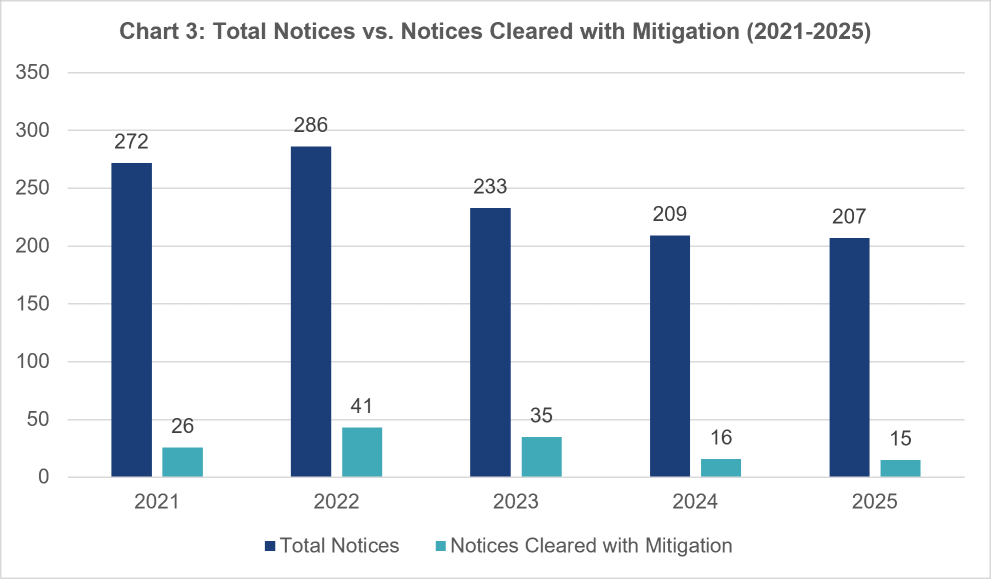
The 2025 Report also highlights CFIUS’s continued focus on identifying and reviewing transactions that were not voluntarily notified. In 2025, CFIUS identified “thousands of potential non-notified transactions,” investigated 90 of those matters to determine whether further review was warranted, and ultimately opened formal inquiries into 62 transactions. CFIUS ultimately requested a filing in nine cases, while in two additional instances the parties voluntarily filed after receiving CFIUS outreach. The Report notes that CFIUS relies on a wide range of information sources to identify non-notified transactions, including “interagency referrals, public tips, classified reporting, media reports, self-disclosures, congressional notifications, commercial databases, and other sources.” The statistics serve as a reminder that the voluntary nature of the CFIUS regime does not eliminate regulatory risk. Even where a filing is not required, parties remain subject to the possibility of post-signing or post-closing scrutiny, underscoring the importance of conducting a careful CFIUS assessment for transactions that may raise national security considerations.
As the 2025 Report itself cautions, a variety of factors affect the data it presents, which per CFIUS may make it difficult to “extrapolate CFIUS trends year-over-year,” especially as the disposition of any particular case depends on its specific facts and circumstances. Nevertheless, the 2025 Report reflects a CFIUS process that is becoming more operationally complex, technically sophisticated, and institutionally developed. The government shutdowns in 2025 demonstrated that funding lapses can delay CFIUS reviews, and potential appropriation warning signs should be considered in deal planning. The increased number of declarations that resulted in a required notice filing (which extended the regulatory timeline in each of the impacted transactions) suggests that the short-form process may be less predictable than perhaps the 2024 declaration statistics might have indicated. At the same time, the establishment of the Office of Research and Analysis, CFIUS’s continued stakeholder engagement, and its sustained compliance and enforcement activity suggest that CFIUS is continuing to expand the tools and institutional capacity through which it assesses and manages national security risk. For deal parties and their advisors, the practical takeaway is that CFIUS issues should be evaluated early, with careful attention to filing strategy, transaction timelines, technical diligence, and proactive regulatory planning.

Partner, New York and Washington, DC

Counsel, New York

Senior Associate, New York

Associate, New York
The contents of this publication are for reference purposes only and may not be current as at the date of accessing this publication. They do not constitute legal advice and should not be relied upon as such. Specific legal advice about your specific circumstances should always be sought separately before taking any action based on this publication.
© Herbert Smith Freehills Kramer 2026
Receive timely insights and briefings from HSF Kramer, tailored to keep you informed and ahead