

Our Australian Class Actions Team
Click here
By Helen Mould and Damian Grave
This briefing note comprises a series of short articles taking a closer look at class actions in Victoria, offering some insights and reflections. From the inception of group costs orders to recent High Court considerations, we explore key developments and emerging trends, which have shaped the Victorian class action regime and which both reflect and impact the broader class action landscape nationally.
The Victorian regime is the second oldest nationally, with the federal regime having been in place since 1992, New South Wales since 2011, Queensland since 2017, Tasmania since 2019 and Western Australia since 2023.
The start of the Victorian class action regime was not without controversy. In late 2000, the Victorian Parliament enacted legislation introducing Part 4A of the Supreme Court Act 1986 (Vic).
For nearly a year prior to the enactment of Part 4A, Rules of Court existed in the Supreme Court of Victoria which followed very closely the terms of Part IVA of the Federal Court of Australia Act 1976 (Cth):
“In 1997 the judges of the Supreme Court suggested to the then Attorney-General that Parliament should legislate along the lines of Part IVA of the Federal Court of Australia Act. The suggestion seemed to be well received. But by 1999 no legislation had been introduced or even foreshadowed and so the judges turned their minds to the introduction of the Federal Court system by means of Rules of Court.”
Brooking JA in Schutt Flying Academy (Australia) Pty Ltd v Mobil Oil Australia Ltd (2000) 1 VR 545 (Schutt Flying Academy) at [9]
These Rules of Court withstood a challenge to their validity in Schutt Flying Academy by a majority of three to two in the Victorian Court of Appeal.
“[T]he protections provided to members of the group, though arguably open to some criticism, nevertheless provide sufficient procedural fairness to those members in that they provide for notice to all, the right to opt out, the right to challenge representation and the right to individual assessment of loss and damage, all in the context of proceedings brought on behalf of all members and for their benefit. It is for the Court to ensure that the object of the rules is achieved so far as possible, and it should not be assumed that it will fail.”
Ormiston JA at [48]
The Bill to introduce Part 4A of the Supreme Court Act 1986 (Vic) was debated in Parliament in October and November 2000. It received Royal Assent in November 2000 but was deemed to come into operation on 1 January 2000.
After Part 4A of the Supreme Court Act 1986 (Vic) was enacted, it also withstood a challenge to its validity. In June 2002, the High Court of Australia unanimously confirmed that the provisions were within the legislative power of the Victorian Parliament:
“The legislative policy underlying group proceedings may be open to legitimate difference of opinion, but the primary object is clear enough. It is to avoid multiplicity of actions, and to provide a means by which, where there are many people who have claims against a defendant, those claims may be dealt with, consistently with the requirements of fairness and individual justice, together. The discretionary powers conferred upon the Court in dealing with a group proceeding are consistent with that objective. To point to the theoretical possibility that in a particular case those powers might not be exercised wisely, or might operate unfairly, is not to deny the existence of the legislative power to establish such a regime.”
Gleeson CJ in Mobil Oil Australia Pty Ltd v The State of Victoria (2002) 211 CLR 1 at [12]
Over the past 25 years, the law and practice associated with class actions in Victoria have developed considerably. Class actions have become a significant feature of the litigation landscape in this State.
These developments in Victoria have taken place within a broader landscape, alongside evolution in the federal class action regime and the class action regimes of other States. There is substantial similarity in the legislation in place in the Commonwealth, Victoria and the other States, and the statutory provisions are regularly the subject of consideration by the Federal Court, State Supreme Courts and Courts of Appeal and the High Court of Australia. For example (and as discussed elsewhere in this briefing note), in March 2025 the High Court handed down its decision in Bogan v Estate of Smedley (dec’d) (2023) 72 VR 394 (regarding interaction between a group costs order and the cross-vesting provisions in the Corporations Act), and the High Court is currently reserved in an appeal from a decision of the Full Court of the Federal Court of Australia regarding solicitors’ common fund orders (R&B Investments Pty Ltd (Trustee) v Blue Sky Alternative Investments Ltd (2024) 304 FCR 395).
In this briefing note, we draw together some key themes and updates to reflect upon the first 25 years of the Victorian class action regime.
We hope this spotlight on the first 25 years of the Victorian class action regime is both helpful and informative.

By Chloe Smith and Damian Grave
In February 2025, Professor Vince Morabito of Monash University released his thirteenth empirical report on Australian class actions, providing up-to-date data on class actions in Victoria and around Australia. This report is titled "Group Costs Orders, Funding Commissions, Volume of Class Action Litigation, Reimbursement Payments and Biggest Settlements" (4 February 2025) and includes information on the number of proceedings filed, the types of claims commenced, and the number and quantum of settlements. The report also includes information on group costs orders made since the introduction of the regime in Victoria in July 2020. The discussion below draws on data from Professor Morabito’s report.
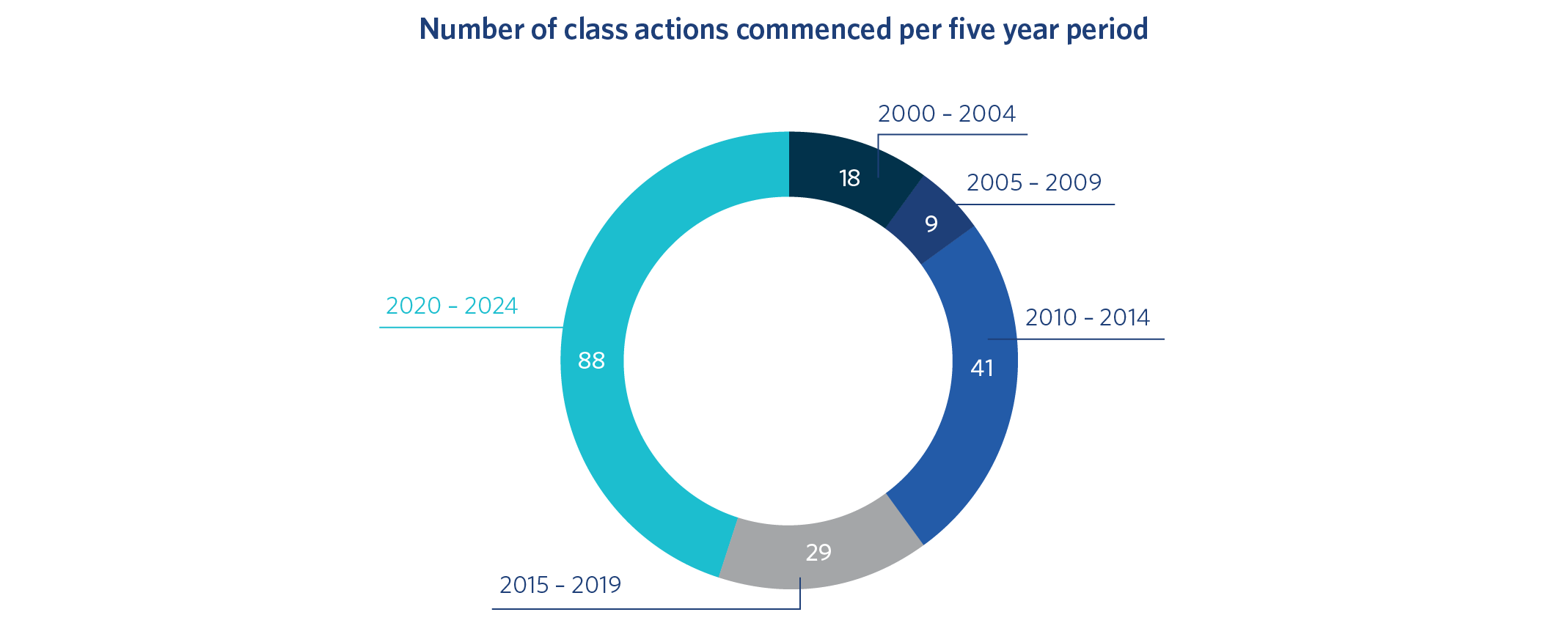
185 class actions have been filed in the Supreme Court of Victoria since the regime was introduced in 2000.
30% of all class actions filed in Australia in the last five years were filed in the Supreme Court of Victoria, confirming that Victoria remains Australia’s second most prominent class action jurisdiction. Although the number of actions commenced in Victoria in 2024 was significantly lower than 2023 (14 in 2024, cf 23 in 2023), the total number of actions commenced in Victoria in the period from 2020 to the end of 2024 is 88 (more than double the number in any other five-year period since the start of the Victorian class action regime).
The Federal Court has seen 175 class actions filed in the period from 2020 to 2024, with 86 of these proceedings filed in the Victoria Registry.
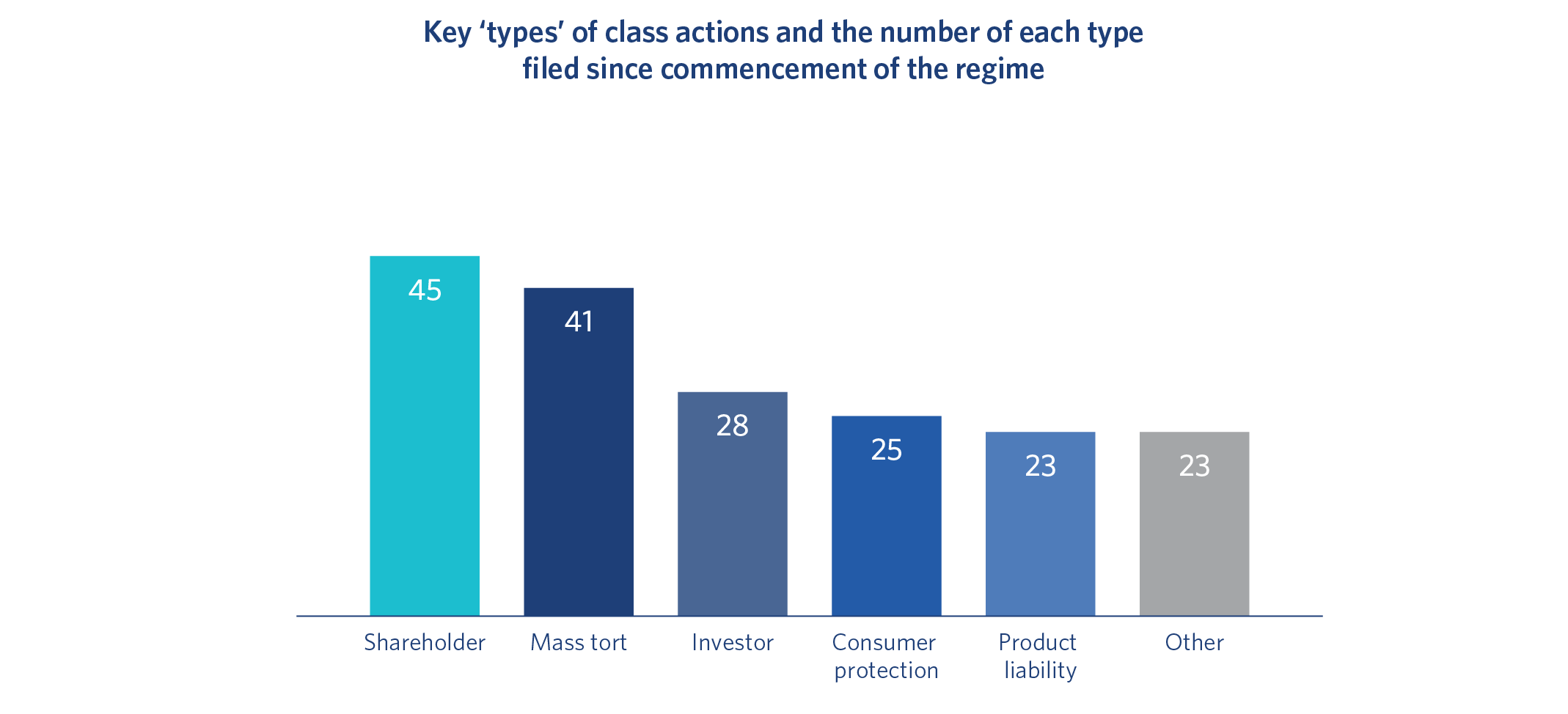
In the 25 years since the Victorian regime commenced, the most common type of class action filed has been shareholder class actions (45 of the actions filed). The next most common type of action has been mass tort (41 of the actions filed). This is followed by investor class actions which comprise 28 actions of the actions filed.
30 shareholder class actions have been filed since 1 July 2020, 36.5% of the total number of class actions filed in this period.
The group costs order mechanism, which is unique to Victoria, commenced on 1 July 2020, 20 years into the commencement of the Victorian class actions regime. Although the period since group costs orders were introduced is a relatively short part of the regime’s 25-year history, there have been 82 class actions filed in this period, 44.3% of all Victorian class actions filed over the last 25 years. This data indicates that the group costs order mechanism has made Victoria an attractive jurisdiction for proponents of class action proceedings.
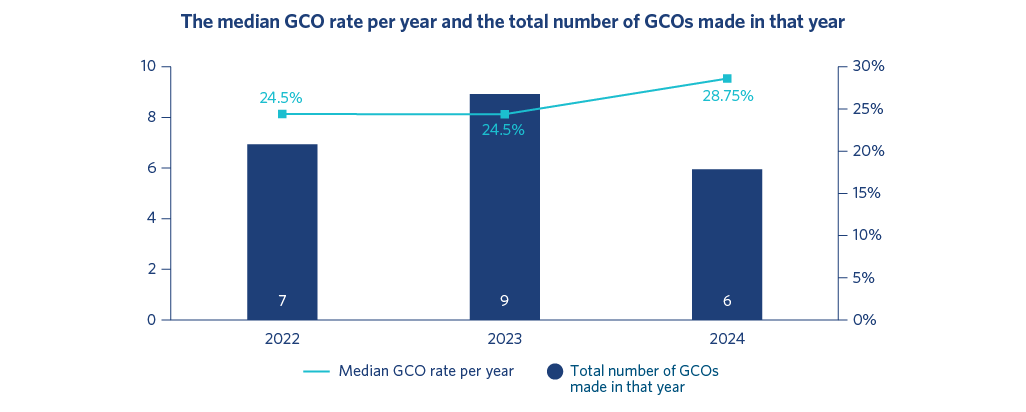
22 group costs orders have been made since February 2022 (when the first order was made). The rate ordered ranges from 14 – 40%, with the median rate sitting at 24.75% as at the end of 2024 (and trending upward, with the median rate in 2024 sitting at 28.75%).
We discuss the group costs order mechanism further here.
Professor Morabito’s report includes data on Australian class action settlements of $50 million and above, up to the end of January 2025.
The largest settlement to date remains the Victorian Supreme Court Kilmore East – Kinglake 2009 Black Saturday Bushfire class action, which settled for approximately $495m in 2014.
The top five settlements by gross settlement sum in the Victorian Supreme Court are:
|
|
Proceeding |
Settlement Sum |
Year |
|
1. |
Kilmore East – Kinglake 2009 Black Saturday Bushfire class action |
$494.6m |
2014 |
|
2. |
Murrindindi – Marysville 2009 Black Saturday Bushfire class action |
$300m |
2015 |
|
3. |
Uber class actions |
$271.8m |
2024 |
|
4. |
Allianz car dealer add-on insurance class action |
$170m |
2025 |
|
5. |
Westpac flex commissions class action |
$130m Note that this settlement is subject to Court approval. |
2025 |

By Claire Jago and Katherine Muir
Since 1 July 2020, plaintiff lawyers have been able to apply to the Supreme Court of Victoria for a “group costs order” (GCO). A GCO is an order that legal costs be calculated as a percentage of any judgment or settlement awarded in the group proceeding. GCOs are an exception to the general prohibition on contingency fee arrangements. There is no equivalent statutory provision in other class action jurisdictions across Australia.
A GCO can be made at any stage of a proceeding. The Court may, however, amend a GCO during the course of the proceeding, including once damages or settlement proceeds are secured. In exchange for the right to be remunerated on a percentage-basis, the plaintiff lawyers are responsible for costs payable to the defendant, including providing any security for costs.
The Victorian Law Reform Commission’s March 2018 report titled Access to Justice – Litigation Funding and Group Proceedings which recommended the introduction of percentage-based remuneration for plaintiff lawyers in group proceedings, noted that the class action regime in Victoria appeared to be underutilised. In the second reading speech for the provision, the Attorney‑General stated that GCOs would promote access to justice by removing potential barriers to commencing class actions.
In less than 5 years since the introduction of GCOs, 82 class actions have been filed in Victoria, comprising 44.3% of all Victorian class actions filed over the last 25 years.1 Within these proceedings, 22 “commencement GCOs” (a GCO made at an early stage of the proceeding) have been made. In terms of sheer volume of cases filed, it appears as though the introduction of the GCO regime has contributed significantly to increased utilisation of the Victorian class action regime.
According to the Attorney-General’s second reading speech, GCOs also have potential to reduce the overall costs to group members in class actions, as a single fee will be payable to the plaintiff lawyers rather than a funding fee plus legal costs.
At the end of 2024, the median rate for all commencement GCOs was 24.75%, ranging from 14 to 40%. This rate seems to be trending upwards, moving from 24.5% in both 2022 and 2023, to 28.75% in 2024. One reason for this increase might be that none of the six GCOs applied for in 2024 was considered in the context of competing class actions. The incentive to seek the lowest possible GCO seems to decrease when a party is not also asking the Court to select one proceeding over another.
Even with the average GCO rate increasing, GCOs may provide a far better financial return for class members than is otherwise available to them in funded class actions. Using the median GCO rate of 24.75% as an example, unless the rate is subsequently varied by the Court, class members can expect to receive around 75% of any monetary compensation (depending on any additional sums deducted for administration costs or payment to the lead plaintiff). By comparison, in a survey carried out by the Australian Law Reform Commission in 2018, it was found that the median return to group members in funded class actions in the Federal Court between 2013 and 2018 was only 51%.2
Finally, the introduction of GCOs was intended, according to the second reading speech, to pave the way for class actions to proceed where they otherwise may not have been viable, such as class actions relating to silicosis, wage theft and corporate wrongdoing.
A review of the categories of class actions filed since the GCO regime was introduced, however, reveals that shareholder class actions have risen in popularity. Compared to the pre-GCO period where shareholder class actions made up only 14.5% of the total number of class actions filed in Victoria, in the post-GCO era they make up approximately 36.5%. Whether these results align with the intended purpose of the GCO regime is likely a point on which opinions will vary.
Although the GCO regime is unique to Victoria, the recent decision of the Full Court of the Federal Court of Australia in R&B Investments Pty Ltd (Trustee) v Blue Sky Alternative Investments Ltd (2024) 304 FCR 395 (Blue Sky) could see a solicitor’s common fund order emerge in the Federal Court.
In Blue Sky, it was held that the Federal Court has the power at the time of settlement or judgment to grant a solicitor’s common fund order which would permit an applicant’s solicitors to receive a portion of the proceeds recovered from the class action. Given the 2019 High Court decision of BMW v Brewster (2019) 269 CLR 574, common fund orders cannot be made at an early stage of a proceeding (meaning that GCOs deliver an additional benefit in the form of certainty for parties and their representatives when compared to a solicitor’s common fund order). The High Court has heard arguments on an appeal from Blue Sky, and the decision is pending.
Interestingly, the first and second respondents in Blue Sky are not only seeking to preserve solicitor’s common fund orders. They (and the Association of Litigation Funders of Australia, seeking leave to intervene) have also asked the High Court to reopen BMW v Brewster, in order to permit common fund orders to be made at an early stage of a proceeding. If the High Court takes this course, there may be practically few differences between a commencement GCO and a solicitor’s common fund order made at an early stage of a proceeding.

By Alan Mitchell and Isabella Gunn
Courts in Australia have the power to protect the integrity of their own proceedings. One way in which they do this is by staying proceedings where these constitute an abuse of process. The categories are not closed, but an abuse of process may be found where:
An example of the Victorian Supreme Court preventing the class action regime being used in a way that would constitute an abuse of the Court’s process is found in the successful 2014 application brought by Treasury Wine Estates (Treasury) to permanently stay proceedings launched against it by Melbourne City Investments (MCI). The arguments leading to Treasury’s success in staying these proceedings were subsequently applied in other class actions commenced by MCI.
MCI was represented by Mr Mark Elliott (Mr Elliott). The company was incorporated by Mr Elliott on 1 November 2011, and he continued to serve as sole director and shareholder – he was the controlling mind of the company.
In 2013, MCI commenced a securities class action against Treasury with Mr Elliott acting as its solicitor. Before Justice Ferguson of the Victorian Supreme Court, Treasury sought orders including that Mr Elliott be restrained from acting as solicitor for MCI in the proceeding and that the proceeding be permanently stayed or struck out as an abuse of process.
Documents subpoenaed by Treasury from MCI revealed that on the date of its incorporation, MCI purchased small parcels of shares in Treasury and over 100 other ASX listed companies. Treasury submitted that an inference could be drawn that these shares were not acquired for investment purposes, but so as to create the opportunity for MCI to become the representative plaintiff in class actions, and thereby enable Mr Elliott to generate legal fees.
In July 2014, Justice Ferguson made orders restraining Mr Elliott from acting for the lead plaintiff and ordered that the proceedings not continue as group proceedings while MCI and Mr Elliott were acting in concert as client and lawyer. Her Honour found, amongst other things, that MCI’s purpose in commencing the class action was to enable its solicitor, Mr Elliott, to generate legal fees. However, her Honour was not satisfied that the proceeding was an abuse of process.
Treasury appealed the trial judge’s decision not to stay the class action as an abuse of process. In December 2014, Treasury’s appeal was successful, with the Victorian Court of Appeal staying MCI’s class action on the basis that it was brought for an illegitimate or collateral purpose.
The majority comprising Maxwell P and Nettle JA observed that the only legitimate purpose for bringing a proceeding is the vindication of legal rights or immunities by way of judicial determination or settlement. Where a proceeding’s predominant purpose cannot be characterised in this way, it is an abuse of process and must be stayed.
The Court of Appeal accepted Treasury’s argument that MCI was only incorporated by Mr Elliott with the intention to launch proceedings against ASX listed companies, enabling him to garner legal fees by acting on the plaintiff’s behalf. Accepting then that the purpose of the proceeding was to ‘generate legal fees’, the operative question for the Court was whether this was a legitimate purpose.
Critical in this case was the fact that MCI need not have its day in the court in order for the proceedings to serve their ultimate purpose and Mr Elliott himself had indicated in writing his belief that each action would settle. Thus, observing that the payment of legal fees is merely incidental to the pursuit of a legal action, the Court found that this was a ‘clear example of an abuse of process’ – Mr Elliott was using the court system as a means by which to generate an income for himself.
MCI applied to the High Court for special leave, but the High Court did not grant leave. In the exchanges with counsel during the hearing, the Court noted that a client using a cause of action to create an income-generating vehicle for its solicitor was an abuse of process of the court. Justice Keane stated that the purpose of judicial power is to quell controversies, and it is an abuse of the judicial power to generate controversies for the profit that can be made from doing so.
The principles emerging from the MCI litigation demonstrate that the integrity of a proceeding cannot be remediated if it is infected with a wrongful purpose from the outset (MCI’s appointment of a different solicitor could not cure the vice). There are often competing class actions about substantially similar facts and claims. Where one class action is infected with a wrongful purpose, upon that being stayed as an abuse of process, the interests of that class may come to be represented by another class action (a different but similar class action had been brought against Treasury by others) which is not infected with a wrongful purpose.

By Helen Mould and Merryn Quayle
In Victoria, as in the other Australian class action jurisdictions, the class action regime is an “opt-out” regime. When a proceeding is commenced, those falling within the group member definition are group members, whether or not they have indicated interest in participating in the class, unless they take steps to “opt out” of the proceeding. The representative plaintiff is not required to identify the members of the class or obtain their consent to the proceeding being brought on their behalf.
Consequently, it can be difficult for the parties to know how many group members exist and what the claim may be worth. This uncertainty can in turn make it difficult for the parties to assess their respective positions and evaluate the potential for settlement.
“Class closure” has evolved in response to this difficulty. Typically at the request of the parties and in the lead up to a mediation, courts will make orders requiring group members to register their claims in order to participate in a settlement. When orders of this nature are made (sometimes described as “soft class closure”), unless group members register by a specified deadline, they will not be permitted to receive a share of any settlement reached and they will be bound by the terms of such settlement (which will typically include a release in respect of group members’ claims). Soft class closure orders may be time-limited, and the class may reopen if no settlement is reached within the period of time specified in the orders.
There are different approaches to class closure in different jurisdictions, and these differences have sharpened in the last five years. In this regard, Victoria stands apart, due to a provision in the Victorian legislation which does not exist in other Australian class action regimes.
The statutory provision which exists in Victoria but not elsewhere is s 33ZG of the Supreme Court Act 1986 (Vic). That section confirms that an order made under s 33ZF (the general provision empowering Courts to make orders “appropriate or necessary to ensure that justice is done”) can extend to setting out a step that group members must take in order to be entitled to obtain any benefit arising out of the proceeding and specifying a date by which such a step must be taken.
Section 33ZG has been recognised as being of “real significance”1 and an explicit source of power to make class closure orders.2 In Parkin v Boral Ltd, the Full Federal Court described s 33ZG as “elaborative”3 of the grant of power in s 33ZF (a characterisation consistent with the prevailing view in the Federal Court that s 33ZF permits the making of soft class closure orders).
An early statement of the principles to be applied in assessing whether and when it is appropriate to make soft class closure orders was set out in Justice J Forrest’s 2013 decision in Matthews at [79]. More recently, the principles have been restated in Justice Nichols’ 2023 decision in Fox v Westpac Banking Corporation [2023] VSC 414 at [18].
The cases make clear that the critical lens is whether the proposed orders are, at the relevant time, appropriate or necessary to ensure that justice is done in the proceeding,4 and this requires a fact-specific assessment on a case-by-case basis,5 described by the Victorian Supreme Court as a “question of balance and judicial intuition”.6
In assessing whether to make soft class closure orders, the Court will evaluate the utility of the orders to resolving the proceeding at mediation and there will be a focus on whether group members will receive adequate notice of the orders and clear information about the impact on their rights and be afforded sufficient opportunity to register in time.
If made, class closure orders will usually be expressed to be subject to further order of the Court (a form described by Justice Nichols as a "safety valve"),7 such that if an unregistered group member can demonstrate sufficient justification, they may apply to be re-admitted to the class, by exercise of the Court’s discretion.

By Gavin Wendt, Chloe Smith and Ruth Overington,
The High Court has considered Part 4A of the Supreme Court Act 1986 (Vic) (Part 4A) several times, developing important principles regarding its operation.
In Schutt Flying Academy (Australia) Pty Ltd v Mobil Oil Australia Ltd (2000) 1 VR 545 a majority of the Court of Appeal dismissed Mobil’s challenge to Victoria’s first modern class actions regime established under Order 18A of the Supreme Court (General Civil Procedure) Rules 1996 (Vic). The dissenting opinion of President Winneke nevertheless called for legislative action to enshrine the rules in a statutory framework.
The Victorian Parliament having subsequently passed legislation enacting Part 4A with retrospective effect, Mobil renewed its challenge in the High Court. Mobil sought declarations that the amending Act was invalid as beyond the legislative competence of the Victorian Parliament.
The High Court dismissed Mobil’s claims in Mobil Oil Australia Pty Ltd v Victoria (2002) 211 CLR 1 and affirmed Part 4A as a legitimate legislative mechanism for the resolution of the common issues of plaintiffs and group members. In doing so, the Court made several important observations:
Some fourteen years later the High Court had cause to consider the effectiveness of Part 4A in resolving finally the common claims of group members: Timbercorp Finance Pty Ltd (in liq) v Collins (2016) 259 CLR 212.
The respondent investors were group members in an earlier Part 4A proceeding against Timbercorp entities on behalf of all persons who had invested in a managed investment scheme of which Timbercorp was the trustee. Some group members had received loans from Timbercorp to fund their investments. The proceeding alleged that Timbercorp failed to disclose certain risks and misrepresented its financial position and sought declarations of statutory wrongdoing, and that group members were not liable for any loans, fees or costs associated with their investments. The claims were unsuccessful at trial.
The liquidators of Timbercorp subsequently sued the respondent investors, alleging they had defaulted under their loan agreements. The respondent investors filed defences challenging the validity of the loan agreements. Timbercorp contended that the investors should have raised those matters for determination in the class action or opted out and were estopped from raising the matters in their defences.
The High Court dismissed Timbercorp’s claims, holding that the respondent investors were not precluded from raising the matters pleaded in their defences. It held that:
The Court’s decision also confirms the limitation of Part 4A. While resolving the common claims of plaintiffs and group members, it does not resolve individual issues or claims which are not common to the group.
In Bogan v Estate of Smedley (dec’d) (2023) 72 VR 394, the Victorian Court of Appeal considered whether and to what extent, the existing group costs order (GCO) made pursuant to s 33ZDA of Part 4A was relevant to the determination of whether the proceeding should be transferred to the Supreme Court of New South Wales pursuant to s 1337H(2) of the Corporations Act 2001 (Cth). The Court held that the GCO was relevant to the exercise of discretion under s 1337H of the Corporations Act and that the GCO would not “travel” because s 1337P would not operate to give legal force to the GCO in the Supreme Court of New South Wales. Further, given the importance of the GCO to the proceeding, that it was made as necessary or appropriate in the interests of justice in the proceeding, and that the factors identifying the more natural forum were neutral, the Supreme Court of New South Wales was not the more appropriate forum.
The questions stated for the opinion of the Court of Appeal were removed to the High Court. On 12 March 2025, the High Court held that the Court of Appeal was correct to conclude that the GCO was relevant to the exercise of discretion as to whether to transfer the proceeding pursuant to s 1337H and that it was correct in concluding that the GCO weighed decisively against transfer being in the interests of justice as there was a considerable risk the class action would not be able to continue in the absence of the GCO: Bogan v Smedley [2025] HCA 7.
The full implications of the High Court’s decision will receive ongoing analysis. Its immediate practical impact is to tie the Bogan proceeding to Victoria because the GCO was made.

By Gavin Wendt, Anna Kretowicz and Ruth Overington
In its Report 134, the Australian Law Reform Commission described competing class actions as “two or more class actions where there is a non-theoretical possibility that a person may be a class member of more than one class action, or two or more class actions with respect to the same dispute filed on behalf of different claimants”.
The phenomenon has required courts to develop the principles informing the appropriate approach to resolving issues associated with multiplicity disputes arising through competing class actions. In Wigmans v AMP Ltd (2021) 270 CLR 623 the High Court held there is no “one size fits all” approach, there is no presumption that the proceeding commenced first in time should prevail, and that relevant factors informing the remedial approach are non-exhaustive and vary from case to case. The guiding principle is that the court must determine “by reference to all relevant considerations, which proceeding going ahead would be in the best interests of group members”.
The factors which may be relevant to resolving multiplicity disputes have been identified with some clarity. In Perera v GetSwift Ltd (2018) 263 FCR 1 at [169] the Federal Court identified the following factors:
In October 2020, the Victorian Supreme Court issued Practice Note SC Gen 10 ‘Conduct of Group Proceedings (Class Actions)’ (Second Revision) which applies to the conduct and management of class actions. Paragraph 8.2 of the Practice Note lists various factors the Court will look to in resolving multiplicity issues, reflecting the multi-factorial approach applied in the authorities discussed above.
Further, the Supreme Court is party to a cooperation protocol with the Federal Court (the Protocol). The Protocol is designed to facilitate the efficiency and effectiveness of class actions where multiple proceedings are brought in competing courts and across more than one jurisdiction. The Chief Justices of the respective courts have agreed to appoint specific representative Judges of each court who may convene joint case management hearings and confer with each other regarding the appropriate management of competing proceedings.
The Supreme Court regularly deals with multiplicity disputes. Recent examples include:
Recently the Court dealt with multiplicity disputes involving Federal Court proceedings. In the Downer EDI class actions, the Protocol was initially invoked before the Federal Court proceedings were transferred to the Supreme Court: Jowene v Downer EDI Ltd [2023] FCA 924.
In Vingrys v International Capital Markets (Supreme Court, Delany J) and Bain/Wyer v International Capital Markets (Federal Court, O’Bryan J), the courts were concerned with three competing proceedings in respect of substantively similar underlying allegations. Invoking the Protocol, Delany J and O’Bryan J held concurrent hearings, made parallel orders and conferred. The orders identified the issues to be addressed by the parties’ evidence and submissions, reflecting the factors identified in the cases described above. Delany J and O’Bryan J further delivered their respective judgments simultaneously: Vingrys v International Capital Markets Pty Ltd & Ors [2024] VSC 455; Bain v International Capital Markets Pty Ltd (No 2) [2024] FCA 847.
Delany J concluded that the Vingrys proceeding should be permanently stayed. Applying the approach in Wigmans, Delany J held that it was in the interests of group members that the Bain/Wyer proceedings go forward. While the Vingrys proceeding offered a greater potential return to group members, this was not a significant factor in favour of the Vingrys proceeding in light of all the evidence. The balance of the factors overwhelmingly favoured the Bain/Wyer proceeding.

By Leah Watterson and Damian Grave
If directors and general counsel of ASX listed companies thought there were a high number of shareholder class actions commenced in Victoria in the past five years, they would be right. Recent data supports the anecdotal evidence and shows that Victoria appears to be an attractive forum for shareholder class actions.
Since the commencement of Victoria’s class action regime in 2000, 45 shareholder class actions have been commenced, representing 24.3% of all class actions filed in Victoria.1
Shareholder class actions typically involve a class of shareholders who purchased shares in an ASX listed company during a certain period of time (known as the relevant period). Generally, these class actions include allegations that the defendant company breached the continuous disclosure provisions of the Corporations Act 2001 (Cth) and the misleading or deceptive conduct provisions of the Corporations Act and the ASIC Act 2001 (Cth), by statements the company made, or failed to make, to the market. The group of shareholders will allege that they suffered loss or damage by purchasing shares in the company at an inflated price during the relevant period.
It is notable that in the first 20 years of the Victorian regime, 15 shareholder class actions were filed in Victoria. In the last five years, 30 shareholder class actions have been filed. This makes shareholder class actions the most prevalent category of class action filed in Victoria in the last five years (at 36.5% of all class actions filed).2
The shareholder class actions filed in Victoria in the last five years have related to companies in numerous sectors of the economy, including the pharmaceuticals, consumer goods and energy sectors.
Why is it that Victoria has been such an attractive forum for shareholder class actions in the last five years?
The key reason is likely to be that Victoria is the only jurisdiction in Australia that has to date introduced group costs order legislation. Section 33ZDA of the Supreme Court Act 1986 (Vic), which allows the Supreme Court of Victoria to make a group costs order, was introduced with effect from 1 July 2020. Essentially a group costs order allows a plaintiff law firm to charge a contingency fee, whereby the lawyers receive a percentage of any damages award or settlement made in the proceeding. If a group costs order is made, the plaintiff law firm must provide any security for the defendant’s costs that the Court may order.
Despite the Full Federal Court recently determining that it had the power to make a contingency fee type order under existing provisions of the Federal Court of Australia Act 1976 (Cth) (see R&B Investments Pty Ltd (Trustee) v Blue Sky (2024) 304 FCR 395 which has been appealed to the High Court) there is no similar provision to Victoria’s s 33ZDA in any other Australian jurisdiction. As the Victorian Court of Appeal notes: “There is no counterpart in either the Federal Court or any other Supreme Court of a State or Territory.” For this reason, the Victorian group costs order regime “provides a funding mechanism for group proceedings that is unique to Victoria” (see Bogan v Smedley (dec’d) (2023) 72 VR 394 at [4]).
The prevalence of shareholder class actions filed in Victoria over the last five years strongly points to the group costs order regime being the catalyst.
Whether Victoria’s attractiveness as a forum for shareholder class actions will continue remains to be seen with only one shareholder class action being commenced in 2024.
On 14 August 2021, amendments to the continuous disclosure provisions in the Corporations Act came into effect. From 14 August 2021 onwards, plaintiffs seeking compensation for alleged breaches of a listed entity’s continuous disclosure obligations under s 674A of the Corporations Act must prove that the company had knowledge, or was reckless or negligent, as to whether information would have had a material effect on the price or value of its securities.
As judgments reflecting this new standard filter through the jurisprudence, any judgments making it more difficult for plaintiffs to establish a breach of the continuous disclosure laws may reduce the number of shareholder class actions filed in Victoria and elsewhere.
As yet, there does not appear to have been a decline in the number of shareholder class actions commenced in Victoria as a result of these amendments. However, as relevant periods which post-date 14 August 2021 become more prevalent, a better indication of the impact of this legislative change may be obtained.
The attractiveness of Victoria as a forum for shareholder class actions may also decline if other jurisdictions introduce a legislative group costs order regime or make similar contingency fee orders based on existing legislation.
Further, if the Supreme Court of Victoria takes a stringent approach to the amount and type of security for costs that plaintiff law firms must provide upfront to the defendants in shareholder class actions, this may delay or deter the number of plaintiff law firms seeking to commence shareholder class actions in Victoria.3
In the interim, Victoria remains a key forum where shareholder class actions have been commenced.

By Lily Veljkovic, Tara Dakin and Aoife Xuereb
There has been a significant increase in product liability class actions filed in the Supreme Court of Victoria since the introduction of the GCO regime. Between July 2020 and December 2024, 12 product liability class actions were filed, compared with just 11 filings from January 2000 to the start of the GCO regime.1
Product liability class actions in Victoria have, and continue to, traverse a variety of industries and sectors, including pharmaceuticals, medical devices and automotives. The automotive sector has been a particular focus in recent times with the subject matter of class actions in that sector stretching beyond the historical association with recall activity (although these also remain a focus) to claims mirroring litigation against the same manufacturer(s) in other jurisdictions. An example is the recent spate of diesel emission class actions filed against numerous car manufacturers around the world, including Mercedes-Benz and Hino Motors, a Toyota related entity, with Australian analogues being filed in the Victorian Supreme Court.
Product liability class actions typically run for between 3 and 5 years from the commencement of the claim to final resolution or determination. The timeframes involved with respect to any negotiated outcome are often heavily impacted by the settlement administration process which can be particularly complex in a product liability context.
In December 2024, the Victorian Supreme Court delivered judgment in the Essure class action, an example of the type of claim referred to above where similar proceedings were underway in other jurisdictions. The lead plaintiff alleged that she and group members had suffered harm, including chronic inflammation that resulted in chronic pelvic pain, arising from the implantation of a contraceptive device. Proceedings were commenced against the entities involved in the design, development or manufacture of the product and those who were the sponsors of the product under the Therapeutic Goods Act 1989 (Cth). The plaintiff alleged that the defendants breached Australia’s consumer protection laws and were negligent in their actions concerning the Essure device. The proceedings were funded by the plaintiff law firm on a “no-win, no-fee” basis.
Following a lengthy trial, Justice Keogh found that the plaintiff had not established general causation because her evidence, including histological studies, corrosion studies and expert opinions on biologically plausible mechanisms of inflammation, was “far from compelling”.2 Further, the Court found that the plaintiff’s own medical records did not support the plaintiff’s case on causation, noting that her treating doctor had diagnosed an alternative condition.
Some notable settlements of product liability class actions filed in the Victorian Supreme Court include:
Based on current trends both in Australia and overseas, product liability class actions will likely remain a significant feature of the Victorian class action regime. There are a number of factors that will inform the form and prevalence of these types of class actions in the future, including the availability of funding, the increased digitisation and complexity of products and the nature and outcome of similar claims in other jurisdictions.

By Matthew Eglezos and Ruth Overington
The class actions regime in Victoria has been the subject of numerous reform recommendations over the years, particularly in relation to proposals to improve access to justice. Although some reform proposals have resulted in important changes, others have not been pursued. Further proposals for reform which may be suggested will need to have regard to class actions law and practice as it has developed, and not simply look to replicate reform proposals of reviews conducted many years ago.
Although the legal framework of the Victorian class actions regime has remained relatively stable since its introduction, its operation has been the subject of consideration by the Victorian Law Reform Commission (VLRC) on two occasions. In 2008, the VLRC considered whether the civil justice system as a whole, including class actions, could be improved.1 That review resulted in 177 recommendations, including 9 recommendations directed to class actions. Many of those recommendations were directed to granting the Supreme Court the express power to award cy-près (or ‘next best’) remedies in circumstances where it is not possible or practicable to identify and compensate at least some of those who suffered loss as a result of a contravention.
Ten years later, in 2018, the VLRC again reviewed the class actions framework, with a view to ensuring that litigants bringing claims through group proceedings and/or with the assistance of litigation funders were not exposed to unfair risks or disproportionate cost burdens.2 The 3 main issues on which the VLRC was asked to report were whether:
The VLRC made 31 recommendations in relation to the above 3 matters. Key recommendations included:
The VLRC’s recommendations also included recommendations not to implement potential changes. In particular, the VLRC did not recommend that funding fees be subject to statutory caps (on the basis that the courts can themselves scrutinise such litigation funding fees), and did not recommend that any certification requirement be introduced before a class action could continue (on the basis that such a proposal would impede access to justice).
The VLRC proposed that its recommendations be implemented with the aim of advancing nationally consistent regulation. It is worth noting that the federal class actions regime has also been the subject of several reviews, including most recently by the Australian Law Reform Commission in 20183 and the Parliamentary Committee on Corporations and Financial Services in 2020.4 These reviews touched on similar issues to those faced in the Victorian class actions regime, including in relation to competing class actions, percentage-based contingency fees and regulation of litigation funders.
Despite the VLRC’s focus on advancing nationally consistent regulation, as is explained below, one of the most substantive reforms implemented in Victoria conferred on the Supreme Court a statutory power which has no equivalent in other Australian jurisdictions: the power to make a ‘group costs order’ (GCO) (i.e. to order contingency fees).
As noted above, the VLRC has made numerous recommendations for reform across in 2008 and 2018 reports. Some of those reforms, such as proposed amendments to the Supreme Court’s practice note on class actions, have been implemented.
Other than in respect of percentage-based contingency fees, reform proposals to amend the terms of Part 4A of the Supreme Court Act 1986 (Vic) have generally not been implemented (and Part 4A largely remains in the form in which it was introduced). That includes the proposed conferral of a power on the Court to award cy-près remedies (arising from the VLRC’s 2008 report), and the controversial proposal from the 2018 report to require the Court, in making an adverse costs order, to take into account matters such as whether a case is a test case or involves a novel area of law, or whether the class action involves a matter of public interest.
The most significant legislative reform arising from the VLRC’s reports is the introduction of s 33ZDA, which permits a plaintiff to apply for an order that its legal costs payable to the firm representing it be calculated as a percentage of any judgment or settlement awarded in the class action. Such GCOs are an exception to the general prohibition on contingency fee arrangements. The second reading speech for the bill which introduced s 33ZDA indicated that the introduction of s 33ZDA was intended to give effect to the recommendation of the VLRC’s 2018 report relating to the introduction of percentage-based remuneration for plaintiff lawyers in class actions.
Despite the consideration given by the VLRC to potential areas of reform of Victoria’s class actions regime (and similar consideration given by reform bodies at the federal level to reform of the Commonwealth class actions regime), there has not been substantial legislative reform to the regime.
This may in part reflect the fact that the Supreme Court has developed substantial expertise in effectively managing class actions, and so legislative reform may not be thought to be the appropriate mechanism for advancing developments in class actions law and practice. Where legislative reform has been thought necessary, primarily in relation to GCOs, Parliament has taken action to amend Part 4A. But given the Court’s mature jurisprudence and oversight of class actions, previous proposals, such as to codify the principles governing the Court’s exercise of its power to approve proposed settlements, may no longer appear necessary.
In 2018, the VLRC noted that matters like the growth of the litigation funding industry and the commercialisation of law firms substantially changed the context of the issues which it was to consider (when compared with its 2008 report). Some 7 years since the VLRC’s last report, the context has changed again. As is noted elsewhere in this briefing (in articles [3] and [8]), in the last 5 years, 82 class actions have been filed in Victoria, of which 30 have been shareholder class actions, and within the 82 actions, 22 GCOs have been made at an early stage of the relevant proceeding. As is further noted in article [7], the Court is increasingly having to resolve multiplicity disputes in light of a growing number of competing class actions. And as is noted in articles [3] and [6], there are or have been several matters before the High Court which have clarified (in the case of the inability of a GCO to ‘travel’)5 or will clarify (in the case of whether a solicitor’s common fund order to be made) current controversies.
As the Victorian class actions regime enters its twenty-fifth year, further reform proposals, either to Part 4A or the Court’s case management practices, are no doubt likely to be suggested. To ensure that the class actions regime remains fit for purpose, any such reform proposals will need to have regard to class actions law and practice as it has developed, and not simply look to replicate reform proposals of reviews conducted many years ago.

By Camille Tewari and Aoife Xuereb
After 25 years of class actions in Victoria, what can we expect to see next?
Victoria is currently the only Australian jurisdiction with a group costs order mechanism, making it a popular forum for class actions in Australia.
Whether the current rate of class action filings in Victoria continues will, in part, depend on whether comparable costs regimes are established or recognised in other jurisdictions. One case to watch in this regard is R&B Investments Pty Ltd (Trustee) v Blue Sky, in which the High Court will deliver judgment on whether a solicitor’s common fund order (CFO) is available in Federal Court proceedings.1
Shareholder class actions remain the most common type of class action filed since the Victorian regime commenced and have noticeably increased in volume in the last five years (with a decrease in 2024).
Whilst relatively few shareholder class actions have proceeded to trial in Australia, we expect shareholder class actions to continue to be a prominent feature of the Victorian class action regime. However, the nature of future proceedings will be informed by the outcome of the various shareholder class actions that are currently before the Supreme Court of Victoria.
We also expect consumer class actions, being the second most common type of class action filed in Victoria in the last five years,2 to continue to feature prominently. Increased shareholder activism and regulatory activity relating to ‘greenwashing’ may lead to more environmental and climate related shareholder class actions in Victoria.
The key emerging risks to watch include:
 |
Recently, new legislation was passed introducing a new tort for serious invasion of privacy into the Privacy Act 1988 (Cth) with further reforms expected to follow. These reforms are likely to result in an increase in privacy-related class actions in various jurisdictions. There is currently a shareholder class action related to a data breach before the Supreme Court of Victoria.3 The outcome of this class action will likely impact the volume and nature of privacy-related class actions in Victoria in the future. |
 |
There is increasing class action risk arising from the use of emerging technologies, in particular AI. There has already been a surge of AI-related class actions in the United States, and we expect that class action promoters in Australia will readily follow suit if harm is perceived to have been suffered domestically in connection with these technologies. Examples of class actions that we could potentially see in Victoria include claims alleging that an AI system mis-sold certain products or discriminated against a group of consumers or shareholder class actions alleging that an organisation engaged in ‘AI washing’. |
 |
On the topic of AI, the Supreme Court of Victoria has recently published guidelines for litigants relating to the responsible use of AI in litigation. The guidelines acknowledge that generative AI tools are already used in legal settings and are relatively permissive compared to interstate counterparts. For example, the Victorian guidelines warn that caution must be exercised where generative AI tools are used to assist in the preparation of witness evidence, whereas the equivalent New South Wales practice note generally prohibits the use of generative AI in these contexts.4 Similarly, the Victorian guidelines encourage transparency in relation to a litigant’s use of AI, whereas the New South Wales practice note specifically requires litigants to disclose whether generative AI was used (or to confirm that it was not used) in certain circumstances. We expect to see AI tools used with increasing frequency in class actions, given the large volumes of data involved. |
 |
We also expect to see the Court continuing to actively case manage class actions issued in the Commercial Court in particular as it seeks to minimise the burden of interlocutory applications, drawing on the revisions to its Practice Note applicable to Commercial Court proceedings.5 |
While the risks continue to evolve, after 25 years, it is clear that the Victorian regime has played – and will continue to play – an important role in the class actions landscape in Australia.
Key insights on the business and legal issues of the day straight to your inbox
The contents of this publication are for reference purposes only and may not be current as at the date of accessing this publication. They do not constitute legal advice and should not be relied upon as such. Specific legal advice about your specific circumstances should always be sought separately before taking any action based on this publication.
© Herbert Smith Freehills Kramer 2026
Receive timely insights and briefings from HSF Kramer, tailored to keep you informed and ahead
