


Categories
Climate Change, Environment, Environmental and Social Standards, Incident Response and Management, Mining and Petroleum, Water and Waste
On 4 March 2023, the UN Intergovernmental Conference on Marine Biodiversity of Areas Beyond National Jurisdiction (Conference) reached agreement on the text of a new treaty which seeks to protect the marine environment.
The Agreement under the United Nations Convention on the Law of the Sea on the Conservation and Sustainable Use of Marine Biological Diversity of Areas Beyond National Jurisdiction (High Seas Treaty) aims to promote the conservation and sustainable use of marine biological diversity in the High Seas.
Snapshot
Background to the High Seas Treaty
In 2017, the United Nations General Assembly voted to convene the Conference to consider a binding international legal instrument for conserving and sustaining biodiversity in the High Seas.
The High Seas cover a significant portion of the world's oceans, making up around two-thirds of its total area (see below map). The High Seas contain vital marine resources and biodiversity, providing vast ecological, economic, social, cultural, scientific, and food-security benefits to humanity. However, these areas face mounting pressures from pollution, overexploitation, climate change, and declining biodiversity.
To address these challenges and to anticipate the increasing global demand for marine resources including food, medication, minerals and energy, a majority of States have agreed on the need for the High Seas Treaty.
The High Seas Treaty takes the form of a new Implementing Agreement under the 1982 United Nations Convention on the Law of the Sea (UNCLOS) to sustainably utilise and protect resources in the High Seas. Article 86 of UNCLOS defines the High Seas as all parts of the sea that are not included in a State’s:
The High Seas Treaty will build upon existing principles in UNCLOS, including the duties to cooperate, protect and preserve the marine environment, and undertake prior impact assessment of activities.
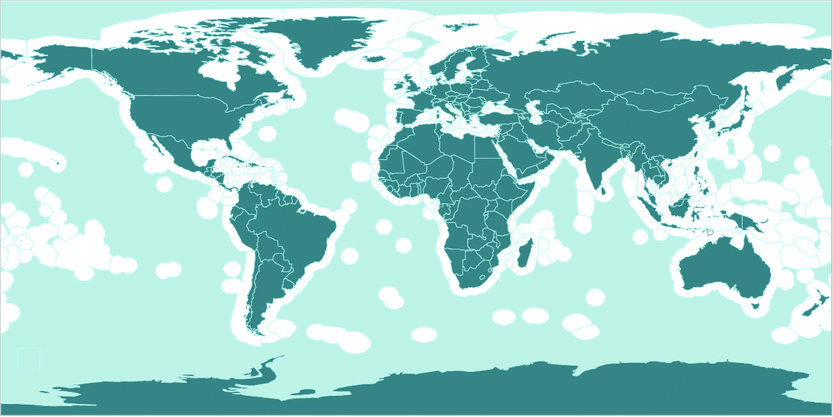
This map shows the High Seas shaded in light green. EEZs are shaded in white: Sumaila et al.
Overview of key High Seas Treaty provisions
The High Seas Treaty sets out a number of key principles and approaches to environmental protection, including:
The guiding principles also recognise the circumstances of small island developing States, least developed countries and landlocked developing countries.
The High Seas Treaty focusses on cooperation between State parties for the conservation and sustainable use of marine biological diversity in the High Seas. Cooperation is also underlined through capacity-building and development and transfer of marine science and marine technology.
The High Seas Treaty addresses marine genetic resources, including the fair and equitable sharing of benefits arising from activities with respect to marine genetic resources and digital sequence information in the High Seas.
The Conference of Parties to be established under the High Seas Treaty will make decisions on the establishment of area-based management tools including MPAs, and on emergency measures that may be applied where a natural or human-caused disaster has caused or is likely to cause serious or irreversible harm to marine biological diversity. This mechanism to establish MPAs in the high seas will assist in achieving the target set in the Global Biodiversity Framework agreed at the Biodiversity Convention COP15 to (among other things) protect and conserve 30% of marine ecosystems by 2030.
State parties must ensure that activities in the High Seas with more than minor or transitory environmental impact undergo screening and an EIA if required. Monitoring reports must be provided and made publicly available, and the Scientific and Technical Body established under the High Seas Treaty may make guidelines and standards relating to assessment and monitoring of impacts to the marine environment, including cumulative impacts.
Next steps for the High Seas Treaty and key takeaways
The agreement on the text of the High Seas Treaty marks a significant step towards safeguarding the health of the world's oceans, strengthening climate resilience, and ensuring the wellbeing and food security of billions of peoples.
The High Seas Treaty is the latest international instrument focused on safeguarding the environment and preserving biodiversity. Other recent initiatives include the Kunming-Montreal Global Biodiversity Framework and the proposed UN Treaty on Plastics Pollution.
Before the High Seas Treaty can enter into force, it needs to be formally adopted at a later UN session and ratified by at least 60 State parties.
An important implication of the High Seas Treaty for business will be the requirement imposed on States to ensure that the potential impacts on the marine environment from planned activities under their jurisdiction or control, which take place in the High Seas, are subject to an EIA process.
For more information, please contact Antony Crockett, Partner, Heidi Asten, Partner, or your usual Herbert Smith Freehills contact.
By Antony Crockett, Partner, Heidi Asten, Partner and Shaun Milligan, Solicitor.
The articles published on this website, current at the dates of publication set out above, are for reference purposes only. They do not constitute legal advice and should not be relied upon as such. Specific legal advice about your specific circumstances should always be sought separately before taking any action.