


Stay in the know
Receive timely insights and briefings from HSF Kramer, tailored to keep you informed and ahead
Subscribe now
While Japanese investors will likely continue to be actively involved in foreign investment, they face an increasingly uncertain international landscape. In January 2026, UN Trade & Development (UNCTAD) issued an investment update warning that "downside risks are mounting", with "geopolitical tensions, regional conflicts, and economic fragmentation trends… likely to depress project activity".
This article explains how Japanese investors can seek to protect their foreign investments in these turbulent times. By appropriately structuring their foreign investments, Japanese investors may be able to obtain protection under international agreements known as investment treaties. These can offer a range of safeguards against State interference with investments, together with a right to pursue international arbitration to resolve disputes.
Anecdotal evidence suggests that many Japanese investors are not obtaining the benefit of these safeguards that are routinely sought out by other international investors. For example, Japan remains severely under-represented as a claimant party nationality in investment treaty proceedings relative to its significant FDI outflows – with only a handful of Japanese investors having brought proceedings under investment treaties. While a cultural approach to dispute resolution that focuses on amicable resolution may go some way to explaining this, the authors' experience is that available protections are often overlooked, and investment structuring to gain such protections takes a back seat, when decisions around investments are made.
Against this backdrop, we consider three practical steps which Japanese investors can take to help maximise their ability to rely on potentially available investment treaty protections, namely:
Under a typical investment treaty, a State agrees to treat investments from qualifying investors of another State in line with various standards and guarantees, in exchange for its qualifying investors also receiving equivalent treatment. These standards and guarantees are usually defined broadly under international law.
Many investment treaties allow qualifying investors from one State (the Home State) to pursue international arbitration against the State hosting their investment (the Host State) if a dispute arises over the Host State's treatment of the investment. This can offer investors various advantages, including the right to have the dispute resolved before a neutral arbitration tribunal, and protection even without a specific contract with the Host State.
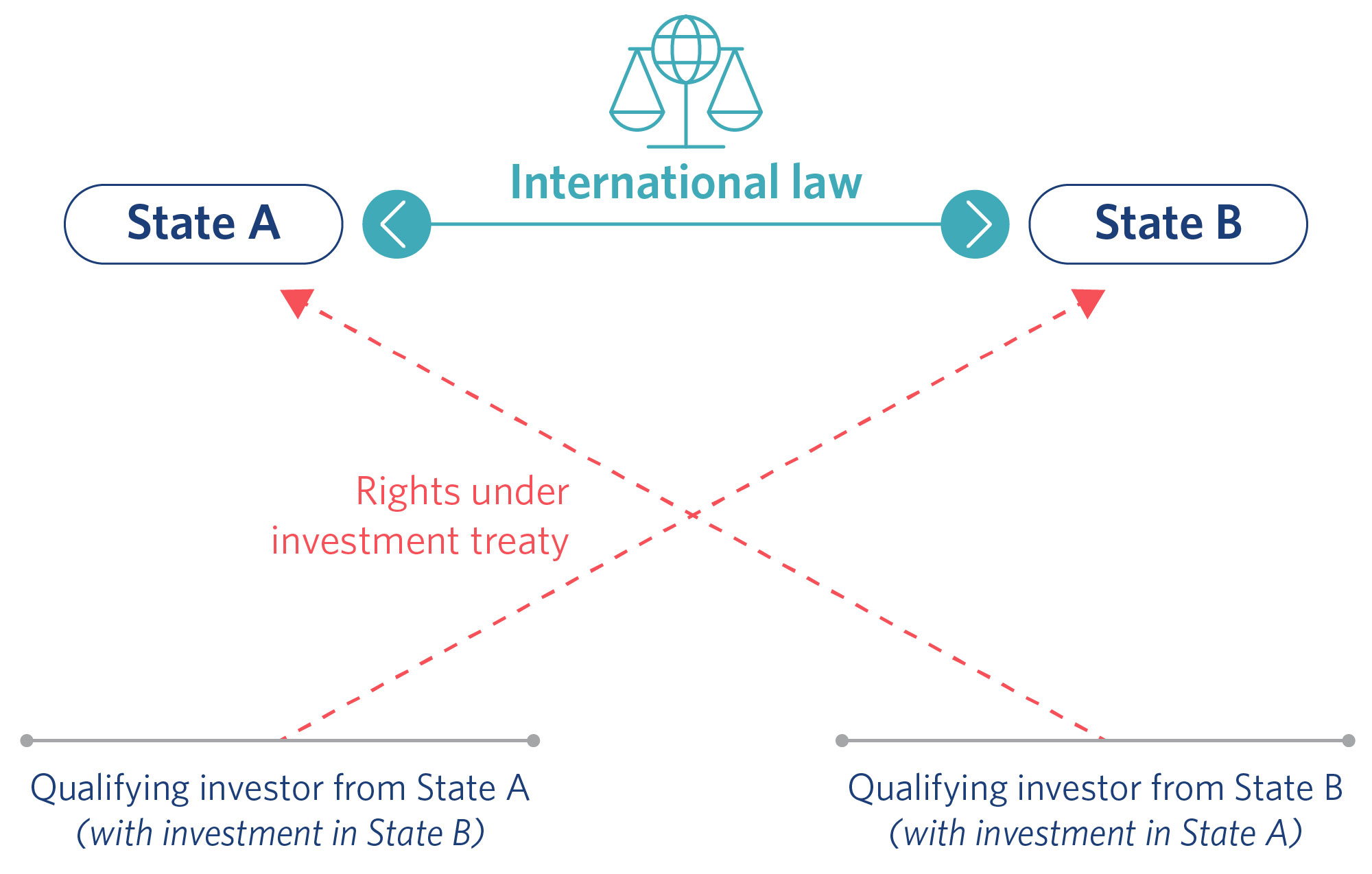
A typical bilateral investment treaty relationship
According to a database maintained by UNCTAD, Japan currently has 36 bilateral investment treaties in force with a range of other States. Japan is also party to a number of multilateral treaties containing investment provisions – including the ASEAN-Japan Comprehensive Economic Partnership Agreement (AJCEP), the Comprehensive and Progressive Agreement for Trans-Pacific Partnership (CPTPP) and the Energy Charter Treaty (ECT). This network of investment treaties can help guide investment planning and structuring decisions by Japanese investors, together with commercial, operational and other considerations.
But even where a Japanese business is considering making an investment in a Host State which does not have an investment treaty with Japan, it may still be possible to obtain treaty protection for the investment by structuring it through a subsidiary incorporated in a third State with an applicable treaty.
It is important to note that the availability and exact scope of protections will depend on, among other things, the precise language used in each investment treaty.
For example, investment treaties can require that investors meet certain requirements before they qualify for protection. These can include a requirement to show that the investment was made in compliance with the law of the Host State, and/or to demonstrate that they have substantial business activities in the Home State. Investment treaties can also include provisions which deny their benefits to investors in certain circumstances.
The dispute resolutions provisions in investment treaties can also vary, such as by requiring certain procedural steps to be followed before pursuing international arbitration. These steps can include the exhaustion of local remedies in the Host State, and/or the satisfaction of a "cooling off" period for negotiations to resolve the dispute.

An example investment structure for an investor with no direct BIT
It is important for Japanese investors to be aware of the common protections which may be available to them under applicable investment treaties. These can include:
It is true that many Japanese investors will want to seek an amicable resolution of their investment disputes and not invoke these protections in formal arbitration proceedings. However, the fact that an investment has been structured in a way that these protections are available and can be invoked if needed, may provide important leverage when negotiating with a Host State.
Proactive risk management is particularly important for Japanese investors due to the nature of the industries in which their investments are often made:
Given the risk of investment disputes in these and other industries, it will be important for Japanese investors to carry out advance planning for potential investment protection issues, including through careful investment structuring (above). Such advance planning may also involve other complementary actions, such as measures to promote supply chain resilience and integrity through risk-based due diligence, and obtaining appropriate insurance against political risks from bodies such as Nippon Export and Investment Insurance (NEXI).

The evolving risks faced by Japanese investors continue to highlight the necessity of effective investment protection strategies tailored to both commercial priorities and operational realities. If you would like further information on the issues discussed in this article, please do not hesitate to reach out. We should also be pleased to provide a copy of our Client Guide on Investment Protection and Investment Treaty Arbitration upon request.
The authors would like to thank Delara Zand for her assistance with this article.

Partner, Tokyo

Partner, Hong Kong

Senior Associate, Tokyo

Associate, London
The contents of this publication are for reference purposes only and may not be current as at the date of accessing this publication. They do not constitute legal advice and should not be relied upon as such. Specific legal advice about your specific circumstances should always be sought separately before taking any action based on this publication.
© Herbert Smith Freehills Kramer 2026
Receive timely insights and briefings from HSF Kramer, tailored to keep you informed and ahead