


Stay in the know
Receive timely insights and briefings from HSF Kramer, tailored to keep you informed and ahead
Subscribe now
Over the summer, we carried out a survey to assess current attitudes amongst governance professionals to an array of topical issues, covering corporate reporting, company administration, board governance arrangements and the pervasive topic of AI.
We are very grateful to those of you who took part in the survey and shared your views. Set out below is a summary of the responses we received, which we hope will be helpful as you navigate these issues in practice.
 Corporate reporting
Although the survey was carried out before the launch of the Government’s root and branch review of the UK’s corporate reporting regime, there were still a number of key reporting issues facing governance teams, in particular how to report on Provision 29 of the Governance Code.
Since the revised Code was published in January 2024, Provision 29 has been the change which has grabbed all the headlines and now companies are grappling with how to report on their implementation of this part of the Code.
We asked respondents:
The good news is that people do seem very prepared when it comes to reporting on Provision 29. Over 80% of respondents who answered this question said that they were very prepared and that significant work had been done.

The extra year which the Financial Reporting Council (FRC) factored in for the implementation of this part of the Code appears to have been well used.
The FRC in its Provision 29 Mythbuster stated that it had found the majority of companies had identified between 30 and 50 material controls. The results of our survey suggest that more companies have identified between 21 and 30 than between 41 and 50, but comfortably the highest number of respondents sit in the 31 to 40 range.
| Number of material controls | Number of responses |
|---|---|
| Less than 20 | 12.5% |
| Between 21 and 30 | 20% |
| Between 31 and 40 | 35% |
| Between 41 and 50 | 10% |
| Between 51 and 60 | 10% |
| 61 or more | 5% |
| Not applicable – we have not assessed our material controls | 7.5% |

Going hand in hand arguably with how prepared companies are feeling ahead of reporting on Provision 29 , the overwhelming majority of respondents have conducted, or are intending to conduct, a dry-run of their effectiveness review before year-end.

In terms of the length of disclosures, the views expressed in the survey again fit with the expectations of the FRC, which stated in its Mythbuster than it anticipated that reporting on Provisions 29 would be no longer than two pages.
For more commentary on Provision 29, see our article Is everything under control? Complying with Provision 29 in practice.
Fittingly, given where we are in the timing for the adoption of the new ISSB-aligned sustainability disclosure regime, levels of preparedness for the changes in reporting in this area lag behind where respondents are in relation to Provision 29.
Just under 70% of respondents observed that whilst work had started to reflect the transition to the new regime, this work was not yet significantly advanced. For those still at the start of their ISSB journey, the experience of Australian reporters, for whom the ISSB-aligned disclosures became mandatory in 2025, may be useful – see our article The starting gun has fired: Where next for ISSB reporting for further details.
While the general trend in corporate reporting developments as reflected in the Government’s recent consultation is to lessen the required disclosures, new requirements have been introduced in relation to payment practices. Asked about support for these new disclosures, equal numbers of respondents were not supportive of these changes as did not express a view either way. Only 24% of respondents were supportive.
This lack of enthusiasm is unsurprising given the general view of the current reporting burden, coupled with the views expressed on whether these new disclosures will drive the change in behaviour the Government wishes to see in relation to payment practices in the UK.
| Will the new disclosures drive the desired behavioural change | Percentage of responses |
|---|---|
| Yes | 9% |
| No | 58% |
| Don't know | 24% |
| No answer | 9% |
 Company administration
There have been a number of interesting developments in matters pertaining to company administration, which those involved in company secretarial functions will have been keeping a keen eye on. All of these developments have the potential to impact internal procedures for these teams.
Since October 2023, the Government has been rolling out the changes being introduced by the Economic Crime and Corporate Transparency Act (ECCTA) in a phased manner, aware that the ECCTA represents the most seismic change to the operations of Companies House since its creation in the 19th century. We asked respondents how they have found the implementation of the new requirements brought into force so far and from the responses received it seems so far, so good.


Virtual AGMs have been a topic for debate for a number of years, and the Government is seeking views on changes which could be made to the Companies Act 2006 as part of its Modernising Corporate Reporting consultation. Ahead of the consultation, the views expressed by respondents to our survey suggest a mixed picture when it comes to whether the proposed changes will be embraced. The majority (56%) were unlikely to hold virtual meetings. The marmite nature of this reform seems set to continue.

The changes made by the Financial Conduct Authority (FCA) to the notification requirements following a share buyback allow companies to consolidate their notifications of buybacks into a single notification to cover a seven day period. Are companies taking advantage of the opportunity to skip the next business day 7.30am notification deadline? Of those respondents who expressed a view on this point, only a very small handful (less than 7%) are planning to continue with the old approach and make their announcement by 7.30am on the business day following the day of purchase. A welcomed relaxation introduced by the FCA it seems!
The implementation of the plan to introduce fully digital share ownership was popular with our respondents, with almost 90% stating that they were either strongly supportive or somewhat supportive of the proposal. For more detail on the implementation of this proposal, read our article After the dinosaurs and the dodo, share certificates are about to become extinct: What dematerialisation means in practice.
 AI
AI seems to be the most hotly debated topic in every walk of society at the moment and so inevitably questions surrounding the approach adopted towards AI were a key part of our survey. Interestingly the use of AI and its penetration into company practices still seems relatively limited. Maybe it’s a case of all talk, not much action – but how long will that last?


Looking at how the company currently uses AI to support the board, a wide range of use cases were cited, with identifying previous relevant information provided to the board and preparing first drafts of board papers or of minutes being the three most common activities mentioned. Focusing specifically on directors, the most common activities for which they seek to use AI are summarising current board packs, identifying previous relevant information provided to the board and providing potential questions to ask at board meetings.
Given the relatively low levels of use within the company secretarial teams, it is interesting to examine the factors identified by the respondents as constraining that use currently and to explore where their aspirations to grow the use of AI lie. The three most frequently cited constraints were the quality and reliability of AI output; concerns about confidentiality and privilege; and lack of training to build capability. As for aspirations for growth, four areas stood out amongst those identified:
 Board governance arrangements
In the wake of concerns voiced about the growing expectations being placed on board members, in particular non-executive directors (for more on this, see our article Great(er) Expectations: Who would be a non-executive director of a UK plc?), we asked respondents for insights into their information arrangements ahead of board meetings. The responses give an indication of the level of information directors are expected to digest and the timescales for doing so.
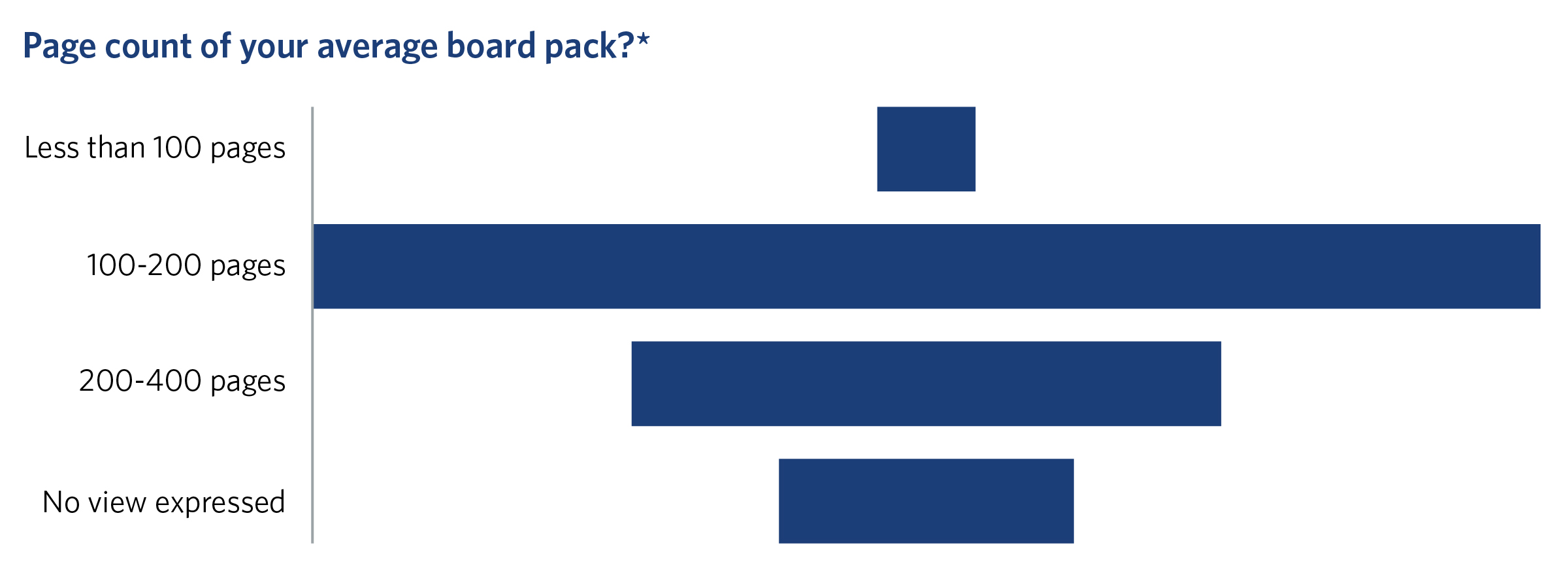
1. *Respondents were asked about board packs excluding committee packs and outside of the full-year or half-year results cycles.

The responses to the question on the number of papers included in the average board pack varied significantly, with some packs including 5 or fewer papers and others receiving in excess of 20. The bulk of the responses fell in the range of 8-12 papers, with 10 papers being the most common response.
 The Governance Code wishlist
One final question we asked respondents was if the FRC were to open the Governance Code up for consultation, which provision would they most like to see reformed. As respondents had a free choice for their response, unsurprisingly provisions across the Code were identified. Those who were raised by more than one respondent were:
Over half of the respondents did not identify any provisions for reform. Given all the reform and change facing governance professionals, maybe this is sign that one area of stability would be very welcome.
The survey was conducted between mid-July and mid-September 2026.

Partner, Head of Corporate Governance Advisory, UK, London

Knowledge Counsel, London

Senior Associate, London

Senior Associate, London
The contents of this publication are for reference purposes only and may not be current as at the date of accessing this publication. They do not constitute legal advice and should not be relied upon as such. Specific legal advice about your specific circumstances should always be sought separately before taking any action based on this publication.
© Herbert Smith Freehills Kramer 2026
Receive timely insights and briefings from HSF Kramer, tailored to keep you informed and ahead