Disputes arising from construction projects are commonly resolved by arbitration. According to HKA's CRUX Insight, principals and contractors claiming against each other for costs and losses associated with damage, defects and delays form a large proportion of the international caseload. However, there is often another avenue for recourse for damage and delays: insurance.  

When arbitrating construction claims, a complex interplay often arises between claims between principal and contractor, and claims with insurers. A principal who focuses on one to the exclusion of the other can inadvertently create a gap in recovery, leaving money 'on the table'. Unfortunately, this is a situation that arises all too often, particularly where the respective claims are handled by different teams within their organisation, without coordination. 

Developing a holistic recovery strategy, addressing claims against both the contractor and insurers, allows principals to assess the relative strengths and priority of the claims, make informed decisions when conducting both claims, and maximise overall recovery.

This article explores some of the key aspects of the interplay and the tensions that arise when a principal has both an insurance claim and a claim under the construction contract. While the principles discussed in this article are those found in common law, there may be similar principles in contracts subject to other systems of law. 

Overview of the parallel avenues for recovery 

In relation to claims against a contractor, most construction contracts incorporate various mechanisms that allow the principal to require the contractor to rectify quality or performance issues or pay for the rectification of the identified issue. For example, construction contracts often contain express defects liability periods within which a contractor is required to rectify defects, as well as express indemnities for the costs of repairing physical damage to the project. A principal may also be able to claim general damages for breach of contract, where such claims are not excluded by a 'sole remedy' regime.  For delay-related losses, construction contracts often provide a right to liquidated damages, being a specific (daily) amount to be paid by the contractor to the principal for delays to project completion.  

Insurance cover for damage and delay will typically be addressed by a 'Construction All Risks' (CAR) policy. A CAR policy provides cover for repairing damage to the project under construction. The policy may also include delay in start-up (DSU) cover for loss of revenue due to delays to project completion as a result of the insured damage. This policy will typically be taken out by the principal or head contractor but will name as insured others involved in the project such as contractors, subcontractors, suppliers, and financiers. For the purposes of the remaining sections of this article, we assume a scenario in which the policy is taken out by the principal.  

Although construction contracts and insurance provide separate avenues for recovery, neither should be considered in isolation of the other.  

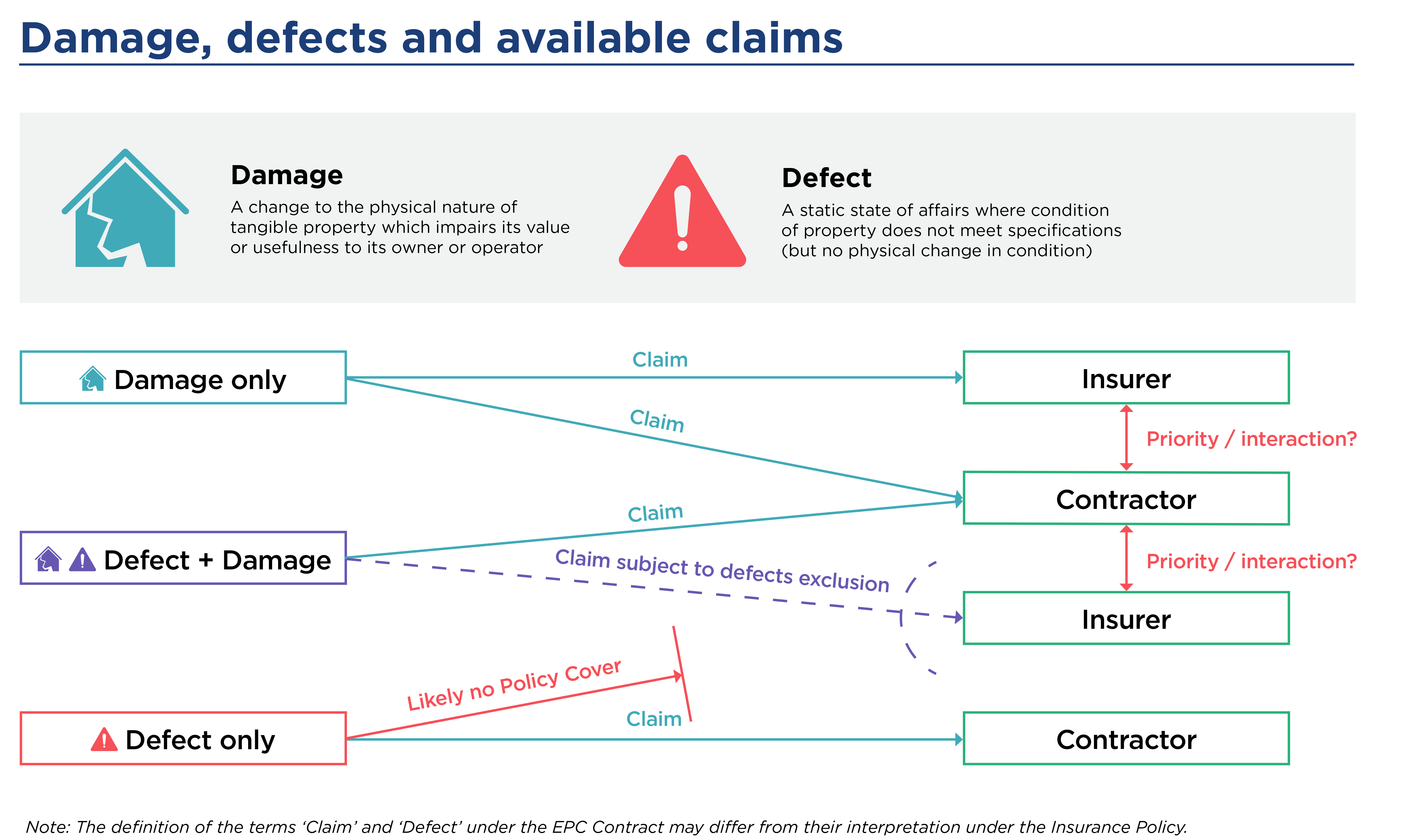
A critical difference between claims brought under a construction contract and insurance claims is the treatment of defects. A contractual claim against the contractor can cover both defects in their work and any damage caused by the defect. In contrast, the touchstone of CAR claims is that there has been damage, but specific exclusions apply in relation to defects.  

For CAR cover to be triggered, there must be damage to the insured property. Damage in this context is a "change to the physical nature of tangible property which impaired its value or usefulness" (Sky UK Ltd v Riverstone Managing Agency [2024] EWCA Civ 1567, [107]). A relevant change in nature can range from patent, catastrophic damage to microscopic changes invisible to the naked eye. In contrast, a defect is a static state of affairs where the condition of property does not meet specifications. This means there can be both a defect and damage and still be cover, but without damage there will be no cover.  

Where both a defect and damage are present, the insurance claim will normally be subject to clauses expressly addressing the extent of cover for defects. The 'LEG' clauses are a series of standard defects clauses commonly used in CAR policies. They provide a range of options that can be included in the policy which differ in the precise exclusions they impose: 

  • LEG1 excludes damage due to defects. This is the broadest of the exclusions contained in the three clauses; 
  • LEG2 excludes costs which would have been incurred had the defect been rectified immediately prior to the damage occurring; and 
  • LEG3 excludes costs incurred to improve the original design or workmanship. 

When considering contractor and insurer claims together, there is a tension for the principal in advocating its position. On the one hand, the principal may seek to emphasise damage in its insurance claim, while the insurer will focus on the defect (to minimise cover). On the other hand, the focus of the principal's claim against the contractor will be on proving that the contractor's work is defective, having failed to meet the required standards, and the principal has therefore suffered loss due to the contractor's defective work.  

A principal who makes detailed arguments that a contractor's work is defective may find itself having those same arguments used against it by the insurer to minimise the insurance claim. Further, a principal who settles its claim against the contractor, and then seeks to recover further from an insurer, might find itself lacking sufficient information about the alleged defects, having lost the opportunity to obtain information from the now disinterested contractor.  

Another key interplay is between the insurer's rights of subrogation and rights to recoveries.  

Once an insurer has paid a claim, it commonly has a right to subrogate, i.e. to step into the shoes of the insured and exercise the insured's rights of recovery against third parties. Similarly, if the insured makes a recovery from a third party, the insurer may be entitled to some of those recoveries to reduce its exposure to the insurance claim. While both rights exist at law, they can be modified by express wording in the insurance policy.  

For example, it is not unusual for an insurer to expressly waive rights of subrogation against other insureds. Further, some policies may specify a particular priority for the application of recoveries, specifying that recoveries reduce either the insured or insurer's exposure first (which is a modification of the usual recovery waterfall of uninsured losses first, then making whole the insurer, and last the deductible). This is particularly the case in relation to DSU cover which, under some policies, will be reduced by reference to the amount of liquidated damages recovered from the contractor.  

In pursuing a claim against the contractor, it is therefore important to understand the scope of, and not to prejudice, the insurer's recovery and/or subrogation rights, to avoid adversely impacting the insurance claim.

There is also an interplay between terms of the underlying construction contract requiring the principal to obtain CAR insurance for the contractor, and the policy taken out.  

First, where the construction contract requires that a party be insured, the question arises as to whether the principal and contractor intended to create an insurance fund which would be the sole avenue for making good the relevant damage, or whether that fund was intended to co-exist with an independent right of action against the contractor (see eg, FM Conway Ltd v The Rugby Football Union [2023] EWCA Civ 418, [49]). If, reading the various provisions of the contract as a whole, an arbitrator considers that the parties intended the insurance to be the sole avenue for redress, then the contractor may have a defence against liability to the principal.  

Second, the construction contract can affect the contractor's rights under the policy. If the policy was taken out by the principal, with the contractor as a named insured, the contractor will only be entitled to cover to the extent that the principal intended and was authorised to take out cover for the insured. In most cases the best evidence of that intention and authorisation will be the construction contract (though this may not always provide a complete answer) (FM Conway Ltd v The Rugby Football Union [2023] EWCA Civ 418, [53]).  

An arbitral tribunal will need to analyse the underlying provisions of the construction contract allocating risk between the principal and the contractor to determine any limits in the scope of what insurance was intended and/or authorised to cover. The existence of any limitations can result in the contractor having less cover than may otherwise be assumed on the face of the policy.  

While this does not prevent the principal from claiming under its insurance, it may prevent the contractor from being able to claim against the insurer. It may also mean that the insurer is able to subrogate against the contractor once it has paid the principal.  

Tensions can also arise in relation to dispute resolution mechanisms. International construction contracts are often subject to arbitration, and it is not uncommon for the policy to also be subject to arbitration.  

Where this occurs, there is a risk that the principal will need to conduct multiple separate proceedings against the contractor and against the insurer. While there can be advantages to keeping the proceedings separate, there can also be advantages to consolidating them into one proceeding (the most obvious of which is cost). However, it is not always straightforward to consolidate proceedings, particularly in the (very common) situation where the arbitration clauses do not align, including for example where they specify different arbitration rules. While some arbitration rules allow consolidation, a principal will generally only be able to consolidate proceedings if all parties agree to do so (which is unlikely in the case of contentious claims that have evolved into arbitration).  

Another practical risk is that the outcome of one arbitration will not be binding on the other. In the worst case, the principal may find itself involved in a lengthy arbitration with its contractor, only to then have to commence an equally lengthy arbitration on similar issues with its insurer.  

Managing the Interplays 

Managing these interplays to maximise recoveries is therefore critical. Importantly, principals need to progress claims – whether under the construction contract or insurance – based on a holistic strategy incorporating both: 

  • expert advice on the nature and cause of defects and damage affecting the property; and 
  • legal advice on the relative strengths of, and interaction between, the two avenues for recovery.  

Each claim can then proceed in parallel and in a way which avoids needlessly prejudicing the other. Ideally, the principal can leverage the contractor's interest in arguing against there being defects to reinforce the principal's position in the insurance claim (and do the same in reverse). This can often lead to an overall settlement with all parties.  

Absent any agreement, proceedings against the contractor and the insurer may be necessary. In practice, many developed international arbitration rules are well-equipped to manage this situation and the related interplays. For example, through a case management stay of one set of proceedings over another, or through coordinated proceedings where a common tribunal can determine both proceedings. However, a principal may ultimately need to prioritise one avenue of recourse over another. This decision will normally be based on an assessment of the strength of evidence, the likelihood of financial recovery and other commercial factors.  

Another key practical takeaway is that when a construction dispute involving some form of physical damage arises, it is important for both principals and contractors to seek the expertise not only of their legal teams in managing arbitrations, but also of their insurance team in managing insurance claims. This approach ensures that a fully integrated recovery strategy is formulated that effectively harnesses the relevant internal experience and expertise.  


Key contacts

Daniel Waldek photo

Daniel Waldek

Partner, Singapore and Vietnam Group

Nick Oury photo

Nick Oury

Partner, Head of Construction Disputes, Middle East, Dubai and Africa Group

Travis Gooding photo

Travis Gooding

Senior Associate, Sydney

Stay in the know

We’ll send you the latest insights and briefings tailored to your needs

Subscribe now
Washington, DC New York Silicon Valley Americas International arbitration Construction and infrastructure disputes Insurance Infrastructure Daniel Waldek Alexander Oddy Nick Oury Travis Gooding