


Stay in the know
Receive timely insights and briefings from HSF Kramer, tailored to keep you informed and ahead
Subscribe now
Historically, the drafting of an arbitration clause was an exercise which traded in identifiable, widely held views about neutral or 'safe' options. Commercial parties, whether from New York, Beijing, or Riyadh, would routinely agree to a 'neutral' seat like London, Paris, or Geneva, confident that the legal ecosystem would insulate their dispute from political influences. These seats earned this status through arbitration-friendly laws, a deep pool of experienced practitioners, and courts with a strong track record of impartial support for arbitral proceedings.
However, today’s geopolitical climate is testing this assumption of neutrality. As we move through 2026, rising nationalist sentiment, shifting alliances, and international sanctions are increasingly influencing how parties perceive different arbitration seats, institutions, and even arbitrators themselves.
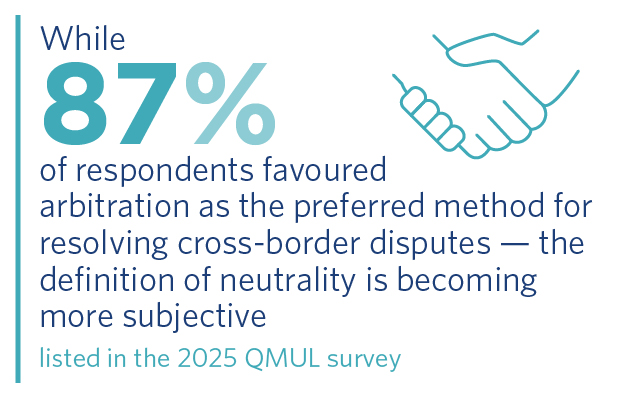
While arbitration remains the preferred method for resolving cross-border disputes, favoured by 87% of respondents in the 2025 Queen Mary University of London (QMUL) survey, the definition of neutrality is becoming more subjective. This does not mean that international arbitration has lost its neutrality in reality, by and large it remains a system insulated from politics, but perceptions matter. In-house counsel and practitioners are now attuned to how geopolitical factors might colour the arbitration process, and they are adapting their strategies accordingly.
This article examines how geopolitics is reshaping decisions on seat selection, choice of arbitral institution, and arbitrator appointments, differentiating tangible risks from mere issues of perception.
Over the past decades, parties from all over the world could easily agree on a shortlist of 'neutral' seats: typically established venues in Europe or North America, such as London, Paris, Geneva, and New York. These were places seen as politically stable, legally reliable, and not inherently biased to either side of an international contract. An Asian and a US party, for example, might both accept London or Paris as a neutral middle-ground.
Global shifts in economic power and politics have gradually eroded this automatic consensus. As investment flows have globalised, we have seen the rise of new economic hubs, particularly in Asia and the Middle East, and with them, the rise of new arbitration centres. Singapore and Hong Kong have cemented their positions as top-tier seats, ranking in the top five across all global regions. For parties navigating the US–China rivalry, these jurisdictions offer sophisticated legal infrastructure combined with geographic and, often, economic proximity to the transaction.
We have also seen a concerted effort to 'onshore' disputes in the Middle East. Parties transacting in Saudi Arabia and the UAE are now less likely to bring their disputes to London or Paris, in particular where state or state-owned entities are involved. With the modernised rules of the Saudi Centre for Commercial Arbitration (SCCA) and Dubai International Arbitration Centre (DIAC), as well as the launch of arbitrateAD in Abu Dhabi, these jurisdictions are positioning themselves as neutral regional hubs with sophisticated and efficient institutions. The message to investors is clear: you no longer need to leave the region to find a reliable, UNCITRAL Model Law-based legal framework for dispute resolution.
Geopolitical fragmentation is accelerating this trend toward regional hubs. Emerging hubs range from Madrid to Johannesburg, Seoul, Nairobi, São Paulo and Astana, with their rise driven by modernised arbitration laws, strengthened institutions and a growing preference for neutral yet regionally familiar venues.
The choice of arbitral institution can be just as crucial as the choice of seat. Institutions like the ICC in Paris, LCIA in London and the AAA/ICDR in New York operate independently of any single national government. In recent years, however, we have seen a proliferation of newer institutions, many of them state-backed or state-established. Examples include the China International Economic and Trade Arbitration Commission (CIETAC) in China, the Asian International Arbitration Centre (AIAC) in Malaysia, and others set up as part of national strategies to attract dispute resolution business.
These state-related institutions present a dilemma of perception. On the one hand, they often adopt international-standard rules and are staffed by experienced professionals. They may also have advisory boards with respected foreign practitioners to bolster credibility. On the other hand, foreign investors may worry whether a state-backed institution can truly act independently of its government’s interests if those interests are implicated in a dispute – especially for disputes involving state-owned enterprises or sensitive sectors.
Recent history shows why these perceptions exist. For instance, a few years ago, the then-director of the AIAC was embroiled in a controversy involving the Malaysian government, which raised questions about the centre’s independence. In Russia, after a sweeping 2016 reform eliminated 'pocket' arbitration courts, only government-approved arbitration institutions are allowed to operate. While that reform aimed to improve quality, it also meant foreign arbitral institutions need approval to handle Russia-related cases, injecting a sovereign gatekeeping element. As a result, some parties also opt for a safer (from their perspective) institution, as a neutral seat on its own may not be sufficient.
Another alternative is ad hoc arbitration, conducted without any institutional umbrella (often under the UNCITRAL Rules). Ad hoc arbitration frees the parties from any concerns about an administering institution’s affiliations. However, it places more responsibility on the parties and arbitrators to manage the process, and a supportive court at the seat may still be required to determine interim measures applications for example. Ad hoc arbitration is common in certain contexts (for example, many investment treaty arbitrations are essentially conducted ad hoc under the UNCITRAL Rules), but in commercial disputes, parties tend to prefer the convenience and predictability provided by institutions. Consequently, ad hoc arbitration is not necessarily an effective solution to geopolitical concerns. Instead, the trend is to find an institution that is both neutral and trusted by all sides.
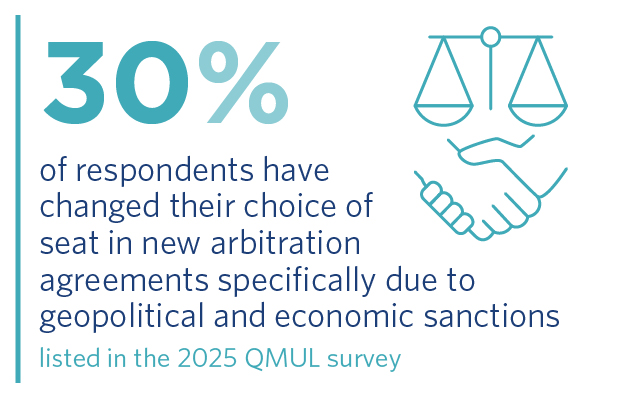
A key question is whether geopolitical concerns are truly changing behaviour, or if they are just talking points. Interestingly, the 2025 QMUL survey reveals that 30% of respondents have changed their choice of seat in new arbitration agreements specifically due to geopolitical and economic sanctions. This is a notable shift from just a few years prior, when such factors barely registered in surveys as reasons for seat selection.
The most acute manifestation of the implications of sanctions is Russia’s Lugovoy Law (Articles 248.1 and 248.2 of the Arbitrazh Procedure Code). This law allows Russian courts to claim exclusive jurisdiction over disputes involving sanctioned Russian parties, even if a valid arbitration clause exists, on the premise that sanctions impede access to justice abroad. This is not a matter of party choice; it is a statutory override that can force a foreign counterparty into Russian courts.
This has led to a pattern of 'duelling injunctions' – while a Russian party may obtain an anti-suit injunction in Russia to stop foreign arbitration, in response, English courts have issued anti-enforcement injunctions to prevent the Russian party from enforcing those Russian court judgments abroad. Furthermore, the enforcement of awards against sanctioned entities is becoming a highly technical exercise in asset mapping. As seen in the Naftogaz v Gazprom saga, enforcing an award requires navigating sovereign immunity defences by targeting commercial (rather than diplomatic) assets and securing specific licenses (eg, from OFSI in the UK) to legally process payments.
Sanctions regimes have also had a more direct impact on arbitration logistics, including constraining the payment of arbitration fees or the hiring of lawyers (who might need special permission to act by reason of their nationality). Banks might block transactions related to the case. Arbitrators and institutions may worry about violating sanctions inadvertently. These hurdles can make certain seats or institutions impractical (although leading arbitral institutions have developed protocols for dealing with sanctioned parties). For example, a sanctioned Russian company might find it almost impossible to post security or pay a London-seated tribunal, whereas arbitrating in a jurisdiction not subject to those sanctions might enable a smoother experience.
Just how far-reaching the impact of sanctions can be is illustrated by a February 2026 decision of the Singaporean High Court. The court upheld an arbitral tribunal's decision to terminate an arbitration because the claimant was unable to pay the tribunal fees or comply with a security for costs order due to sanctions. As there was no sign that the sanctions would be lifted in the near future, the continuation of the proceedings became 'impossible' within the meaning of the UNCITRAL Model Law, and the court found that the tribunal was correct – and even required – to terminate the proceedings. In that particular case, the claimant's claim for a nine-figure sum was dismissed even though the claimant would be time-barred from bringing a new claim if sanctions were to be lifted in the future.
Sanctions have also provided grounds (or pretexts) for court intervention in certain countries. There have been cases of Russian courts issuing anti-suit or anti-arbitration injunctions to stop arbitrations seated abroad, on the basis that the foreign venue is 'unfriendly' or that the dispute should be heard in Russia due to sanctions. While such orders have no legal force outside Russia, they complicate matters – an arbitral tribunal might proceed regardless, but enforcement of its award in Russia (or perhaps other aligned jurisdictions) could be thwarted. Commercial parties will ask themselves: will the courts at our chosen seat, or in any country where we may need to enforce the award, be influenced by their government’s foreign policy stance? The answer may well be 'no' as most courts consider questions purely from a legal perspective – but optics and perception of risk are increasingly a factor.
In a world ever more defined by US-China strategic competition and by the conflicts in the Middle East and Ukraine, parties may prefer to avoid their counterparty's 'home courts' in an arbitration context too. Questions have been raised – perhaps unfairly – about whether New York or Washington D.C. can be viewed as apolitical seats given the polarisation in US politics in recent years. Similarly, Western parties might shy away from seats in Mainland China or Russia. Even historically neutral venues like London and Hong Kong are being scrutinised through a new lens. While arbitral courts in those cities remain impartial, perception can trump nuance (or facts) when parties negotiate a dispute resolution clause.
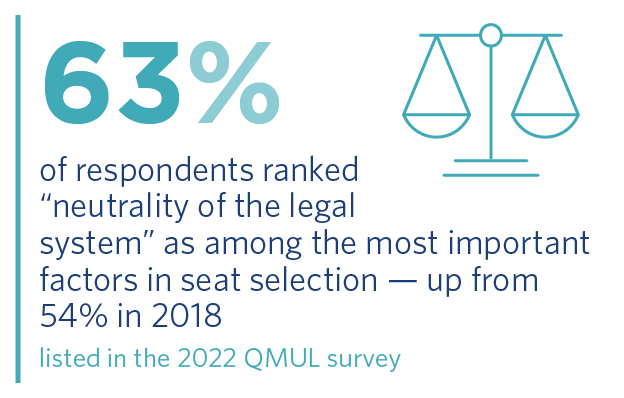
That said, geopolitical factors are one factor among many, and often not the decisive one. The same surveys show that the fundamental criteria for choosing a seat remain neutrality, a reliable legal framework, and strong courts. In the 2022 QMUL survey (which focused specifically on energy disputes worldwide), 63% of respondents ranked “neutrality of the legal system” as among the most important factors in seat selection – up from 54% in 2018.
Geopolitics does feed into that neutrality concern, as parties interpret “neutral legal system” in light of world events. However, considerations such as the quality of a jurisdiction’s national arbitration law, the track record of its courts in supporting arbitration, and the availability of good local counsel still carry greater weight in the long run than transient political issues. In other words, a country will not lose its status as a safe arbitral seat overnight because of a political incident or the imposition of sanctions related to an international conflict – but if parties perceive a pattern that could affect the fairness or legal certainty of arbitrating there, they will adjust.
Perhaps the most concerning trend is the intrusion of politics into the assessment of an arbitrator’s neutrality. Arbitrators can be challenged if there are legitimate doubts as to their impartiality. In investment treaty cases, arbitrators of the same nationality as the state party are usually disallowed. However, recent jurisprudence in Russia has introduced a "presumption of bias" based solely on nationality. In the 2024 Thywissen ruling, the Russian Supreme Court refused to enforce an award on the basis that the tribunal included nationals from "unfriendly" states (Ukraine, the UK, and Denmark). The court presumed that these arbitrators lacked impartiality due to their countries' sanctions regimes—a stance that contradicts the global consensus that an arbitrator is a private individual, not a state representative.
This is of course an outlier and does not represent a collapse of the international consensus. Major institutions continue to appoint arbitrators based on their qualifications and experience. The 2024 IBA Guidelines on Conflicts of Interest reinforce this by requiring "reasonable enquiries" into conflicts but do not endorse blanket bans based on nationality (General Standard 7). For counsel, the takeaway is a practical one: when drafting clauses involving jurisdictions with high geopolitical sensitivity, the safest approach may be to include explicit provisions regarding arbitrator nationality in order to future-proof the award.
The era of the default arbitration clause is over. While the fundamental machinery of international arbitration remains sound, and indeed indispensable, it is now operating within a fragmented geopolitical matrix. Choosing the seat of arbitration, the governing institution, and even the individuals who will hear the case has become a more strategic exercise in light of geopolitical shake-ups. International arbitration has always been lauded for providing a neutral playing field for resolving disputes involving global businesses. That neutrality is still intact, but it requires conscious maintenance. By making informed choices about seats, institutions, and arbitrators, and by acknowledging and addressing the perceptions around them, parties can ensure that, even in a fractured world, their disputes will be heard and resolved on the merits, free from outside interference.
The authors would like to thank Xani Lawrence for his assistance in preparing this article.

Partner, Head of Disputes, Middle East, Dubai

Partner, Head of Energy Sector, London

Senior Associate, London

Knowledge Counsel, London
The contents of this publication are for reference purposes only and may not be current as at the date of accessing this publication. They do not constitute legal advice and should not be relied upon as such. Specific legal advice about your specific circumstances should always be sought separately before taking any action based on this publication.
© Herbert Smith Freehills Kramer 2026
Receive timely insights and briefings from HSF Kramer, tailored to keep you informed and ahead