


Transactions
The value of everything
View our insights
South Korea entered 2025 amid significant political turbulence following the attempted declaration of martial law in December 2024 – an unprecedented episode that unsettled both domestic and international observers. Although institutional stability was ultimately preserved, the episode exacerbated an already challenging macroeconomic environment characterised by persistent inflationary pressure, currency weakness, and heightened global trade tensions, particularly involving the United States.
Beyond short-term volatility, South Korea continues to face deep-rooted structural challenges: demographic decline, labour market rigidity and rising social expenditure are increasingly weighing on long-term growth prospects. At the same time, Korean corporates are under mounting pressure to accelerate strategic transformation, optimise balance sheets and preserve long-term competitiveness in an increasingly fragmented global economy.
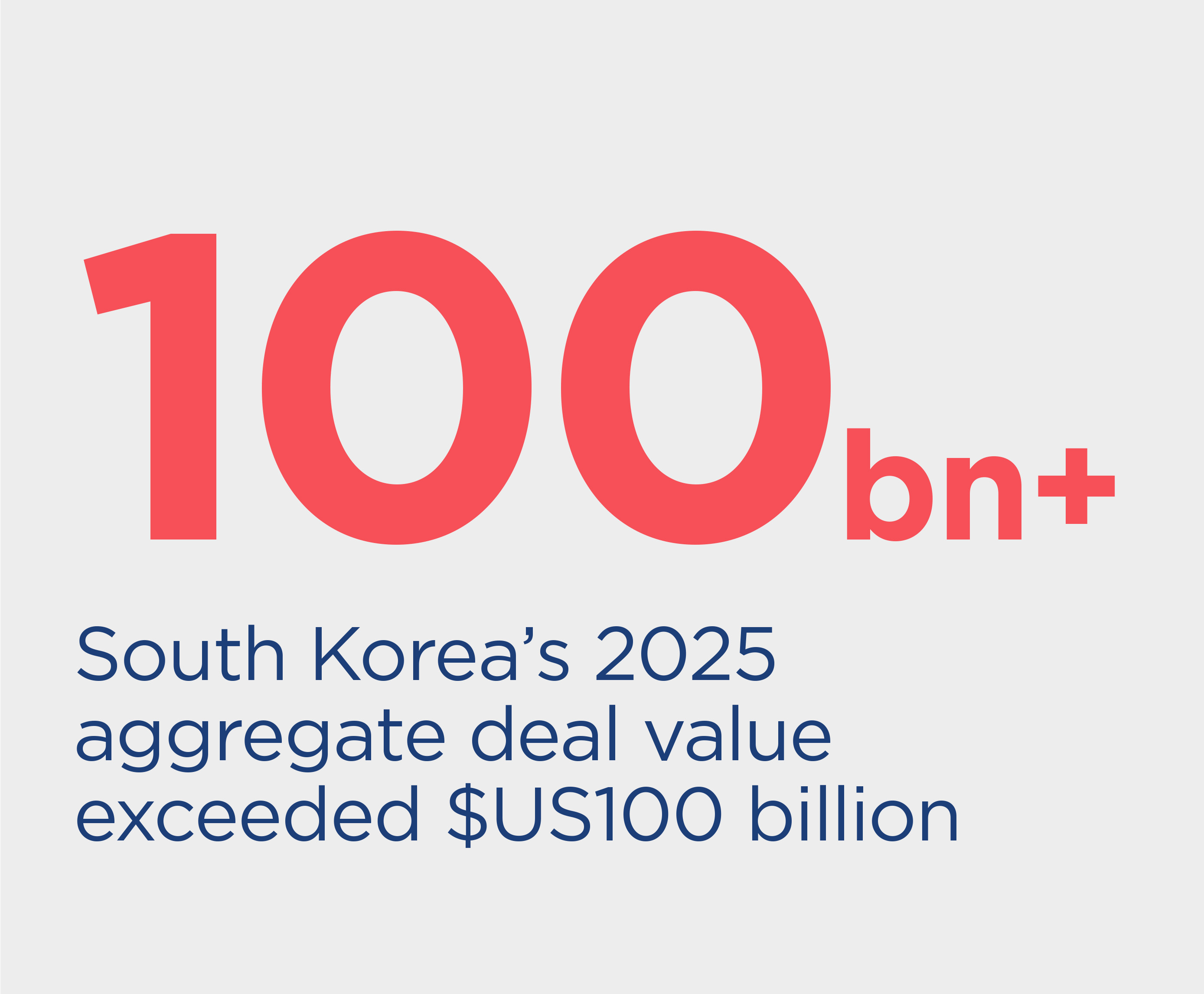
South Korea's M&A market demonstrated notable resilience in 2025 despite political turbulence and macroeconomic headwinds. While overall transaction volumes declined slightly across domestic, inbound and outbound segments, aggregate deal value surged to over US$100 billion, its highest level since the record year of 2021. This compares with US$70 billion in 2024 and US$65 billion in 2023, positioning South Korea among the Asia-Pacific's top four M&A markets - alongside Mainland China, Japan, and India – and accounting for nearly 15% of the total regional deal value.
This performance was underpinned by sustained interest from domestic conglomerates (Chaebols), financial sponsors and foreign investors seeking exposure to high-quality assets in financial services, technology, industrials, healthcare and energy-related sectors. The continued weakness of the Korean Won further enhanced inbound deal attractiveness, while leading Chaebols pursued targeted overseas acquisitions and strategic portfolio optimisation initiatives.
The surge in deal value was driven by a pronounced rebound in large-cap transactions. In 2025, 15 transactions exceeding US$1 billion were announced, exceeding the previous peak recorded in 2021. Their combined value reached approximately US$46 billion – around US$12 billion higher than in 2021, compared with US$16 billion in 2024 and US$12 billion in 2023.
Notable transactions included Naver Financials' US$10 billion acquisition of Dunamu, the operator of crypto exchange Upbit, structured as a share swap; Samsung Biologics’ US$7.6 billion spinoff of its drug development businesses; and Air Liquide’s US$3.3 billion (enterprise value) acquisition of DIG Airgas from Macquarie, representing the largest inbound transaction of the year.
Beyond these large-cap transactions, mid-cap deals and carve-outs continued to attract strong competition, reflecting a market increasingly focused on strategic repositioning, capital discipline and portfolio rationalisation rather than purely expansionary growth.
Private equity sponsors – both domestic and international – remained central to deal activity. Supported by significant dry powder and a more disciplined approach to valuation, they concentrated on platform investments, bolt-on acquisitions, and take-private transactions, frequently partnering with strategic investors to manage risk and execution complexity. This activity unfolded against the backdrop of a slowdown in private‑equity exits, with sponsors managing an expanding backlog of ageing portfolio companies – prompting greater reliance on continuation funds, secondary processes and other alternative exit routes until IPO conditions improve.
At the same time, the acceleration of AI technologies is reshaping corporate strategy, creating both disruption risk and new M&A opportunities as acquirers reassess business models, seek capability‑driven assets and position themselves for the next wave of innovation.
The appetite for external growth is expected to remain present in 2026, albeit in a more selective and strategic manner. Chaebols are likely to continue pursuing acquisitions in AI, semiconductor design and software – particularly outside Korea – while simultaneously conducting strategic portfolio reviews and divesting non-core assets. South Korea's growing global cultural influence is also expected to reinforce its soft power, encouraging foreign investors to deepen their interest in local companies.
Nevertheless, several factors warrant close monitoring. Domestic political stability and inter-Korean relations will remain critical, particularly against the backdrop of heightened geopolitical tensions involving China, Japan, Taiwan, and the United States. Macroeconomic fundamentals – including inflation trends, currency volatility, domestic consumption, and innovation capacity – will continue to shape M&A dynamics. Broader societal challenges, such as declining birth rates, an ageing population and evolving attitudes towards work, are also likely to influence deal activity over the medium term.
The most significant potential headwind, however, may arise from regulatory change. South Korea is preparing one of the most substantial capital market reform packages in decades, aimed at revising regulations for fair valuation rules in listed company M&A and strengthening disclosure requirements for listed companies, alongside expanding the taxation of treasury-share buybacks. While these reforms are widely expected to enhance market fairness and transparency, they may also dampen M&A activity in the near term by increasing execution risk and regulatory scrutiny.
Click below to read our Asia chapter.
The value of everything
The contents of this publication are for reference purposes only and may not be current as at the date of accessing this publication. They do not constitute legal advice and should not be relied upon as such. Specific legal advice about your specific circumstances should always be sought separately before taking any action based on this publication.
© Herbert Smith Freehills Kramer 2026
Receive timely insights and briefings from HSF Kramer, tailored to keep you informed and ahead