


Download Alumni Matters 2025
Get your copy now
Download PDF (8MB)
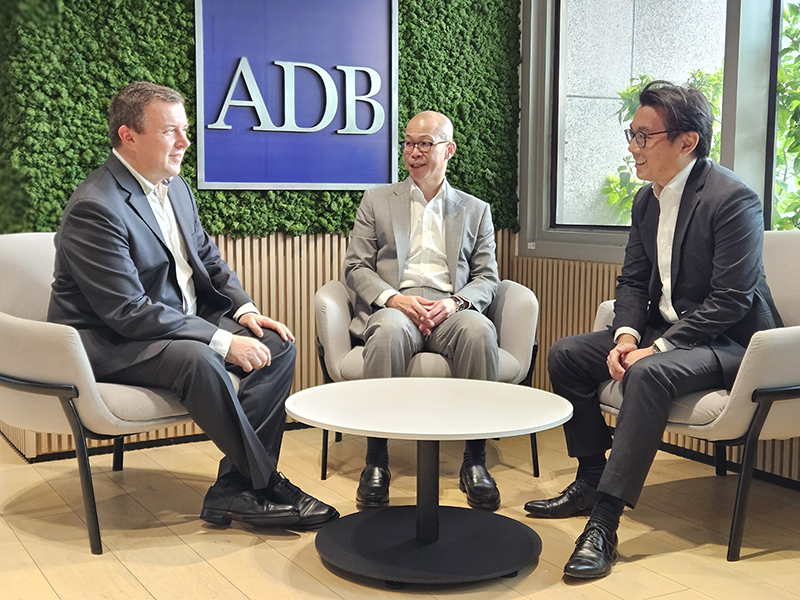
Maybe that is not so surprising when considering the motivations of all three of them – Cheong-Ann Png, Nigel Chin and Andy Bennett – to work for an international financial institution that is truly making a difference to the lives of people that it serves in the Asia-Pacific region.
For those not familiar with Asian Development Bank (ADB), it was founded in 1966, with headquarters in Metro Manila in the Philippines, and is a regional multilateral development bank (MDB) owned by its 69 member countries, 50 of which are from the Asia-Pacific region. At that time, most of the economies in the region were either relatively poor or underdeveloped. Nearly 60 years later, ADB has gone a long way towards achieving its strategic development objectives, working with its members and partners, even though the region still faces many challenges.
Currently, ADB supports operations in its 42 developing member countries (DMCs) that create economic and development impact, delivered through both public and private sector operations, advisory services and knowledge support. While a significant portion of ADB’s loans and grants support infrastructure development across key sectors, such as transport, energy and health, it also finances critical government reform programmes. ADB committed US$24.3 billion from its own resources in 2024, coupled with mobilising US$14.9 billion in cofinancing in collaboration with its partners.
Cheong-Ann, Nigel and Andy all came to the bank via different routes. Originally from Singapore, Cheong-Ann, who was with Herbert Smith (as was) in London between 2000 and 2003, had been working for the International Monetary Fund in Washington DC before joining ADB in 2007. Since 2018, he has been an assistant general counsel leading the sovereign operations team covering, at various times, Central Asia, East Asia, Southeast Asia, Afghanistan, Pakistan and the Caucus region.
Nigel, originally from New Zealand, was with Herbert Smith (as was) in Singapore for seven years between 2005 and 2012, before moving to a US law firm and then to ADB in 2017. He was familiar with ADB as it was a key client of his mentor, retired Herbert Smith partner, Michelle Chen – and ADB remains a client of the firm to this day. By contrast with Cheong-Ann and Andy, Nigel is a principal counsel supporting the private sector operations of the bank, which provides financing to private and state-owned entities across diverse industries and sectors in the region to promote sustainable and inclusive economic growth.

Given the nature of private sector operations, Nigel has cause to instruct Herbert Smith Freehills Kramer from time to time and, it almost goes without saying, is very happy with the service the firm delivers.
Having trained to be a scientist (he has a D.Phil in genetics and molecular epidemiology), Andy, originally from the UK, thought he would finish up as an intellectual property lawyer. Training (from 2006) and qualifying with Herbert Smith (as was), he went on secondment to the Singapore office (where he met Nigel) and remained there until moving to join ADB in 2019. He is now a principal counsel, and, like Cheong-Ann, supports sovereign operations but in the South Asia and Pacific regions.
All three enjoy and take great satisfaction from being in-house counsel for a major MDB with a different set of priorities and challenges. Specifically, financing operations in an international law and development environment requires a different set of considerations that build in a greater range of requirements and risks, not to mention the challenges of working with governments and bilateral and multilateral partners.
As Cheong-Ann explains, “You apply the basic skills that you picked up as a commercial lawyer: legal analysis, drafting, communication, and so on. All these continue to be very important. At the same time, the challenges with working on ADB financings are multifaceted given the varying country contexts and range of stakeholders involved.”
At the same time, the ADB legal team plays an important role in strategic corporate initiatives. An example was the groundbreaking financial restructuring to combine the lending operations of the bank’s Asian Development Fund with its ordinary capital resources that was approved by its Board of Governors in 2015. The merger boosted ADB’s total annual lending from US$13 billion to US$18 billion. During the pandemic, ADB approved a US$13 billion package in support of government countercyclical expenditures, and a US$9 billion new facility for vaccine financing, in 2020.
Andy Bennett
Alumnus of Singapore office, 2006-2019
They also use their imagination to help with increasingly innovative products. One such product is the Innovative Finance Facility for Climate in Asia and the Pacific (IF-CAP), which was launched in 2023. IF-CAP is a leveraged guarantee facility for climate finance that enables ADB to use the guarantees it receives from its partners, Denmark, Japan, Korea, Sweden, the UK and the US, to leverage ADB’s balance sheet to expand lending to climate-related projects in its DMCs by a factor of US$4.5 for every US$1 of guarantee. It was the first of its kind guarantee facility ever undertaken by a MDB and was an initiative on which Nigel had the privilege of working. Nigel comments, “The IF-CAP guarantees to date should enable ADB to unlock an additional $11 billion in climate financing. Working at ADB and having the opportunity to contribute in a significant way to such impactful projects is incredibly rewarding.”
Andy, too, has been working on some groundbreaking projects. He mentions the full mutual reliance framework (FMRF), which brought together the ADB and the World Bank. Typically, when cofinancing a project, each institution would apply its own operational policies that borrowers have to abide by, for example on environmental and social safeguards, anticorruption and integrity, procurement and financial management. The borrower would have to work with each lender to ensure compliance. However, under FMRF, a rigorous policy analysis established “substantial alignment” between the policies which, together with the trust established over many years of collaboration, enables one of the two institutions to serve as ‘lead lender’ in charge of the preparation and supervision of a co-financed project in accordance with its operational policies.
Cheong-Ann Png
Alumnus of London office, 2000-2003
As Andy explains, “Under this first of its kind arrangement between MDBs, approved by the respective Board of Directors of the World Bank and ADB in 2025, the borrower only needs to interact with the lead lender with reference to a single set of operational policies. This is a game changer in terms of efficiency for our clients and saving on transaction costs.”
The mandate of the institution provides very strong motivation to carry through the work, as Cheong-Ann says: “How we harness what we learnt from our law firm days and apply ourselves as lawyers within a development institution undertaking complex and innovative projects is a very interesting and rewarding challenge, and a large part of what keeps a lot of us here”.
Nigel adds: “We’re using the powers that we learnt for good. That helps drive us to deliver for the organisation and to do our best to achieve positive outcomes in what are often very tricky situations. When you look back at what you’ve achieved, you have a real sense of pride, and that’s something we hear from colleagues across the Office of the General Counsel.” Andy adds: “What we are doing is very important work to help ADB achieve its development priorities across Asia and the Pacific.”
The ADB legal team has also been recognised in industry awards, including being named as one of the top 10 innovative in-house legal teams under the FT Innovative Lawyers Asia-Pacific Awards 2025 with ADB’s work on the ADB-World Bank Full Mutual Reliance Framework also being highlighted, as well as its work in supporting the poor and vulnerable people of Afghanistan via UN agencies for which it won in the sustainability and impact category of the FT Innovative Lawyers Asia-Pacific Awards 2024. The team has also been recognised as the best in-house legal team in the region by the Asian Legal Business Southeast Asia Law Awards for the past five years running.
Nigel Chin
Alumnus of Singapore office, 2005-2012
As well as the satisfaction they gain from their work, each of Cheong-Ann, Andy and Nigel enjoys living in the Philippines – even if Manila with its infamous traffic is not always the easiest of cities in which to get around! With a better balance than during law firm days, Nigel and Andy are able to spend more time with their children and Andy likes to explore the countryside on his bike or going to any one of the many fantastic beaches in the Philippines. Cheong-Ann visits his mother regularly in Singapore and is working on his tennis game. And from time to time, the three of them gather for their HSF Kramer lunch at Nigel’s favourite restaurant, Paradise Dynasty.
Transformative change: Shaping the future
Our Senior Alumni Ambassador shares his thoughts on the latest developments from the firm and alumni network
Reflections from Jonathan Scott of a career shaped by curiosity, courage and a touch of charisma
Maria Wang-Faulkner encourages everyone to capitalise enthusiastically on the potential while paying heed to the risks
Joshua Goldman and Hannah Lee are keeping calm in high-paced environments
Career milestones, unexpected lessons, Shein and ESG and what keeps him inspired
Lewis McDonald, co-head of the Herbert Smith Freehills Kramer Global Energy group, offers his thoughts on the energy trilemma
Mallika Mathur, Robin Carvell-Spedding, Mark Tudor and Matthew Warren unpack the three-way balancing act facing policymakers and industry leaders alike
Three alumni all now at the Asian Development Bank give fascinating insight into the social purpose of the bank
Justin D’Agostino, Rebecca Maslen-Stannage, Howard Spilko and Paul Schoeman recount how the combination came about
Ajneet Jassey and Jennifer Ewah are driven to ensure their organisations are operating responsibly
Former partners turned career NEDs explain how stepping back can offer the clarity needed to lead forward
Ean Brown shares his story of founding a start-up, the thrill of creating something from nothing, and overcoming the challenges of starting a business
Ben Jolley and Andy Leadston talk about their time away from Herbert Smith Freehills Kramer and what brought them back
Get your copy now
The contents of this publication are for reference purposes only and may not be current as at the date of accessing this publication. They do not constitute legal advice and should not be relied upon as such. Specific legal advice about your specific circumstances should always be sought separately before taking any action based on this publication.
© Herbert Smith Freehills Kramer 2026
Receive timely insights and briefings from HSF Kramer, tailored to keep you informed and ahead