

Download Alumni Matters 2025
Get your copy now
Download PDF (8MB)
Sometime in 2012, Ajneet Jassey was surprised to see she had been singled out for an award in the Evening Standard. The columnist Simon Jenkins, a vocal critic of official awards which, in his opinion, were handed out only to those with the right connections, came up with his own list of people who he felt truly deserved awards. (Of course, these were fictitious awards, but still significant).
In recognition of Ajneet’s counselling on domestic violence for the Refuge charity and as a volunteer adviser at the Royal Courts of Justice Advice Centre scheme while a junior lawyer with Herbert Smith (as was), he wrote: “Solicitors do not normally qualify for praise, but Ajneet Jassey appears to be a character from Bleak House. Seconded from a City law firm, she attached herself to the charity Refuge to battle for victims of domestic violence. She found a mission as legal adviser to these desperate emotional casualties. Homes for battered women enjoy none of the glamour of cancer and children’s charities. They need the physical and legal first aid that no police or hospital can give them. An award too to all ‘pro bono’ employers such as Jassey’s.”
Surprised – and delighted - though she was by this public recognition, for Ajneet, “giving back” was a normal part of the Sikh faith in which she was raised. As has been her absolute commitment to using whatever influence she has to make sure that others have access to opportunities similar to those she has enjoyed.
Ajneet’s parents were immigrants to the UK. She grew up in a working class family, was state-educated and did not go to a Russell Group university. However, with determination (and, as she emphasises, luck) together with an enlightened approach by Herbert Smith Freehills Kramer to recruit from as wide a range of people as possible (see feature on Jonathan Scott, page 04), Ajneet was given opportunities that she believes should be open to everyone.
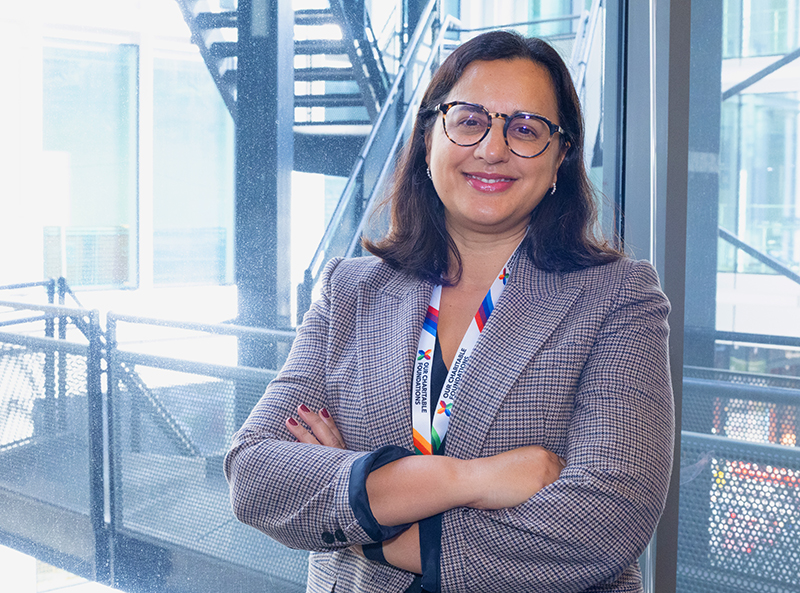
Ajneet Jassey
Alumna of London office
1996 - 2007
“I am a passionate advocate for groups who are under-represented, particularly in the legal profession” she says. “I have been lucky to be able to take advantage of opportunities in my life and hope others will similarly benefit as well.”
Ajneet joined Herbert Smith (as was) as a trainee in 1996. During her training, she secured an internship with UNCITRAL, the UN Commission on international trade, and the firm sponsored that break from her training contract. On qualification, she joined the Dispute Resolution group, specialising in general commercial disputes and then banking/financial services litigation. She qualified as a solicitor/advocate.
For a lawyer specialising in banking and financial services disputes, Ajneet’s next move — in 2007 to the Bank of England — was a natural progression. Starting off in the Bank as a senior legal adviser, over a period of 13 years at the Bank, Ajneet took up a number of senior management roles in the organisation, including a business facing role leading the Bank’s roll-out of its GDPR programme.
She was also deputy head of the Enforcement and Litigation Division, and later the Central Banking Division before setting up and heading a new Compliance function within the Bank’s Risk Directorate. She headed this group until leaving the Bank in early 2021 to join Lloyds Banking Group.
Her other significant contribution to the Bank was in relation to Diversity, Equity and Inclusion (DEI); supported by the Bank’s leadership (first Mark Carney and then Andrew Bailey), Ajneet played a key role in helping the BoE transform its approach to DEI. Ajneet was co-chair of the Bank of England’s Ethnic Minority Network for two-and-a-half years and a founder member of the Bank’s Black, Asian, Minority Ethnic (BAME) Task Force.
The move to head up LBG’s Litigation and Regulatory teams in 2021 was an exciting and challenging brief. The leadership role appealed to her, but she also enjoyed the role of being a lawyer, so this was a combination of roles that worked well. As general counsel, she oversees the contentious regulatory and litigation portfolio across the consumer, commercial and insurance businesses as well as for the Group.
In the fast-paced and changing environment in which financial services companies operate, Ajneet is giving a lot of thought to legal function transformation. An ongoing strategic review incorporates everything from making the best use of technology, particularly AI, to analysing the skills that lawyers of the future are likely to need in order and the scope for alternative resourcing. “We like to work in an agile way,” Ajneet says. “Increasingly, that is expected of us, and I support that completely.”
And, as has now become clear, promoting diversity and inclusion remains paramount for her. For the past four years, as DEI sponsor for the Legal & Secretariat function, she has championed initiatives that foster meaningful change. Her influence extends beyond just the legal function and the organisation: she is also a trustee of the Lloyds Bank Foundation, which helps hundreds of small community based charities each year.

Jennifer Ewah is head of Legal for Amnesty International’s International Secretariat. In that role, she handles, with her team, everything from trademark management, company and commercial, and coordinating the legal dimensions of Amnesty’s campaigns and strategic advocacy. The International Secretariat has offices in 20 locations. The wider movement of Amnesty International consists of sections in over 70 countries. There are adjoining legal teams within the International Secretariat, covering law and policy, and strategic litigation, with which Jennifer’s team collaborates.
Jennifer has had a portfolio career. After training and qualifying into the Infrastructure and Energy Project Group at Herbert Smith (as it then was), she has worked in-house for a range of businesses across a number of industries. She also founded and ran for 10 years her own social purpose enterprise, Eden Diodati, an ethical jewellery and fashion company working with a social cooperative of formerly marginalised women, numbering 5,000 artisans many of whom survived the Rwandan 1994 genocide. Though the social purpose enterprise is no longer operating, Jennifer saw first-hand how design, creativity and resilience could be married within a social enterprise context to create impact and healing for communities.
Before joining Amnesty International this April, she was legal director for CDP, a global not-for-profit organisation which pioneered environmental disclosure, with nearly 70% of market capitalisation across the major indices reporting to it on climate change, water security and deforestation metrics of performance. CDP encourages investors, companies, cities, states and regions worldwide on how best to build a sustainable economy by measuring and acting on their environmental impacts.
Central to her career, and her beliefs, is her commitment to promoting and protecting human rights and environmental sustainability. Being of African origin and seeing first-hand how global imbalances and inequity works through lived experience, she had always been looking to work for mission-driven organisations in support of those aims.
However, she took the view that, to be effective in pursuing her goals, it was crucial to spend time working directly for businesses. “No experience is ever a waste. I was privileged to study at Oxford University, and my parents are doctors. Despite my schooling being predominantly non-fee paying, I am replete with privilege. I know there are few women in my position that come from my ethnic background, so giving back is of fundamental importance to me.”

Jennifer Ewah
Alumna of London office
2002 - 2007
She knew she would best gain that experience from working in-house, no matter how much she gained from private practice – “I wanted to know everything that was important to how a business operates.” That included understanding the context of operating ethically and, as companies often claim, “doing the right thing”. Jennifer explains: “How can you ascertain what doing the right thing is if it isn’t contextualised within the environment faced by companies if their business operation falls short and is faced with regulatory fines, sanctions and censure, not to mention losing their reputation? I needed to be close to business to see how to prevent being in these situations.”
Jennifer has provided in-house legal services at executive management level, within dynamic and fast-paced organisations. With substantial experience within the public and private sectors, including commercial, technology, infrastructure, regulatory compliance, data privacy, data management and litigation in international organisations, she is a specialist in commercial contracts, providing strategic legal advice, at C-suite and board level. Whilst having worked across several seemingly disparate industries and sectors in-house, that background instilled in her an ability to adapt extremely quickly to the unique considerations of each new organisation.
Jennifer describes herself as a highly motivated self-starter, who feels it is important to build relationships of trust with colleagues and stakeholders by understanding the critical mass of their mission objectives and advising accurately, and with commitment. Working within a number of industries, Jennifer witnessed a full spectrum of practice. Overall, she has seen how businesses genuinely aim to operate ethically and responsibly, but there is always more that they can do. This commercial experience has been very valuable as she applies it in the context of a human rights organisation. “My deepest ambition has been to serve a mission-driven organisation like Amnesty that works tirelessly to bring about systemic change and accountability, including within governmental and corporate structures to respect and hold sacrosanct human rights principles.”
“Today, those entities, states and structures urgently need to embrace human rights-based metrics of success by holding violators to account. We cannot afford (and future generations will not forgive) the inhumane, ethically “unbalanced books” of our generation’s legacy. Whilst Amnesty is a prominent human rights organisation that has won the Nobel Peace Prize, it is situated in a world of increasing instability, autocracy, harsh strategic business concerns (often placing human rights at the wayside of profitability) and increasingly competitive geopolitics.
“I got really great experience in the private sector that translates well to the world of human rights because understanding the primordial mindset of business and government bodies helps with determining the risk calculus within my remit.”

Jennifer Ewah
She also saw her client businesses through periods of crisis, which she can put to use in her current role, since, almost by definition, Amnesty exists to respond to, and ameliorate crises that are inherent to violations of human rights principles, the world over. The organisation has existed for over 60 years, driving change through advocacy and campaigning for state and non-state actors to be held accountable under international law for adherence to a plethora of human rights frameworks such as the UN Universal Declaration of Human Rights and Guiding Principles on Business and Human Rights.
How does she feel that businesses can be persuaded to operate more responsibly? Jennifer feels it is a combination of carrot and stick. “I do really believe that businesses that are fundamentally obsessed with shareholder primacy will start to lose relevancy. The carrot is that there is an opportunity in doing the right thing to have a legacy that is positive for your organisation in terms of its footprint, whether or not that is translated into increased short-term financial ROI.”
She continues: “The stick is important too. There, we want to see regulatory policy advances. Organisations such as Amnesty then play a role in calling out those who are violating human rights and/or not engaging in environmental best practice. In short, businesses need an ethical backstop if they wish to succeed in future.”
Jennifer also appreciates her time with Herbert Smith (as was), between 2002 and 2007. “It was the most fantastic experience,” she says. “I learnt from people who were world-class in their spheres. Through working on complex cross-border deals, I was steeped in the practice of intellectual rigour but, more than that, the skill of reasoning. Legal discipline often requires going back to first principles and working out solutions from there. That is how I work to this day.”
This was a stepping stone for her ultimate career objective. “As a woman of African origin, I understand all too well how conflict, displacement, and climate change can destabilise societies, especially leaving those in the “bottom billion” without support for the basic rights and necessities of food and sustenance. I know that my life is fundamentally driven by a passion to contribute to the betterment of the lives of others. That’s my North Star.”
Transformative change: Shaping the future
Our Senior Alumni Ambassador shares his thoughts on the latest developments from the firm and alumni network
Reflections from Jonathan Scott of a career shaped by curiosity, courage and a touch of charisma
Maria Wang-Faulkner encourages everyone to capitalise enthusiastically on the potential while paying heed to the risks
Joshua Goldman and Hannah Lee are keeping calm in high-paced environments
Career milestones, unexpected lessons, Shein and ESG and what keeps him inspired
Lewis McDonald, co-head of the Herbert Smith Freehills Kramer Global Energy group, offers his thoughts on the energy trilemma
Mallika Mathur, Robin Carvell-Spedding, Mark Tudor and Matthew Warren unpack the three-way balancing act facing policymakers and industry leaders alike
Three alumni all now at the Asian Development Bank give fascinating insight into the social purpose of the bank
Justin D’Agostino, Rebecca Maslen-Stannage, Howard Spilko and Paul Schoeman recount how the combination came about
Ajneet Jassey and Jennifer Ewah are driven to ensure their organisations are operating responsibly
Former partners turned career NEDs explain how stepping back can offer the clarity needed to lead forward
Ean Brown shares his story of founding a start-up, the thrill of creating something from nothing, and overcoming the challenges of starting a business
Ben Jolley and Andy Leadston talk about their time away from Herbert Smith Freehills Kramer and what brought them back
Get your copy now
The contents of this publication are for reference purposes only and may not be current as at the date of accessing this publication. They do not constitute legal advice and should not be relied upon as such. Specific legal advice about your specific circumstances should always be sought separately before taking any action based on this publication.
© Herbert Smith Freehills Kramer 2026
Receive timely insights and briefings from HSF Kramer, tailored to keep you informed and ahead